
Why Do Escalator Friction Wheels Wear Out Easily?
In an escalator operating system, the escalator friction wheel is an important component that ensures power transmission and smooth operation. Once the friction wheel becomes worn, it may not only reduce transmission efficiency, but also cause abnormal noise, slipping, unstable operation, and even accelerate the wear of other elevator & escalator spare parts.
For maintenance personnel and purchasers, understanding the real causes of friction wheel wear helps prevent failures in advance and reduce maintenance costs.
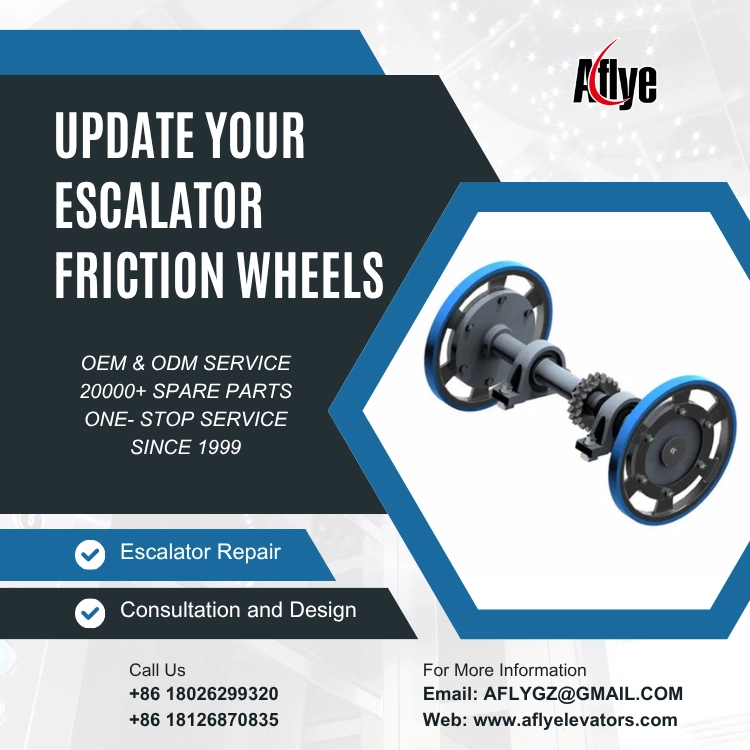
1. Long-Term Heavy-Duty Operation
Continuous high-frequency operation is one of the most common reasons for accelerated friction wheel wear. In locations such as shopping malls, subway stations, and airports, escalators often operate for long periods without interruption.
Under constant friction and pressure, the friction wheel surface may gradually become thinner, smoother, or partially worn flat, eventually causing slipping problems.
2. Uneven Force Caused by Installation Deviation
If the friction wheel is installed incorrectly or does not align properly with related transmission components, uneven force distribution may occur.
Concentrated pressure on one side of the wheel causes uneven wear, which can affect the stability of the entire escalator system. In many cases, abnormal side wear is not caused by the spare part itself, but by improper installation or adjustment.
3. Material Aging or Unstable Product Quality
The material quality of the friction wheel directly affects its service life.
When operating for long periods in environments with high temperature, humidity, or dust, the wheel material may gradually age, causing reduced elasticity and wear resistance.
If low-quality escalator spare parts are used, cracks, hardening, and abnormal wear are more likely to appear over time, even if the parts seem usable initially.
4. Insufficient Maintenance and Environmental Factors
Poor daily maintenance can also accelerate friction wheel wear.
Dust accumulation, oil contamination, and foreign objects entering the transmission area can disrupt normal friction conditions and increase surface wear.
In humid or poorly ventilated environments, some elevator & escalator spare parts may age faster, indirectly affecting friction wheel performance.
5. Secondary Wear Caused by Other Component Problems
Friction wheel wear is not always an isolated issue.
When bearings, chains, guide components, or other related elevator & escalator spare parts develop problems, the friction wheel may be forced to handle additional loads, leading to secondary wear.
Therefore, maintenance personnel should not only inspect the wheel surface itself, but also evaluate the operating condition of the entire escalator system.
Maintenance Recommendations
To extend the service life of escalator friction wheels, the following maintenance measures are recommended:
Perform regular inspections
Check for uneven wear, cracks, hardening, or slipping
Verify installation alignment and matching accuracy
Keep the equipment clean to reduce dust and debris in the transmission area
If significant wear is found, the matching escalator spare parts should be replaced as early as possible to prevent larger failures.
Conclusion
Understanding the causes of escalator friction wheel wear helps maintenance teams identify problems faster, reduce downtime, and lower repair costs.
As a professional elevator & escalator parts supplier, A-FLY provides various escalator friction wheels and related elevator & escalator spare parts to help customers achieve more stable and efficient maintenance management.