
Commonly Overlooked Details When Replacing Elevator Buttons
In elevator maintenance and modernization projects, replacing elevator buttons may seem like a “small task.” In practice, however, it is one of the most common sources of repeated rework and customer complaints.
Buttons are installed, but problems such as no backlight, false triggering, abnormal signals, or even impact on overall elevator operation soon appear. In most cases, these issues are not caused by button quality itself, but by overlooked details.
As a long-term global elevator & escalator spare parts supplier, A-FLY has concluded from extensive project experience that around 80% of button replacement failures are caused by selection and installation details, not the product itself.
1. Focusing Only on Appearance and Size, While Ignoring Core Electrical Parameters
This is the most common mistake. When replacing elevator buttons, many people first check:
Whether the panel size matches
Whether the mounting holes align
Whether the appearance looks consistent
But they overlook the most critical factors—operating voltage, current, and signal type.
Once voltage or signal logic is mismatched, problems such as abnormal backlighting, unrecognized signals, or even control system damage may occur.
2. Not Confirming the Interface Type and “Plugging It In to Test”
Elevator buttons are not universally interchangeable. Different systems have very different interface requirements. Commonly overlooked issues include:
Same number of pins, but different wiring sequences
Mixing dry-contact buttons with modular interfaces
Reversing common lines and signal lines
In these situations, the button may “look normal” but will cause frequent errors or false triggering during operation.
3. Ignoring Button Return Feel and Mechanical Condition
Even brand-new buttons should be checked for:
Smooth return action
Any sticking or resistance
Consistent travel when pressed
If the return mechanism is not smooth, even if the signal appears normal at first, false triggering or failure may occur shortly after—creating hidden risks.
4. Overlooking the Impact of the Operating Environment on Button Lifespan
Many button failures are not installation issues, but environmental mismatch:
High humidity in underground garages or coastal areas
Frequent cleaning in hospitals and shopping malls
Extremely high usage frequency in busy public buildings
In such environments, standard buttons are prone to moisture ingress and accelerated aging. Without selecting waterproof or heavy-duty elevator buttons, problems are likely to recur.
5. Not Verifying Backlight and Display Logic
In COP / LOP systems, backlighting is not just for appearance—it is a key part of status feedback. Ignoring issues such as:
Backlight voltage mismatch
Different logic for normally-on or normally-off lighting
Poor synchronization with main board signals
can lead to passenger confusion or even the impression that the elevator system is malfunctioning.
6. Ignoring Signal Compatibility Between Buttons and the Main Board
In modernization or partial upgrade projects, it is common to see:
Main board upgraded, but buttons remain old
Buttons replaced, but main board logic unchanged
Mixing new and old systems significantly increases the risk of incompatibility between buttons and the main board, making repeated rework very likely.
7. Incomplete Functional Testing After Installation
Some maintenance teams only check whether a button can be pressed after replacement, while ignoring:
Repeated press testing
Multi-floor linkage testing
Long-term operational stability checks
As a result, problems only appear days or weeks later, increasing overall maintenance costs.
8. Why Professional Selection Is More Important Than “Temporary Replacement”
Elevator buttons are high-frequency components. If selection is incorrect, the impact extends to the entire elevator user experience.
Instead of repeated rework, it is better to:
Clearly confirm original system parameters
Choose button models with strong compatibility
Communicate selection details with a professional supplier
9. How A-FLY Helps Customers Avoid These Issues
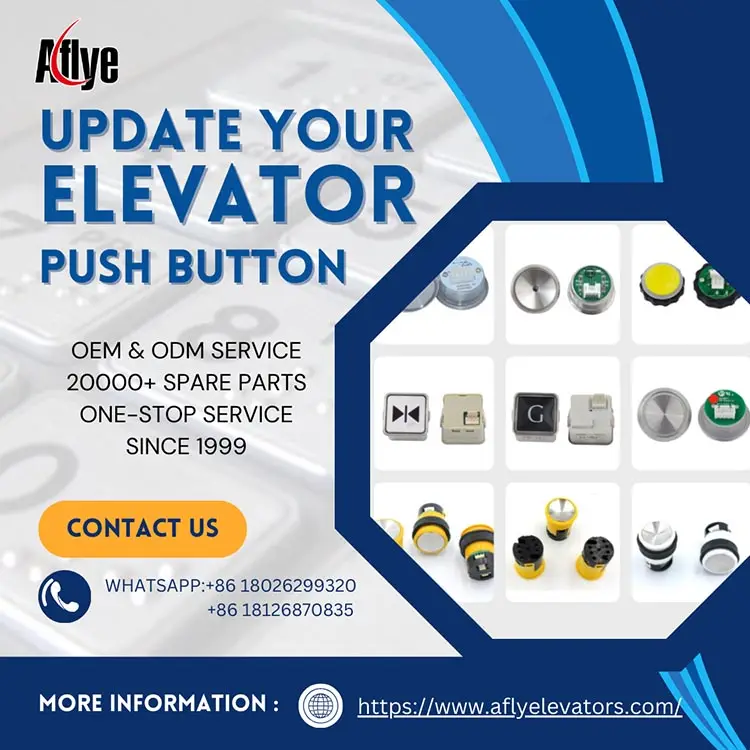
As an experienced elevator & escalator spare parts supplier, A-FLY places strong emphasis on parameter verification and compatibility guidance when supplying elevator buttons, COP/LOP buttons, and related components.
This helps customers avoid missing critical details during the replacement stage and reduces the risk of rework.
Conclusion
Replacing elevator buttons is not a test of installation speed—it is a test of attention to detail.
Only by carefully considering voltage, interface type, signal logic, operating environment, and system compatibility can long-term stable operation be achieved.
By choosing reliable elevator components and working with a professional supplier like A-FLY, you can truly achieve one replacement, long-term peace of mind.