
Impact of Elevator Light Curtain Installation Angle on Detection Coverage
In elevator door systems, the elevator light curtain is one of the most important safety components. It forms a detection field at the doorway using multiple infrared beams. When an obstruction is detected, the system prevents the door from closing or reopens it, effectively avoiding passenger entrapment.
However, in real installation and maintenance work, many cases of false triggering or detection failure are closely related to improper installation angles.
As a professional elevator and escalator parts supplier, A-FLY has found in global maintenance cases that the performance of light curtains depends not only on product quality but also on installation accuracy and angle settings.
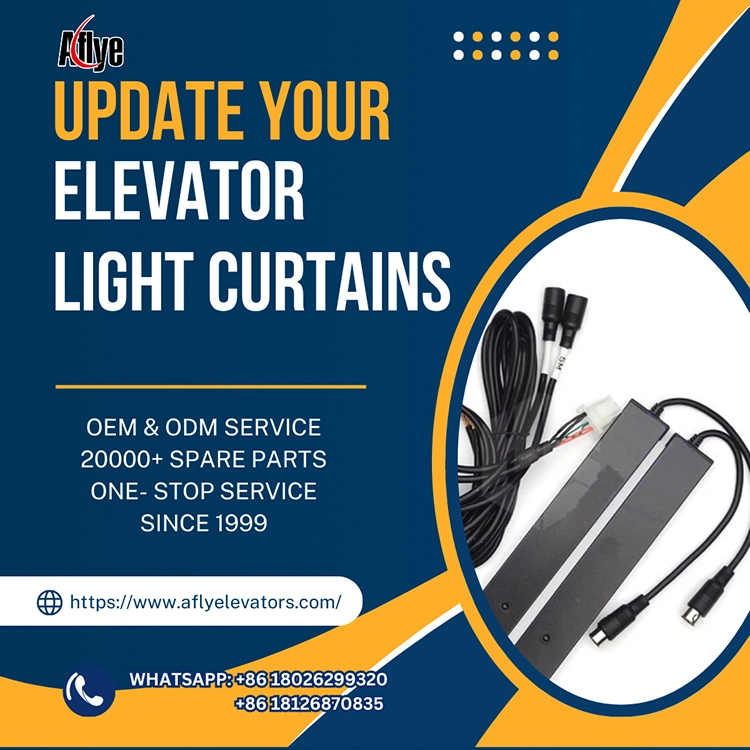
1. Installation Angle Determines Detection Coverage
An elevator light curtain consists of a transmitter and a receiver, forming a vertical detection grid through multiple infrared beams. When the installation angle deviates, the distribution of these beams also changes.
If the light curtain is not installed vertically, the detection area may shift or become uneven, affecting overall coverage. This means that objects that should be detected may fall into “blind zones.”
Therefore, the installation angle directly affects detection range and accuracy and must be carefully controlled.
2. Angle Deviation Creates Detection Blind Spots
When the light curtain tilts inward or outward, the detection field may not fully cover the doorway area. For example:
Inward tilt may reduce detection outside the door
Outward tilt may miss areas near the inner door edge
These conditions create local blind spots, reducing safety protection effectiveness.
3. Misalignment Causes False Triggering
The transmitter and receiver must be properly aligned. If their angles are inconsistent, the infrared beams cannot align correctly, leading to system misjudgment.
Common symptoms include:
Frequent door reopening without obstruction
Repeated triggering during door closing
Intermittent light curtain failure
This issue is common after parts replacement or reinstallation.
4. Impact on Beam Density and Detection Accuracy
Elevator light curtains use multiple beams to form a high-density detection field. When the installation angle is incorrect, beam spacing may change, affecting detection accuracy.
For example:
Excessive spacing reduces the ability to detect small objects
Overlapping beams may cause false triggering
Thus, proper installation affects not only alignment but also detection performance.
5. Interaction with Door Structure
Light curtains are usually installed close to the door frame. If the angle is incorrect, it may interfere with the door structure. For example:
Moving doors may block beams
Door frame reflections may cause interference
Installation position may deviate from standard
These factors can affect normal operation, so door system structure must be considered during installation.
6. Environmental Factors Amplify Angle Errors
In environments with strong light or complex conditions, installation precision becomes even more critical. For example, in areas with direct sunlight or strong glass reflections, angle deviations may amplify interference.
Therefore, in such environments, it is important to choose light curtains with strong anti-interference capability and ensure precise installation.
7. How to Install Elevator Light Curtains Correctly
To ensure proper operation, the following should be observed during installation:
Ensure vertical installation
Align transmitter and receiver accurately
Secure firmly to prevent vibration-induced misalignment
Perform multi-angle testing after installation
Standardized installation ensures optimal performance.
8. Importance of High-Quality Light Curtains
High-quality elevator light curtains offer better beam stability, stronger anti-interference capability, and improved installation adaptability, reducing issues caused by angle deviation.
A-FLY provides various models of elevator light curtains and related components suitable for different systems. With stable performance and strong compatibility, these products help improve door system safety.
Conclusion
The installation angle of elevator light curtains directly affects detection coverage and safety performance.
Through proper installation, regular inspection of key components, and cooperation with a reliable supplier like A-FLY, false triggering issues can be minimized and overall elevator safety improved.
For maintenance engineers, even small differences in installation angle can determine the reliability of the entire system.