
Why Check Related Components When Replacing a Traction Sheave?
In elevator maintenance or modernization projects, replacing a traction sheave is often treated as a “single-component task.” Many on-site teams focus only on whether the traction sheave itself is worn, while overlooking other components that are highly coupled with it.
The result is often disappointing: shortly after installing a new traction sheave, problems such as slippage, abnormal noise, or unusually shortened wire rope life reappear.
As a long-term global elevator & escalator spare parts supplier, A-FLY has found through numerous cases that a traction sheave is never an isolated component—any replacement must be considered from the perspective of the entire traction system.
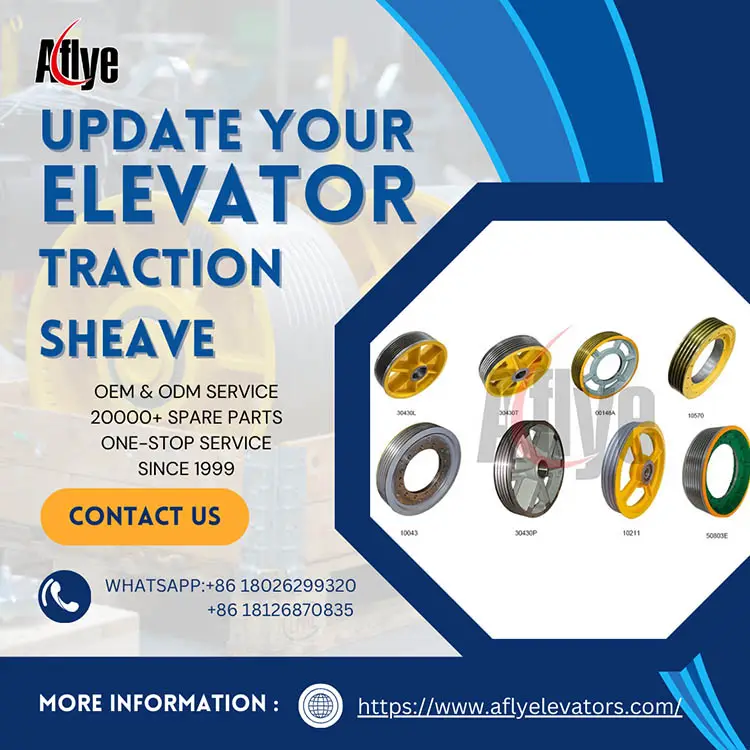
1. The Traction Sheave Is the Load Center—But Not the Only Variable
The traction sheave transmits driving force through friction with the wire ropes. Its operating condition is directly influenced by:
Wire rope structure and condition
Stability of the tensioning system
Coordination of deflector sheaves and return sheaves
Operating parameters and load changes
If only the traction sheave is replaced while these related components are ignored, the new sheave may be forced to operate under incorrect conditions.
2. Wire Ropes: Most Often Overlooked, Yet Most Critical
When replacing a traction sheave, wire ropes must be inspected at the same time, for several key reasons:
Existing ropes may have already been “shaped” by the old groove profile
Rope diameter may have changed due to long-term wear
Internal fatigue may not be visible on the surface
If the groove profile of the new traction sheave does not match the existing wire ropes, even ropes that “still look usable” can experience uneven loading and abnormal friction—ultimately shortening the service life of both components.
3. The Tensioning System: A Key Factor in Preventing Slippage
Stable operation of a traction sheave depends on proper wire rope tension. After replacing the traction sheave, failing to check the tensioning system may result in:
Insufficient tension, leading to slippage
Uneven tension, causing localized wear
Amplified load fluctuations during start and stop
These issues often do not appear immediately, but gradually worsen during operation.
4. Deflector Sheaves and Return Sheaves: The “Invisible” Influencers of Load Paths
Although deflector sheaves and return sheaves do not directly provide traction, they alter the rope path and force angles. If they suffer from:
Worn grooves
Increased bearing resistance
Misalignment during installation
the wire rope may already be in an abnormal condition before it reaches the traction sheave, preventing the new sheave from performing properly.
5. Traction System Parameter Changes Are Often Overlooked
In some projects, traction sheave replacement is accompanied by:
Motor or inverter (VFD) adjustments
Load changes
Optimization of acceleration and deceleration curves
These parameter changes directly affect traction conditions. Without a system-level check, mismatches between new and existing components can easily become hidden risks.
6. Why Does “Only Replacing the Traction Sheave” Lead to Repeated Rework?
The reasons are straightforward:
The root cause of the problem is not eliminated
New components wear faster under abnormal operating conditions
Subsequent replacement of wire ropes or other sheaves becomes necessary
Ultimately, this increases maintenance costs and elevator downtime.
7. The Correct Approach: Treat the Traction System as a Whole
When replacing a traction sheave, it is recommended to simultaneously inspect at least:
Wire rope wear and structural condition
Tension level and consistency of the tensioning system
Operating condition of deflector and return sheaves
Compatibility between traction sheave groove profile and rope diameter
This approach does not increase workload unnecessarily—it helps avoid much higher maintenance costs in the future.
8. A-FLY’s Integrated Traction System Component Support
As a professional elevator & escalator spare parts supplier, A-FLY provides traction sheaves in multiple specifications, along with wire ropes, deflector sheaves, return sheaves, and other related components.
During the selection stage, A-FLY assists customers in system-level matching to help projects achieve one-time replacement and long-term stable operation.
Conclusion
Replacing a traction sheave is never a simple “single-part repair”—it is a system-level adjustment.
Only by inspecting and addressing all key related components at the same time can problems be truly resolved and the service life of the entire traction system be extended.
In elevator maintenance and modernization projects, choosing an experienced and comprehensive supplier like A-FLY is an important step toward safe, stable, and cost-effective operation.