
Troubleshooting Approach for Elevator Door Lock Mechanical Jamming
In elevator door systems, the door lock is one of the core safety components. The elevator can only start running when the door lock is fully engaged and sends a correct signal. Therefore, if the mechanical structure of the door lock becomes jammed, it will not only affect door operation but may also directly cause elevator shutdowns or frequent alarms.
In practical maintenance work, door lock jamming is a common issue. As a professional elevator and escalator parts supplier, A-FLY has found that most door lock failures are not electrical problems, but are caused by mechanical wear or poor alignment. Understanding the correct troubleshooting approach is essential for improving maintenance efficiency.
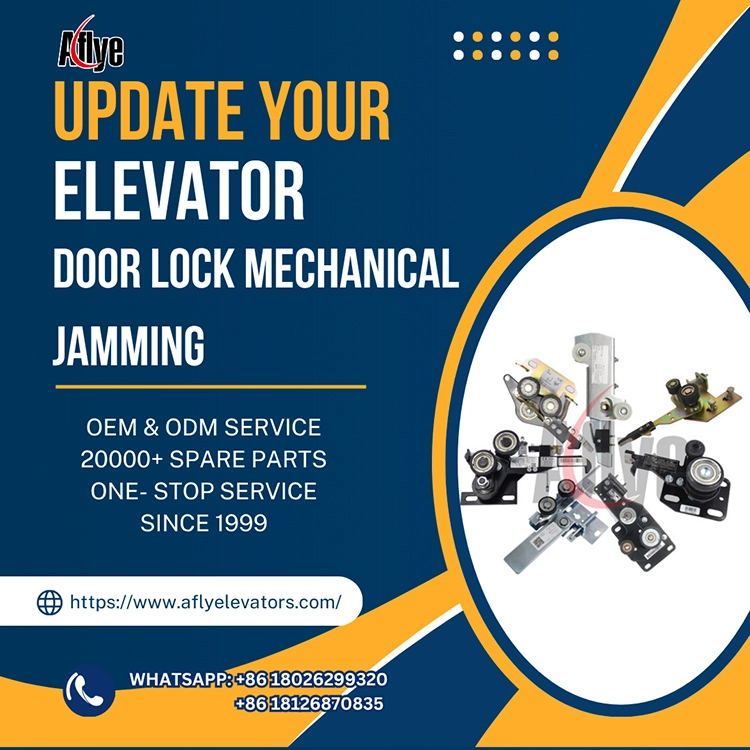
1. Typical Symptoms of Door Lock Jamming
During routine inspection or fault diagnosis, mechanical jamming of the door lock usually presents as:
Elevator indicates “door lock not closed”
Elevator cannot start
Jerking or resistance during door opening/closing
Delayed or unsmooth door lock operation
These issues are often related to increased resistance within the lock mechanism and require combined mechanical and electrical analysis.
2. Check Moving Parts First
The door lock typically includes components such as lock hooks, springs, and linkage rods. Over time, these parts may wear, deform, or suffer from insufficient lubrication, leading to jamming.
Key inspection points include:
Whether the lock hook is worn or deformed
Whether the spring has lost elasticity
Whether moving parts operate smoothly
If critical components are damaged, the corresponding elevator parts should be replaced promptly.
3. Inspect Lubrication Condition
Insufficient lubrication is one of the main causes of door lock jamming. Without proper lubrication, friction between metal parts increases significantly, affecting movement.
Maintenance recommendations:
Apply lubricant regularly
Remove old grease and accumulated dirt
Keep mechanical parts clean
Proper lubrication can effectively extend the service life of escalator and elevator components.
4. Check Installation and Alignment Accuracy
Sometimes, door lock jamming is not caused by internal faults but by improper installation or misalignment. For example, poor alignment between the door vane and the lock mechanism may cause abnormal stress on the lock hook.
Common issues include:
Incorrect door vane entry position
Improper installation angle of the lock
Door movement misalignment
These factors can obstruct normal operation and lead to jamming.
5. Inspect Related Door System Components
The door lock does not operate independently—it interacts with multiple components, such as:
Door hanger rollers (affect door trajectory)
Door operator system (controls opening/closing)
Guide rails (affect door stability)
If these related components have issues, they may indirectly cause door lock jamming. Therefore, a system-wide inspection is necessary.
6. Remove Debris and Address Environmental Factors
In complex environments such as factories or underground parking areas, dust, debris, or foreign objects may enter the lock mechanism and affect its operation.
Maintenance actions:
Clean debris inside the lock
Check for foreign object obstruction
Keep the lock area clean
These simple steps can often resolve minor jamming issues quickly.
7. Replace the Door Lock Assembly When Necessary
If internal components are severely worn or deformed, repair alone may not fully resolve the issue. In such cases, replacing the entire door lock assembly is recommended.
Using high-quality elevator parts ensures better compatibility and durability, reducing the likelihood of recurring faults.
8. Choose a Reliable Supplier
As a critical safety component, the quality of the door lock directly impacts elevator safety. Therefore, selecting a reliable supplier is essential.
A-FLY provides a wide range of elevator door locks, door vanes, door hanger rollers, and related components compatible with various elevator brands. With stable and reliable product quality, A-FLY helps maintenance teams improve efficiency and reduce failure rates.
Conclusion
Mechanical jamming of door locks is a common issue, but improper handling can lead to serious operational problems.
Through systematic troubleshooting, proper maintenance, timely replacement of key components, and cooperation with a reliable supplier like A-FLY, stable operation of the elevator door system can be effectively ensured.
For maintenance engineers, mastering the correct repair approach is key to improving efficiency and ensuring safety.