
Operational Issues Caused by Elevator Leveling Sensor Failure
In an elevator operating system, the leveling sensor is one of the key elevator components responsible for ensuring precise car alignment at each floor. Many people assume that leveling accuracy mainly depends on the inverter or main control board. However, in reality, the condition of the leveling sensor directly determines positioning precision.
Once this sensor malfunctions, the elevator may develop various deviations that seem minor—but can pose significant safety risks.
As a long-term global elevator & escalator spare parts supplier, A-FLY has found through maintenance cases that over 30% of elevator mis-leveling issues originate from aging or damaged leveling sensors.
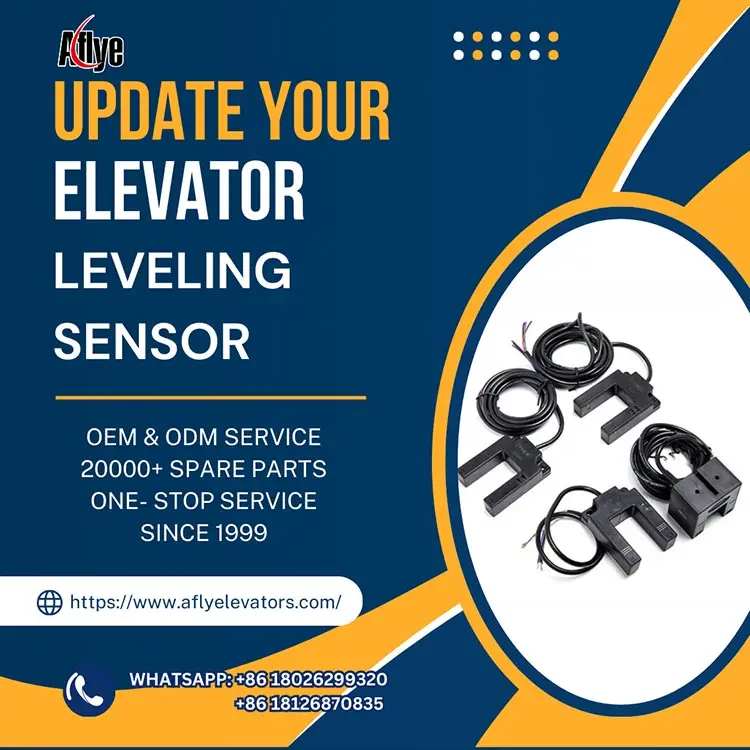
1. What Is the Function of an Elevator Leveling Sensor?
The leveling sensor is typically installed in the hoistway to detect the precise position of the car as it arrives at a designated floor. It sends position feedback signals to the control system, enabling the elevator to:
Stop accurately at floor level
Decelerate smoothly before stopping
Confirm door zone positioning
Coordinate with door locks, light curtains, and other elevator components
In essence, it is a core element of the elevator’s “positioning system.”
2. Most Common Operational Deviations After Leveling Sensor Failure
1) Car not level with the floor
This is the most typical—and potentially dangerous—symptom:
The car stops a few centimeters above or below the landing
Passengers may trip when entering or exiting
Wheelchairs or carts experience difficulty passing
Such deviations often result from delayed signals, false triggering, or changes in detection distance.
2) Car creeping or slight movement after stopping
If leveling signals are unstable, the control system cannot accurately determine the final position, leading to:
Slight upward or downward movement after arrival
Repeated micro-adjustments
Mild car vibration
This indicates inaccurate leveling feedback, with the system continuously attempting to correct the position.
3) Doors fail to open properly
The elevator must confirm that it has entered the door zone before allowing door opening. A faulty leveling sensor may cause:
Doors failing to open despite arriving at the floor
Repeated door zone signal errors
Door lock system misjudging position
Such issues are often mistaken for door lock or door operator faults, when the real cause may be inaccurate leveling signals.
4) Floor display inconsistent with actual position
If detection points shift or signals are lost, the system may misjudge the car’s location:
The display shows arrival at a floor, but the car is slightly misaligned
Leveling error varies depending on travel direction
More noticeable during low-speed operation
This reduces passenger confidence and increases stress on other elevator components.
5) Rough or unstable operation
Leveling sensors are also involved in deceleration control logic. When malfunctioning, they may cause:
Premature deceleration, resulting in sluggish operation
Late deceleration, causing hard stopping impact
Increased jerkiness when entering a floor
Over time, this accelerates wear on the traction system, guide shoes, and other elevator components.
6) Frequent fault codes
Abnormal leveling signals can trigger various protective alarms, such as:
Leveling signal loss
Door zone not confirmed
Position feedback errors
If main board and encoder issues have been ruled out, the leveling sensor should be carefully inspected.
3. What Causes Leveling Sensor Failure?
Common causes include:
Sensor aging and reduced sensitivity
Misalignment or loose installation
Dust or oil contamination in the hoistway
Poor cable contact or moisture exposure
Damaged magnets or triggering plates
These issues are particularly common in high-humidity or dusty environments.
4. When Should the Leveling Sensor Be Replaced?
Replacement is recommended—rather than repeated adjustment—when:
Leveling errors occur repeatedly
Cleaning and recalibration fail to stabilize performance
The housing shows aging or sealing failure
The sensor has been in service for many years with increasing fault frequency
Timely replacement with high-quality elevator components effectively reduces safety risks associated with mis-leveling.
5. The Importance of Choosing a Reliable Elevator Parts Supplier
Leveling sensors require high stability and strong anti-interference capability. Low-quality products may lead to signal drift and false triggering.
As a professional elevator & escalator spare parts supplier, A-FLY offers multiple models of elevator leveling sensors and related components. These products provide stable response, strong environmental resistance, and long service life—widely used in elevator maintenance and modernization projects to improve positioning accuracy and safety.
Conclusion
Elevator mis-leveling may not appear to be a major fault, but it is often the source of serious safety risks. Ignoring aging or abnormal leveling sensors can lead to cascading wear of other elevator components and increased maintenance costs.
Regular inspection of positioning-related elevator components and choosing reliable suppliers like A-FLY are essential steps to ensure precise, safe, and comfortable elevator operation.