
Hidden Wire Rope Damage Caused by Mismatched Traction Sheave Grooves
In an elevator traction system, the traction sheave and wire rope are a pair of core components that rely heavily on precise matching.
When abnormal wire rope wear is found, many maintenance teams focus mainly on the rope itself, while overlooking a more hidden—but far more influential—factor: whether the traction sheave groove profile is properly matched.
As a long-term global elevator & escalator spare parts supplier, A-FLY has found through numerous replacement cases that mismatched traction sheave grooves are one of the “invisible killers” leading to premature wire rope failure.
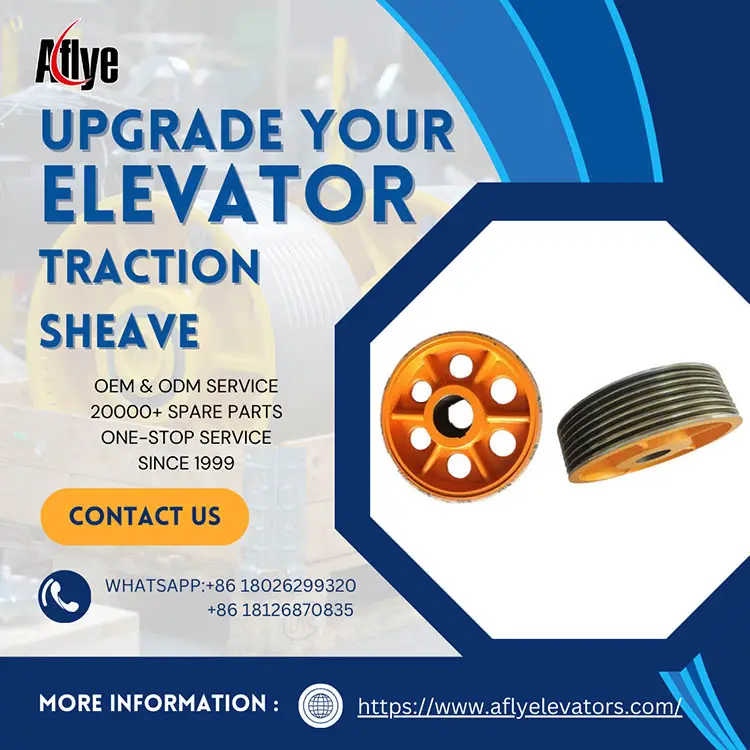
1. Why Is the Traction Sheave Groove Profile So Critical?
The groove profile of a traction sheave is designed to ensure that during operation the wire rope experiences:
Even load distribution
Proper contact area
Stable friction
No abnormal squeezing of rope strands
Once the groove profile does not match the rope structure, diameter, or surface condition, the wire rope is subjected to non-design stresses during every operating cycle.
2. Common Types of Groove Profile Mismatch
In real-world projects, typical mismatches include:
Groove too narrow, causing the wire rope to be “pinched”
Groove too shallow, resulting in insufficient contact area
Groove bottom radius not matching the rope diameter
Traction sheave replaced while still using an old or incorrect groove specification
These issues may not cause immediate broken wires, but they gradually accumulate hidden damage.
3. Hidden Damage #1: Premature Fatigue of Internal Rope Strands
When the groove is too narrow or stress is overly concentrated, the wire rope may appear normal externally, while internally it already suffers from:
Local flattening of strands
Reduced elasticity
Repeated bending of internal wires
This type of fatigue is difficult to detect visually, yet it significantly shortens the overall service life of the wire rope.
4. Hidden Damage #2: Abnormal Polishing or Localized Wear on the Outer Layer
An improper groove profile alters the contact pattern between the rope and the traction sheave, leading to:
Excessive friction in localized areas
Repeated “polishing” of specific wires
Uneven shiny spots on the rope surface
Such wear is often mistaken for “normal operating marks,” but in reality it has already disrupted load balance within the rope.
5. Hidden Damage #3: Increased Risk of Slippage and Micro-Sliding
If the groove is too wide or friction conditions are mismatched, the wire rope may fail to seat firmly on the sheave:
Micro-sliding during start or braking
Impact loads concentrated on certain wires
Noticeable fluctuations in rope-end tension
Over time, this accelerates damage at rope ends and anchoring zones.
6. Hidden Damage #4: Disruption of Lubrication Conditions
A properly designed groove helps maintain even distribution of lubrication on the wire rope.
With mismatched grooves, the following may occur:
Lubricant squeezed out too quickly
Local dry friction
Abnormal temperature rise
This further amplifies wear and accelerates rope degradation.
7. Why Does This Damage Occur “Silently”?
Damage caused by mismatched traction sheave grooves has several typical characteristics:
Slow progression
No immediate impact on operation
Difficult to detect during routine inspections
Once discovered, the rope is often already near its replacement limit
As a result, the issue is often ignored until rope life is noticeably shortened and the root cause is finally traced.
8. What Should Be Checked When Replacing Traction Sheaves or Wire Ropes?
To avoid hidden damage, the following points should be considered during component replacement:
Confirm groove profile compatibility with wire rope specifications
Avoid mixing traction sheaves of different design concepts
Inspect traction sheave wear when replacing wire ropes
Avoid the practice of “changing the rope but ignoring the sheave”
The traction system must always be evaluated as a complete unit.
9. A-FLY’s Support for Properly Matched Traction System Components
As a professional elevator & escalator spare parts supplier, A-FLY provides traction sheaves, wire ropes, and related elevator components in multiple specifications.
During the selection stage, A-FLY assists customers in confirming compatibility between groove profile, rope diameter, and operating conditions—helping reduce hidden damage and repeated replacement costs caused by mismatches.
Conclusion
Damage caused by mismatched traction sheave grooves is not dramatic, but it is persistent.
It may not cause immediate failure, yet it silently shortens wire rope life and increases safety risks over time.
In elevator maintenance and modernization projects, only by treating the traction sheave and wire rope as a matched system, and by choosing reliable components from experienced suppliers like A-FLY, can long-term safe, stable, and reliable operation truly be achieved.