
The Special Requirements for Medical / Accessible Elevator Buttons
In hospitals, rehabilitation centers, nursing homes, and public accessibility facilities, elevators are more than just transportation equipment—they are critical infrastructure directly related to patient safety and the user experience of people with limited mobility.
As one of the most frequently used interfaces between passengers and the elevator system, medical / accessible elevator buttons are subject to much higher requirements in terms of safety, reliability, and human-centered design.
As a long-term global elevator & escalator spare parts supplier, A-FLY has found through numerous medical and public-sector projects that standard elevator buttons are not always suitable for medical or accessible elevators.
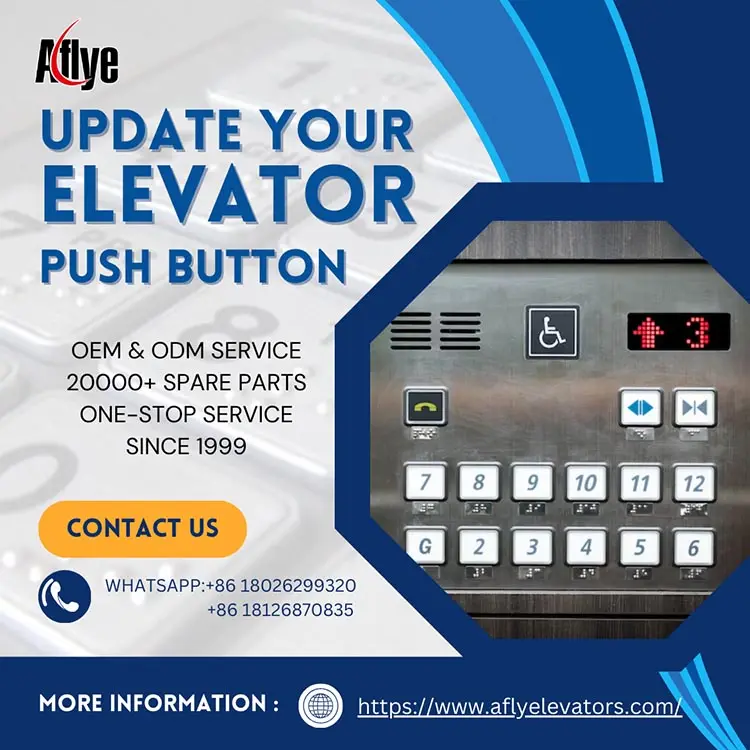
1. Lower Operating Force to Avoid “Buttons That Are Hard to Press”
Users of medical and accessible elevators often include:
People with limited mobility
Wheelchair users
Elderly passengers
Patients with reduced hand strength
For this reason, elevator buttons must be designed with low actuation force, allowing light pressure and smooth return. Buttons that are too stiff may prevent users from effectively calling the elevator. This is one of the most basic—yet most commonly overlooked—requirements for accessible elevator buttons.
2. More User-Friendly Button Height and Layout
Compared with standard COP / LOP buttons, medical and accessible elevator buttons have stricter installation requirements:
Reachable height for wheelchair users
Proper spacing between buttons to prevent accidental presses
Easier access to critical functions (door open, door close, alarm)
A well-designed layout significantly improves real-world usability, rather than simply meeting formal accessibility standards.
3. Clear Visual Identification and Tactile Design
Medical and accessible environments must account for users with visual impairments. Elevator buttons therefore often require:
Clear, high-contrast characters
Wear-resistant markings that do not fade easily
Braille or raised tactile dots
These details allow passengers to operate the elevator accurately without relying solely on vision and are a key feature of accessible elevator button design.
4. Stable Backlighting and Clear Feedback
Hospitals and similar facilities often have complex lighting conditions. Elevator buttons must provide:
Stable and consistent backlighting
Clear status indication
Definite activation feedback (light or sound)
Users should be able to immediately confirm that a button has been successfully pressed, avoiding repeated presses or misoperation.
5. Stronger Resistance to Water, Moisture, and Contamination
Medical elevators are often exposed to:
High-frequency cleaning
Repeated wiping with disinfectants
Relatively high ambient humidity
As a result, medical / accessible elevator buttons usually require enhanced waterproof, moisture-resistant, and corrosion-resistant performance to reduce failures caused by moisture or contamination.
6. High Compatibility with the Elevator Control System
Medical elevators demand extremely high operational stability. If buttons are incompatible with the main control board, problems may include:
No response to button presses
False triggering
Abnormal alarm system behavior
Therefore, during selection, it is essential to ensure that button voltage, interface type, and signal logic fully match the original elevator system. This is one of the most critical selection principles in medical elevator projects.
7. Why Standard Buttons Should Not Be Used as Substitutes
In the short term, standard buttons may appear to “work,” but over time they can lead to:
Poor usability and increased complaints
Higher failure rates and maintenance costs
Non-compliance with accessibility or medical facility standards
Medical / accessible elevator buttons are specialized components that carry both functional and safety responsibilities.
8. A-FLY’s Button Solutions for Medical and Accessible Applications
As a professional elevator & escalator spare parts supplier, A-FLY offers a range of elevator buttons, COP/LOP button modules, and related components designed specifically for medical and accessible elevator applications.
These products meet high project standards in terms of tactile response, character readability, long-term stability, and system compatibility.
Conclusion
The special requirements of medical / accessible elevator buttons are not optional—they are a reflection of safety, dignity, and respect for users. Choosing the right buttons not only improves elevator reliability but also ensures that elevators are truly accessible to everyone.
For medical and public-access projects, working with an experienced and reliable elevator & escalator spare parts supplier like A-FLY provides a safer, more sustainable long-term solution.