
Abnormal Symptoms of Aging Elevator Door Operator Controllers
During elevator door system troubleshooting, many maintenance technicians tend to first check door rollers, door vanes, or the light curtain, while overlooking a critical core component—the elevator door operator controller.
In fact, controller aging is one of the most common root causes of abnormal door opening and closing. As the “brain” of the elevator door system, its condition directly affects the coordinated operation of the entire set of elevator components.
As a professional elevator & escalator spare parts supplier, A-FLY has found through global maintenance cases that repeated door system failures and frequent door motor damage are often closely related to aging door operator controllers.
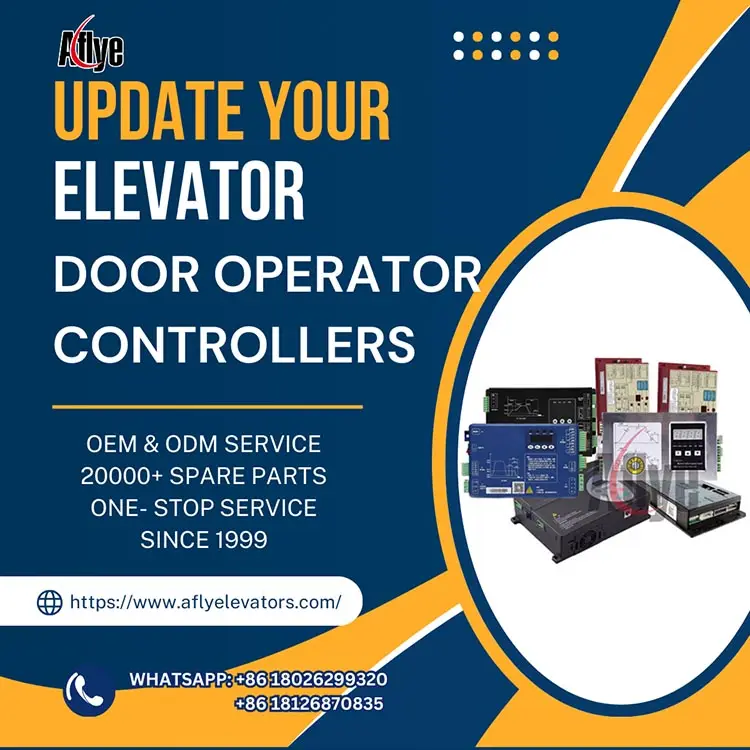
1. The Role of the Elevator Door Operator Controller
The elevator door operator controller manages the entire door opening and closing process, including:
Controlling door motor start/stop and speed
Monitoring door panel position
Coordinating light curtain and door lock signals
Implementing door cushioning and anti-pinch logic
It is the control hub connecting multiple elevator components. Once its performance degrades, a series of cascading abnormalities can occur.
2. Typical Abnormal Symptoms of an Aging Door Operator Controller
1) Door opening and closing speed becomes unstable
When internal electronic components age and output becomes unstable, the most noticeable symptom is irregular door speed:
Doors sometimes open too fast, causing noticeable impact
Doors close slowly or pause unexpectedly
Inconsistent operating rhythm
This instability accelerates mechanical wear of door rollers, door tracks, and other related elevator components.
2) Doors repeatedly reopen and cannot close properly
An aging controller may misjudge signals, leading to behaviors such as:
Doors reopening just before fully closing
Repeated door movements even after reaching position
False detection of obstacles
Over time, this not only affects passenger experience but also causes door motor overload.
3) Door motor overheating or frequent motor failure
Abnormal output current from an aging controller forces the motor to operate under non-ideal conditions:
Heavier or strained motor sound
Increased temperature of the door drive unit
Significantly shortened motor lifespan
Although these issues appear to be motor-related, the root cause is often hidden losses caused by controller aging.
4) Door movement vibration or lack of smoothness
As internal drive modules age, speed control accuracy declines, resulting in:
Vibration during start-up or stopping
Minor jumping during door travel
Unnatural transitions during opening and closing
This not only affects ride comfort but may also interfere with signal stability of the light curtain and door lock.
5) Frequent door system fault codes
Aging controllers are prone to signal acquisition errors or logic instability, commonly triggering:
Door lock not-in-position alarms
Abnormal door zone signals
Door operator communication errors
If fault diagnosis repeatedly finds no clear mechanical cause, controller aging should be a primary consideration.
6) Increased sensitivity to environmental conditions
As electronic components age, anti-interference capability weakens, leading to:
More frequent faults at higher temperatures
Abnormal door operation in humid environments
Disordered door actions during voltage fluctuations
These symptoms indicate degradation of key internal components such as capacitors and driver chips.
3. When Should the Door Operator Controller Be Replaced?
Replacement is recommended—rather than repeated repair—when any of the following occur:
Door system fault frequency continues to increase
Problems persist after replacing motors or door rollers
Burn marks, bulging components, or visible aging appear on the control board
Service life exceeds the original design expectancy
Timely replacement of this core control component can effectively prevent repeated door system failures.
4. The Importance of Choosing a High-Quality Door Operator Controller
Door operator controllers are high-technology elevator components with strict requirements for stability and compatibility. Low-quality products may result in:
Unstable control logic
Insufficient motor protection
Shortened overall door system lifespan
As an experienced elevator & escalator spare parts supplier, A-FLY provides multiple models of elevator door operator controllers and related door system components. These products feature stable operation, strong anti-interference capability, and long service life, making them suitable for various door system repair and modernization projects.
Conclusion
Aging elevator door operator controllers rarely fail suddenly. Instead, they reveal themselves gradually through multiple subtle abnormalities. Ignoring these early warning signs often leads to cascading damage of other elevator components and higher maintenance costs.
Regular inspection of door system control components and choosing reliable elevator spare parts suppliers like A-FLY are key steps to ensuring safe, smooth, and reliable elevator door operation.