
Elevator Guide Shoe Roller Noise: Troubleshooting & Replacement
During elevator operation, abnormal noise from the car guide shoe rollers is one of the most common complaints reported to maintenance personnel. Passengers may hear humming, knocking, or continuous friction sounds, especially during startup, deceleration, or when the elevator passes rail joints. In many cases, these issues do not immediately cause the elevator to stop, but they often indicate that the guide shoe system has already developed abnormal wear.
As a long-term supplier serving the global elevator and escalator spare parts market, A-FLY has observed in numerous maintenance projects that if guide shoe roller noise is not addressed promptly, it may eventually lead to car vibration, abnormal guide rail wear, and even affect other critical elevator components.
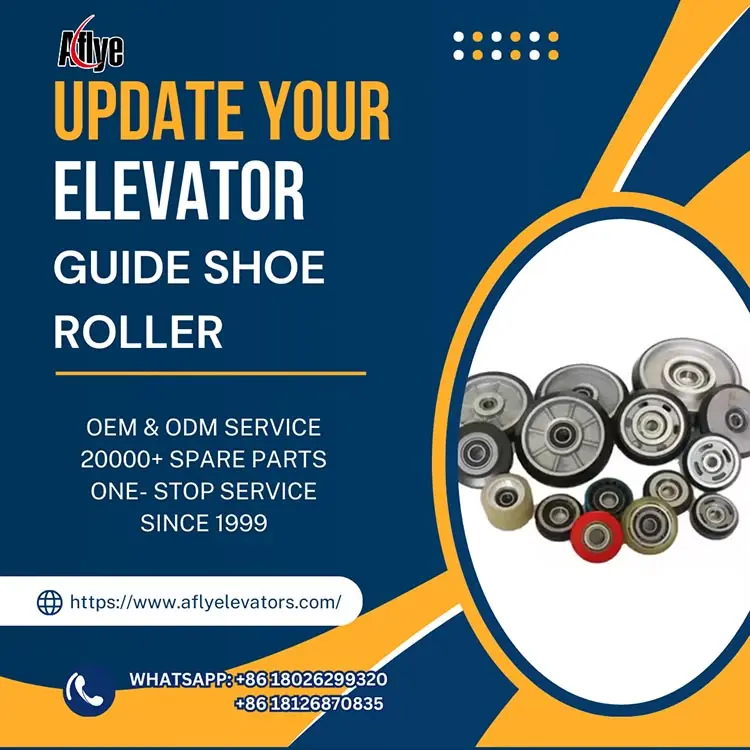
1. The Role of Guide Shoe Rollers in Elevator Operation
The primary function of elevator car guide shoe rollers is to ensure stable guidance and vibration reduction while the car travels along the guide rails.
By using rolling motion instead of sliding friction, guide shoe rollers help to:
Reduce operational noise
Minimize friction resistance
Improve ride comfort for passengers
Once the guide shoe rollers become abnormal, the guiding system loses its original stability, and noise is usually the earliest warning signal.
2. Common Causes of Guide Shoe Roller Noise
1. Worn or Damaged Roller Bearings
When the bearing lubrication fails, dry friction occurs, producing grinding or periodic noises. The sound typically becomes louder over time.
2. Roller Surface Wear or Hardening
After long-term operation, the roller material may become flattened or hardened, causing uneven contact with the guide rail and generating noise.
3. Poor Guide Rail Surface Condition
If the guide rail has burrs, corrosion, or accumulated dust, it can amplify roller noise—even when the rollers themselves are in good condition.
4. Improper Installation or Adjustment of Guide Shoes
Incorrect guide shoe clearance or uneven force distribution may cause rollers to operate under eccentric load, accelerating wear and producing abnormal noise.
5. Mixing Old and New Rollers
In partial maintenance work, replacing only one or a few rollers may lead to inconsistent rolling conditions, resulting in continuous noise.
3. How to Effectively Troubleshoot Guide Shoe Roller Noise
When investigating noise on-site, the following steps are recommended:
Determine under which conditions the noise occurs (startup, constant speed, or deceleration)
Check whether the noise is concentrated at a specific height or section of the shaft
Manually inspect whether the rollers rotate smoothly
Inspect the guide rail surface condition and cleanliness
This systematic troubleshooting approach helps avoid misdiagnosing the issue as a traction machine or drive system problem.
4. Potential Risks of Ignoring Guide Shoe Roller Noise
If guide shoe roller noise is ignored for a long time, it may lead to:
Increasing vibration of the elevator car
Accelerated wear of guide rails
Abnormal stress on guide shoe brackets and connectors
Reduced lifespan of other elevator components
From a long-term maintenance perspective, the earlier the issue is addressed, the lower the total cost.
5. When Should Guide Shoe Rollers Be Replaced?
In practical maintenance work, replacement is recommended when:
Bearings rotate poorly or show obvious resistance
Roller surfaces show cracks, hardening, or severe wear
Noise persists even after cleaning and adjustment
The elevator has been in service for many years and the guide shoe system has aged
Preventive replacement is often more effective than repeated adjustments.
6. Key Points When Replacing Guide Shoe Rollers
To prevent recurring noise after replacement, attention should be paid to:
Compatibility between roller size and guide rail specifications
Whether the bearing sealing structure suits the operating environment
Replacing guide shoe rollers in sets on the same car whenever possible
Re-adjusting guide shoe clearance after replacement
These details directly determine the long-term operating performance.
7. Reliable Guide Shoe Roller Solutions from A-FLY
As a professional supplier of elevator and escalator spare parts, A-FLY provides a wide range of elevator guide shoe rollers and related elevator components. These products have been verified in real projects for:
Excellent wear resistance
Stable bearing performance
Consistent dimensional accuracy
They help customers effectively reduce noise problems and avoid repeated maintenance.
Conclusion
Noise from elevator car guide shoe rollers is not simply normal aging, but rather an early warning signal from the guidance system.
Through systematic troubleshooting, timely replacement of guide shoe rollers, and the use of reliable elevator spare parts, the elevator car can return to smooth, quiet, and safe operation.
In elevator maintenance and modernization projects, partnering with an experienced supplier such as A-FLY is an important step toward improving operational quality and reducing long-term maintenance costs.