
Poor Door Closing Caused by Worn Landing Door Rollers
Among common elevator faults, issues such as landing doors not closing smoothly, slower closing speed, or friction noise during door closing are frequently reported. Many people initially suspect a door operator problem, but in reality, the true cause is often a small and easily overlooked elevator component—the elevator landing door roller.
Although door rollers are small, they directly determine how smoothly the landing door slides. Once worn, they continuously increase the load on the door operator and may even trigger a series of related failures.
1. Typical Symptoms of Worn Landing Door Rollers
When landing door rollers begin to age or wear, the elevator gradually shows the following abnormal behaviors:
Increased resistance during door closing.
As the roller surface becomes deformed or flattened, contact with the door track becomes uneven, significantly increasing sliding friction and slowing door movement.
Rising operating noise.
Worn rollers lose their roundness, producing periodic vibration during rotation. Passengers may hear “clicking,” “squeaking,” or metal-on-metal friction sounds.
Higher door operator load.
The door operator must output more driving force to complete the closing action. Over time, this accelerates aging of door operator belts, motors, control boards, and other elevator components.
In severe cases, doors may fail to close fully or repeatedly open and close, affecting overall elevator efficiency.
2. Why Do Landing Door Rollers Wear So Easily?
Elevator landing doors are high-frequency components—opening and closing thousands of times per day in commercial buildings is not uncommon. Rollers constantly bear door weight and impact forces, making wear inevitable. Common causes include:
Material aging: Standard plastic or low-density nylon rollers may harden, crack, or deform in high-temperature or dusty environments.
Contaminated or deformed tracks: Dust, sand, or track wear can cause uneven roller wear, leading to rapid failure on one side.
Door panel sagging or misalignment: Abnormal clearances in door hangers or guide rails create uneven load on rollers, sharply reducing service life.
Insufficient lubrication: Lack of cleaning and lubrication turns rolling into sliding, accelerating friction and wear.
3. Chain Reactions Caused by Delayed Roller Replacement
Many maintenance teams overlook door roller issues until the door operator alarms. In fact, worn rollers can trigger a series of cascading problems:
Increased door motor current and reduced motor lifespan
Accelerated wear of belts and gears
Misalignment of door lock contacts, causing abnormal closing signals
Light curtain misjudgment, resulting in repeated door opening and closing
This not only increases spare part replacement frequency, but also raises failure rates and overall maintenance costs.
4. The Correct Solution: Not Just Replacing Rollers, but Systematic Inspection
When poor door closing is observed, the following steps are recommended:
Inspect the rollers for flat spots, cracks, or uneven wear; check rotation smoothness and any binding.
Check door tracks for grooves, burrs, or deformation; polish or replace if necessary.
Verify door panel vertical alignment and hanger clearances to ensure even load distribution on rollers.
Replace with high-quality door rollers and readjust door opening and closing speed to ensure smooth force transmission.
5. How to Choose More Durable Elevator Door Rollers
High-quality landing door rollers typically feature:
High-strength, wear-resistant nylon or polyurethane materials
Built-in precision bearings for smooth rolling
Strong impact resistance and anti-aging performance
Stable dimensions compatible with multiple door systems
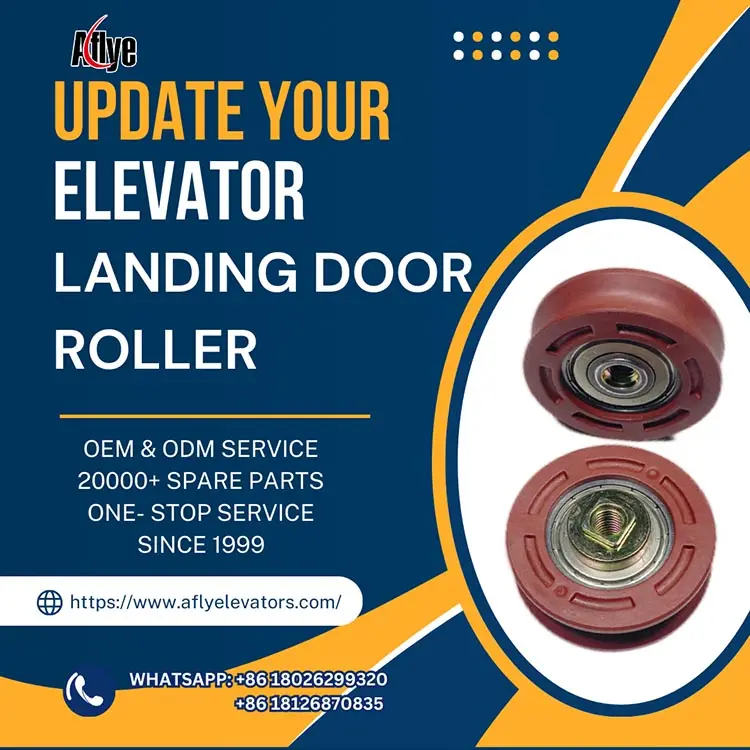
As a professional elevator & escalator spare parts supplier, A-FLY offers multiple models of elevator landing door rollers and related elevator components. These products are wear-resistant, low-noise, and long-lasting, making them suitable for residential buildings, commercial complexes, and high-frequency applications—effectively reducing door system failure rates.
Conclusion
When elevator landing doors do not close smoothly, it is often not a major fault, but a warning sign from worn door rollers. Timely inspection and replacement of worn rollers not only restore smooth operation, but also protect the door operator system and extend the service life of the entire set of elevator components.
Choose a reliable parts supplier like A-FLY to ensure every door opening and closing is smoother, quieter, and safer.