
Old Escalators Consume Too Much Energy Running at Full Speed? Upgrade These 5 Systems for Energy Saving
In shopping malls, hotels, subway stations, and public buildings, many old escalators still use the traditional control method of continuous full-speed operation after startup. Even when no passengers are using the escalator for a long time, the motor and Escalator Drive System continue running, which not only increases energy consumption but also accelerates the wear of chains, rollers, handrails, and other mechanical components.
Therefore, Escalator Energy Saving has become an important direction for old escalator modernization.
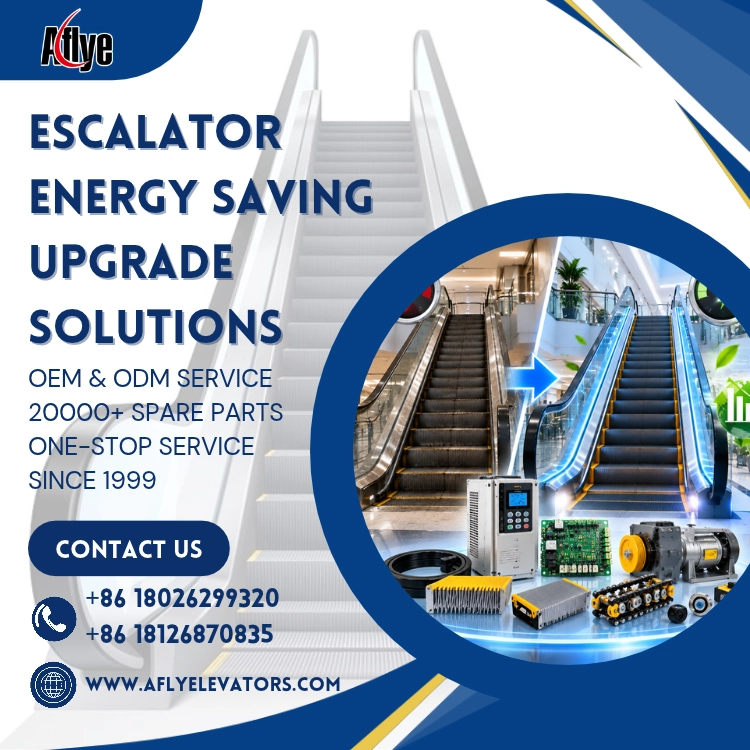
1. Why Do Old Escalators Consume More Energy?
Common reasons include:
The escalator continues running at rated speed even when no passengers are present;
Old Escalator Controllers lack energy-saving control functions;
Direct motor starting cannot adjust operation according to passenger flow;
No Escalator Passenger Sensor is installed;
Traditional lighting systems remain continuously switched on;
Wear of drive chains, bearings, and other components increases mechanical resistance.
2. How to Upgrade Escalators with Variable Frequency Energy Saving Technology?
1. Install or Upgrade Escalator Inverter
Adding or upgrading an Escalator Inverter allows the escalator to operate under different modes through variable frequency control, such as normal-speed operation and low-speed standby mode.
When passenger demand is low, the system can reduce operating speed and lower unnecessary energy consumption.
2. Upgrade Escalator Controller
If the original controller cannot support variable frequency control logic, an Escalator Controller Upgrade can be carried out.
The upgraded controller enables the inverter, passenger sensors, and existing safety circuits to work together properly.
3. Install Passenger Detection Sensors
Installing an Escalator Passenger Sensor at the entrance allows the system to detect passenger flow.
When passengers approach, the escalator returns to normal operating speed. During idle periods, it can enter an energy-saving standby mode according to the control strategy.
4. Inspect the Drive System
During an Old Escalator Upgrade, the mechanical drive system should also be inspected, including:
Motor;
Sprocket;
Bearings;
Other transmission components.
Excessive mechanical resistance can reduce the actual energy-saving effect after modernization.
5. Upgrade to LED Lighting
Replacing traditional lighting with Escalator LED Lighting can further reduce power consumption and improve illumination around the escalator entrance and skirt panel areas.
3. Safety Systems Must Not Be Ignored
During Escalator Modernization, variable frequency control must not affect the original safety protection functions.
Important Escalator Safety Parts should be inspected together, including:
Emergency stop switches;
Comb plate switches;
Step chain protection devices;
Handrail protection systems;
Other safety components.
After upgrading, the system should be properly adjusted and tested according to the original equipment requirements and applicable safety standards.
4. Escalator Modernization Parts Purchasing Recommendations
Before purchasing Escalator Modernization Parts, it is recommended to provide:
Escalator speed;
Lifting height;
Motor power;
Controller model;
Operation mode;
Inverter parameters;
Existing safety circuit information.
Different escalators have different control logic. It is not recommended to install only an inverter without checking compatibility.
The motor, controller, sensors, inverter, and safety circuits should be evaluated together before modernization.
5. A-FLY Elevator & Escalator Parts Supply Capability
A-FLY provides a wide range of escalator modernization parts, including:
Passenger sensors;
LED lighting;
Other escalator upgrade components.
These products are suitable for:
Escalator maintenance;
Energy-saving upgrades;
Escalator modernization projects.
A-FLY supports:
Model confirmation;
Parameter matching;
OEM/ODM customization;
One-stop electrical and mechanical escalator parts supply.
We provide complete parts solutions for engineering contractors, maintenance companies, and distributors.
Conclusion
Energy-saving modernization of old escalators is not simply about adding an inverter.
A successful upgrade requires comprehensive matching of the inverter, controller, passenger detection system, drive system, and lighting system to achieve lower energy consumption, improved reliability, and longer service life of escalator components.