
Why Does Elevator Safety Gear Wedge Wear Affect Braking Performance?
The elevator safety gear is one of the most important mechanical safety devices in an elevator system.
When the overspeed governor activates the safety gear, the wedge blocks move into contact with the guide rails and generate braking force.
If the working surface of the elevator safety gear wedge block becomes significantly worn, deformed, or damaged, the contact condition between the wedge and the guide rail may change, affecting the normal operation and stopping performance of the safety gear.
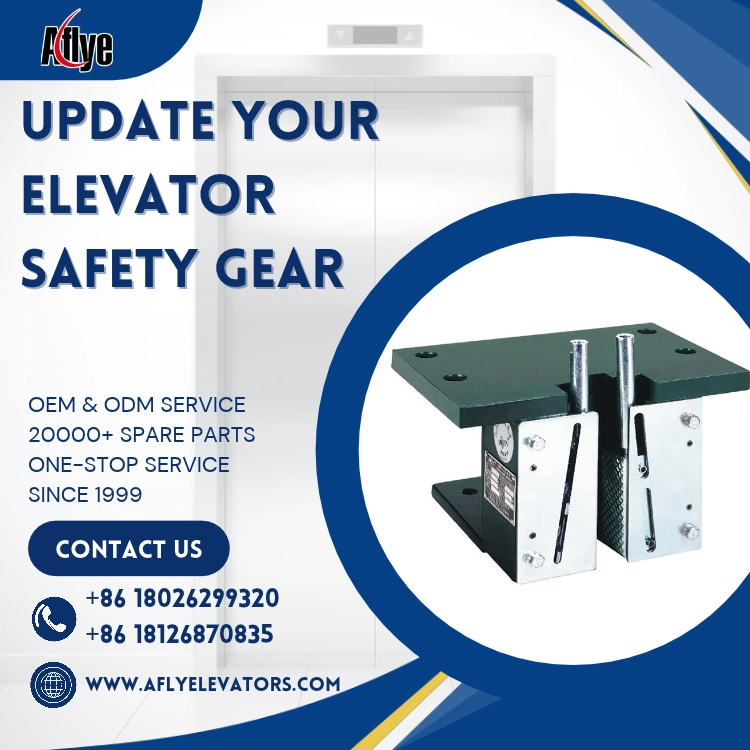
1. Why Do Elevator Safety Gear Wedge Blocks Wear?
Common causes include:
The safety gear has been activated before, causing strong friction between the wedge block and the guide rail;
Incorrect wedge installation position or improper left/right clearance;
Burrs, corrosion, or abnormal wear on the guide rail working surface;
Incomplete reset of the safety gear mechanism, causing slight contact between the wedge and guide rail;
Long-term operation causing corrosion or material property changes on the working surface.
Therefore, when safety gear wedge wear is detected, the condition of the guide rail and the complete safety gear mechanism should also be inspected.
2. Why Does Wedge Wear Affect Braking Performance?
During safety gear activation, the wedge block must clamp the guide rail according to the designed movement path.
When the working surface becomes worn, changes may occur in:
Contact area between the wedge and guide rail;
Wedge geometry;
Force distribution during clamping.
Possible problems include:
Uneven force between left and right safety gears;
Abnormal wedge clamping action;
Changes in stopping distance or activation performance;
Abnormal scratches appearing on the guide rail surface;
Difficulty resetting the safety gear after activation.
For progressive safety gears, the condition of the related elastic components and braking force adjustment mechanism should also be checked.
3. How Should Elevator Maintenance Handle This Problem?
During elevator maintenance, technicians should inspect:
Safety gear wedge working surfaces;
Guide rails;
Safety gear clearance;
Lifting mechanism;
Connection condition between safety gear and overspeed governor.
If the wedge block has wear exceeding the manufacturer's allowable limit, cracks, severe scratches, or deformation, it should not simply be polished and reused.
The safety gear should be repaired or replaced according to the original manufacturer's requirements and applicable safety standards.
After maintenance, the required safety gear testing must be completed to confirm correct operation.
4. Elevator Safety Gear Purchasing Tips
When purchasing elevator safety gear components, the following information should be confirmed:
Safety gear model;
Rated load capacity;
Applicable elevator speed;
Guide rail specifications;
Safety gear type;
Wedge block structure.
Since the safety gear is a critical elevator safety component, replacement parts should not be selected only based on appearance or dimensions.
Correct matching with the original safety system and application parameters is essential.
5. A-FLY Elevator & Escalator Parts Supply Capability
A-FLY supplies a wide range of elevator safety components, including:
Safety gear wedge blocks;
Buffer systems;
Other elevator safety parts.
These products are suitable for elevator maintenance, repair, and modernization projects.
A-FLY can assist with:
Model confirmation;
Specification matching;
Project parameter verification.
We also supply elevator door system parts, traction system components, and various escalator wear parts to meet the spare parts requirements of engineering contractors and maintenance companies.
Conclusion
Wear on the working surface of an elevator safety gear wedge block is not simply a cosmetic issue.
When abnormal wear is found, the wedge block, guide rail, and related mechanical linkage should be inspected together.
Following the manufacturer's requirements for repair or replacement helps ensure that the elevator safety system maintains reliable activation and braking performance.