
Escalator Running Speed Remains Stable but Energy Consumption Keeps Increasing? Don't Just Check the Motor — The Drive System Is More Important
If an old escalator maintains a seemingly normal operating speed but its energy consumption continues to increase, it does not necessarily mean the drive system is working properly. After years of operation, increased mechanical resistance and reduced transmission efficiency can force the motor to deliver more torque to maintain the same speed, resulting in stable operating speed but higher energy consumption.
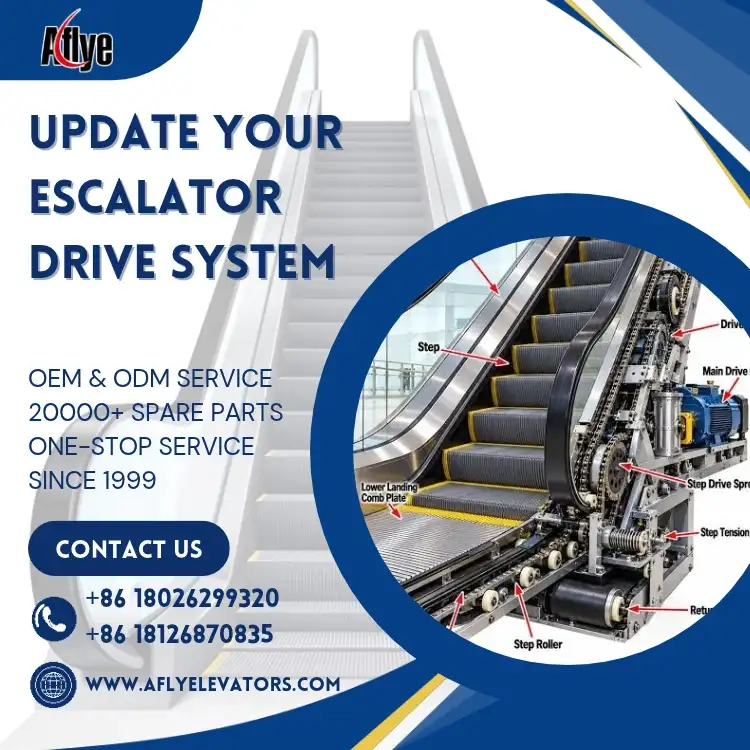
1. Why Does an Escalator Consume More Power Even When Its Speed Is Normal?
1. Escalator Step Chain Wear or Improper Tension
After long-term operation, escalator step chains may experience elongation, pin wear, and other forms of deterioration. Excessive chain tension or insufficient lubrication increases running resistance, resulting in a higher motor load.
2. Increased Resistance in the Handrail System
Worn or seized friction wheels, support rollers, guide rollers, and bearings in the escalator handrail system can increase handrail running resistance, requiring more power from the drive system.
3. Escalator Step Roller Wear
Worn step roller surfaces, increased bearing resistance, or improper contact with the guide rails can increase step running resistance. Although the inverter may maintain a stable operating speed, the motor must deliver more torque to compensate.
4. Brake Components Causing Mechanical Drag
Abnormal brake clearance, worn brake components, or incomplete brake release may create continuous friction, keeping the drive system under additional load.
5. Aging Inverter and Control Parameters
Older inverters and control components may have outdated parameters or reduced operating efficiency. Even if the escalator maintains a stable speed, the drive system may no longer operate at its optimal efficiency.
2. How Should Escalator Energy-Saving Modernization Be Carried Out?
During escalator modernization, replacing only the motor is not enough. The entire system should be inspected, covering the drive, transmission, steps, handrail, and control systems.
First, check the motor operating current and load. Next, inspect the condition of the step chain, step rollers, friction wheels, and bearings. Then examine the brake components, transmission mechanism, and handrail system.
For escalators operating under high loads over extended periods, inverter upgrades, motor replacements, and drive system optimization can be considered according to actual operating conditions. These improvements help reduce unnecessary mechanical resistance and overall energy consumption.
3. Purchasing Recommendations for Escalator Modernization Parts
When purchasing escalator modernization parts, it is recommended to provide the escalator brand, model, operating speed, drive motor specifications, and photos of the original components.
For transmission components such as step chains, friction wheels, and step rollers, it is also necessary to confirm dimensions, bearing specifications, installation methods, and material requirements. Incorrectly matched components may actually increase operating resistance after modernization.
4. A-FLY Elevator & Escalator Spare Parts Supply Capabilities
A-FLY provides a wide range of elevator and escalator spare parts, including escalator drive components, step chains, step rollers, handrail components, friction wheels, brake components, safety switches, and control components.
We also support escalator energy-saving upgrades and old escalator modernization projects, offering model identification, dimensional matching, and OEM/ODM customization.
As a one-stop elevator and escalator spare parts supplier, A-FLY provides comprehensive component sourcing solutions for contractors, maintenance companies, and distributors.
Conclusion
A stable escalator operating speed does not necessarily mean that the drive system is operating efficiently.
If the operating current continues to increase, particular attention should be paid to transmission resistance, step chains, rollers, the handrail system, brake components, and the control system rather than focusing on operating speed alone.
Through systematic inspections and targeted modernization, unnecessary mechanical resistance can be reduced, helping lower the long-term energy consumption of aging escalators.