
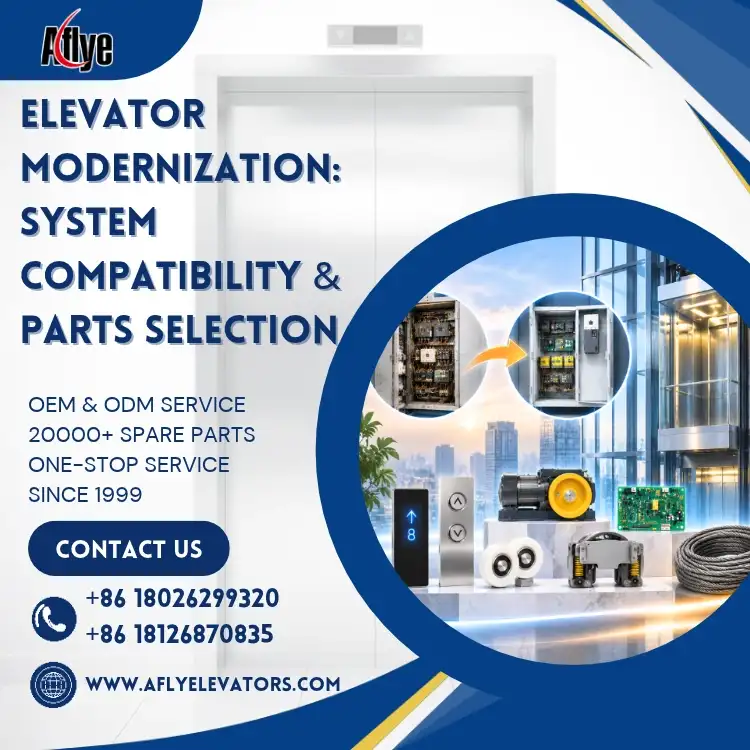
How to Avoid Compatibility Issues Between New and Existing Systems During Complete Elevator Modernization? System Matching and Spare Part Selection Are Key
As elevators age, more and more older units require complete elevator modernization. However, during actual modernization projects, compatibility issues often arise when new control systems cannot properly match existing door operators, push buttons, display systems, encoders, and other components. This can lead to communication failures, operational problems, and extended commissioning periods after installation.
Therefore, elevator modernization is not simply about replacing equipment. More importantly, it involves ensuring compatibility between new and existing systems.
1. Why Do Compatibility Issues Occur Between New and Existing Systems?
1. Different Communication Protocols
After years of operation, older elevators may use proprietary communication methods. New control cabinets, display boards, and COP/HOP systems may adopt different communication protocols, resulting in unrecognized signals, unresponsive buttons, and other communication problems.
2. Incompatible Electrical Interfaces
Elevator equipment from different generations may have different voltage requirements, interface definitions, and signal transmission methods. Common differences include:
Different push button interfaces
Different display board communication methods
Incompatible encoder feedback signals
Mismatched door operator control signals
Without confirming these parameters in advance, commissioning difficulties are likely to occur after installation.
3. Differences in Mechanical Dimensions
Some modernization projects focus only on electrical upgrades while overlooking mechanical installation compatibility. Components such as door operators, traction machines, and guide rail accessories may have different dimensions, requiring additional verification of their mounting structures.
2. How to Avoid Compatibility Issues During Complete Elevator Modernization?
1. Conduct a System Assessment Before Modernization
Before starting a modernization project, collect the following information:
Original elevator brand and model
Control system model
Traction machine specifications
Door operator model
Encoder specifications
COP/HOP dimensions
Existing elevator operational problems
With complete equipment information, it becomes easier to determine which components can be retained and which require upgrading.
2. Prioritize an Integrated Modernization Solution
It is not recommended to replace only one core component without evaluating the entire system. For example, when replacing an elevator control cabinet, the following components should also be checked:
Inverter compatibility
Encoder feedback signals
Door operator communication
Display system compatibility
Safety circuit connections
This helps minimize additional adjustments and commissioning problems after installation.
3. Ensure Accurate Matching of Key Spare Parts
For elevator push buttons, display boards, door operator controllers, and safety components, both electrical parameters and mechanical dimensions must be verified. Selecting replacement parts based only on appearance is not sufficient.
3. How to Resolve Compatibility Issues After Installation?
If operational problems occur after modernization, troubleshooting should cover the entire system connection:
Communication between the controller and peripheral devices
Input and output signal definitions
Power supply voltage
Wiring and connection methods
System parameter settings
Mechanical installation conditions
Where necessary, replace incompatible elevator modernization parts with properly matched components rather than simply modifying the wiring.
4. Purchasing Recommendations for Elevator Modernization Parts
When purchasing elevator modernization parts, it is recommended to provide:
Photos of the original equipment
Model nameplates
Installation dimensions
Interface and connector photos
Control system specifications
For electrical products such as control boards, push buttons, display boards, encoders, and door operators, communication methods and signal compatibility must be carefully confirmed.
5. A-FLY Elevator & Escalator Spare Parts Supply Capabilities
A-FLY provides a wide range of elevator and escalator spare parts for complete modernization projects, including:
Elevator control cabinets, control boards, and inverters
Elevator push buttons, COP/HOP panels, and display systems
Door operators, door vanes, door hanger rollers, and door locks
Encoders, traction sheaves, and wire ropes
Safety gears, overspeed governors, and buffers
Escalator steps, handrails, chains, and other wear parts
We support model identification, technical parameter matching, OEM/ODM customization, and project-based component supply, helping elevator contractors and maintenance companies reduce compatibility risks during modernization projects.
Conclusion
The biggest challenge in complete elevator modernization is not simply installing new equipment, but ensuring stable compatibility between new and existing systems.
Confirming technical parameters, matching system interfaces, and selecting the right spare parts in advance can help reduce communication failures and operational problems after modernization, improving the overall performance and reliability of upgraded elevators.