
Does an Old Elevator Door Header Need to Be Replaced During Modernization? Check These 4 Conditions Carefully!
During old elevator modernization projects, many contractors prioritize replacing the door operator, door hanger rollers, or door controller while overlooking the condition of the door header assembly. In fact, the elevator door operator header provides an important mounting foundation for the door operator and related guide components. Its structural condition directly affects installation accuracy, door panel movement, and overall door operating stability.
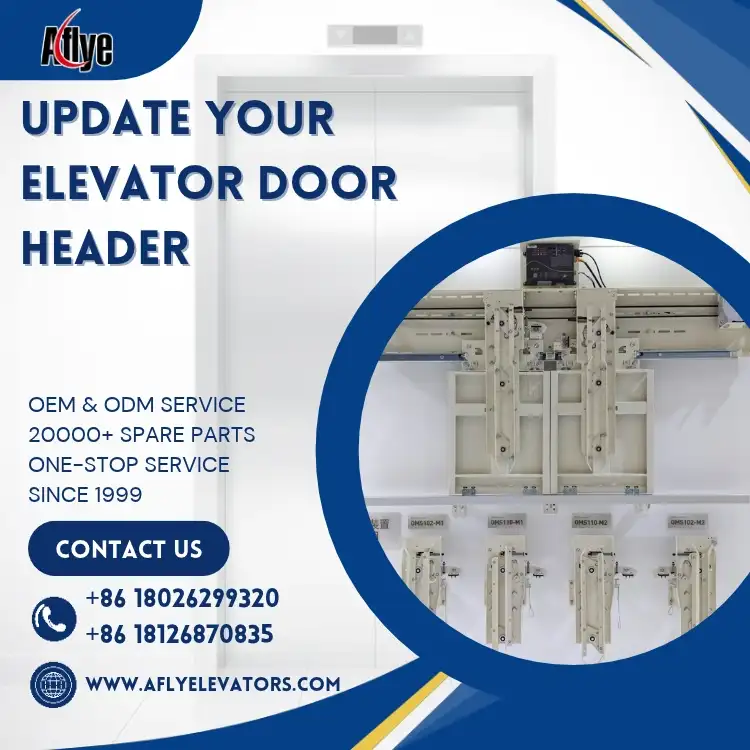
1. When Should an Elevator Door Header Be Replaced?
1. Structural Deformation or Cracks
Long-term loads from the door operator and door panels, combined with vibration and installation stress, may cause the door header to deform. Cracks may also develop around welded joints, or mounting holes may become damaged, affecting installation stability.
2. Worn Mounting Holes or Unreliable Bolt Fixing
If the mounting holes become enlarged, threads are damaged, or connecting areas are severely corroded, simply tightening the bolts again may not provide a secure and stable installation.
3. Misalignment of the Door Operator
Deformation of the door header may cause incorrect positioning between the door operator and door guide rails, resulting in door jamming, panel vibration, or uneven wear of door hanger rollers.
However, these problems may also be caused by improper door operator adjustment or guide rail conditions. Therefore, the door header should not be assumed to be damaged without further inspection.
4. Incompatibility with a New Door Operator
When upgrading the door operator of an old elevator, the new equipment may have different mounting dimensions, fixing hole positions, or load requirements compared with the original door header. It is then necessary to evaluate whether the entire door header assembly should be replaced or an appropriately verified adapter structure should be used.
2. How Should Elevator Door Header Problems Be Addressed?
Before modernizing an old elevator, inspect the door header's straightness, welded joints, mounting holes, corrosion, and connection structure. At the same time, check the installation condition of the door operator, door hanger rollers, and guide rails.
If the problem is only caused by installation misalignment, adjustments can be made according to the manufacturer's requirements.
However, if structural deformation, cracks, or insufficient mounting strength are found, qualified professionals should evaluate the appropriate repair or replacement solution. Forced straightening or arbitrary enlargement of mounting holes is not recommended.
3. What Specifications Should Be Confirmed When Purchasing an Elevator Door Header?
When purchasing an elevator door operator header assembly, it is recommended to provide:
Elevator brand and model
Door operator model
Door header dimensions
Mounting hole positions
Door guide rail structure
On-site installation photos
For elevator door system modernization projects, the new door operator's mounting method, load requirements, and door panel operating clearance should also be confirmed to ensure proper compatibility between the door header and related door operator components.
4. A-FLY Elevator Door System Spare Parts Supply
A-FLY provides elevator door operator headers, door operators, door operator controllers, door hanger rollers, door sliders, door vanes, and door lock components.
We support model identification, dimensional matching, OEM/ODM customization, and bulk purchasing.
We also supply control cabinets, push buttons, display boards, escalator steps, step chains, handrails, and various other elevator and escalator spare parts to meet the needs of elevator maintenance, door system upgrades, and old elevator modernization projects.
Conclusion
Whether an old elevator door header needs replacement during modernization depends primarily on its structural integrity, installation accuracy, and compatibility with new equipment.
Inspecting the elevator door header in advance while evaluating the door operator and guide rail conditions can help reduce repeated installation work and improve door opening and closing stability after modernization.