
Working Principle and Maintenance of Elevator Buffers
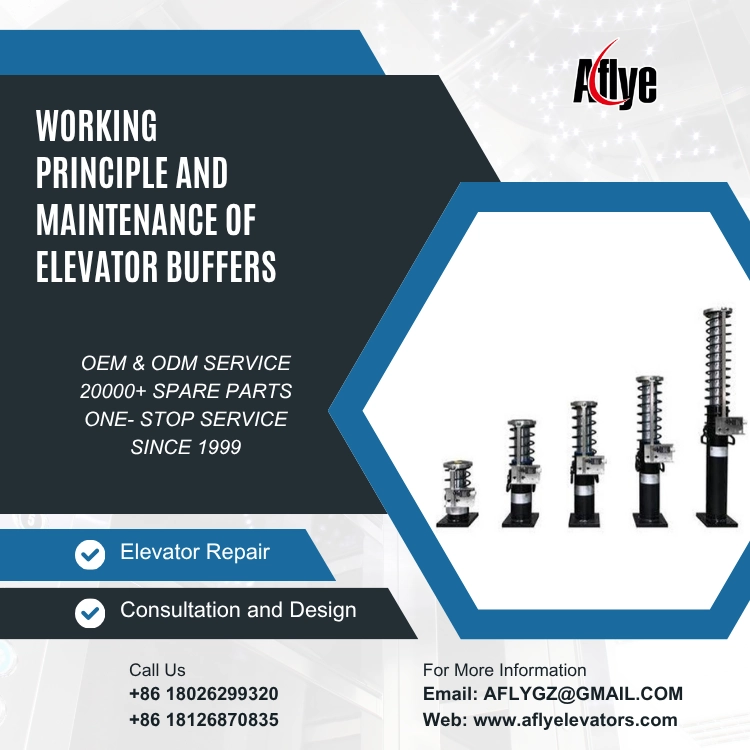
In an elevator safety system, the elevator buffer is an important protective device installed at the bottom of the elevator shaft. Its main function is to absorb the impact energy of the elevator car or counterweight under extreme conditions, preventing severe equipment damage.
Although buffers rarely operate during normal elevator use, their reliability is directly related to overall elevator safety performance.
As a professional elevator & escalator parts supplier, A-FLY recommends that maintenance teams pay close attention to this critical elevator spare part.
1. Working Principle of Elevator Buffers
The basic working principle of an elevator buffer is to absorb impact energy and reduce the speed of moving components.
When abnormal downward movement or bottom impact occurs, the elevator car or counterweight compresses the buffer. Through elastic deformation or hydraulic action, the kinetic energy is converted into heat or other forms of energy, thereby reducing impact force.
Common elevator buffers are mainly divided into:
Spring buffers
Hydraulic buffers
Spring buffers absorb energy through elastic deformation and have a relatively simple structure.
Hydraulic buffers use hydraulic oil flow to achieve cushioning effects, providing smoother braking performance and making them more suitable for high-speed elevator systems.
2. Importance of Elevator Buffers
As the final safety protection device, the elevator buffer functions when other protection systems fail or under extreme operating conditions.
It can effectively reduce impact force and minimize damage to the elevator car, guide rails, and other elevator & escalator spare parts, thereby protecting the overall equipment structure.
3. Common Faults and Risks
If the buffer experiences aging, oil leakage, spring fatigue, or installation abnormalities, its buffering performance may be affected.
Common on-site issues include:
Reduced buffering performance
Poor reset function
Insensitive operation
Although these problems may not be obvious during daily operation, they can create significant risks under abnormal conditions.
4. Key Points for Daily Maintenance
During maintenance work, technicians should regularly inspect the buffer appearance and confirm that there are no obvious:
Deformation
Cracks
Leakage
For hydraulic buffers, special attention should be paid to:
Hydraulic oil condition
Seal integrity
For spring buffers, technicians should inspect whether the springs show signs of fatigue or damage.
At the same time, the installation position should be confirmed to ensure secure and correct mounting.
5. Timely Replacement of Critical Components
For buffers that have been in service for a long time or show declining performance, matching elevator spare parts should be replaced promptly to avoid failure during critical situations.
Choosing high-quality elevator & escalator spare parts can effectively improve the overall safety of the elevator system.
Conclusion
Understanding the working principle and maintenance of elevator buffers helps maintenance personnel better ensure elevator safety and reliability.
As one of the key safety devices, elevator buffers may not operate frequently, but they must always remain in reliable condition.
As a professional elevator & escalator parts supplier, A-FLY provides various elevator buffers and related elevator & escalator spare parts solutions to help customers achieve safer and more efficient maintenance management.