
Why Worn Escalator Drive Sprockets Cause Chain Skipping
In an escalator transmission system, the drive sprocket and main drive chain are responsible for core power transmission. Once the sprocket becomes worn, sites often begin to experience abnormal chain noise, vibration during operation, increased mechanical shock, and even chain skipping that leads to escalator shutdowns. Chain skipping is not an accidental fault — it is a typical sign of mechanical matching failure.
As a professional elevator and escalator parts supplier serving the global maintenance market, A-FLY has found that more than 60% of escalator chain-related faults originate from geometric changes caused by sprocket wear.
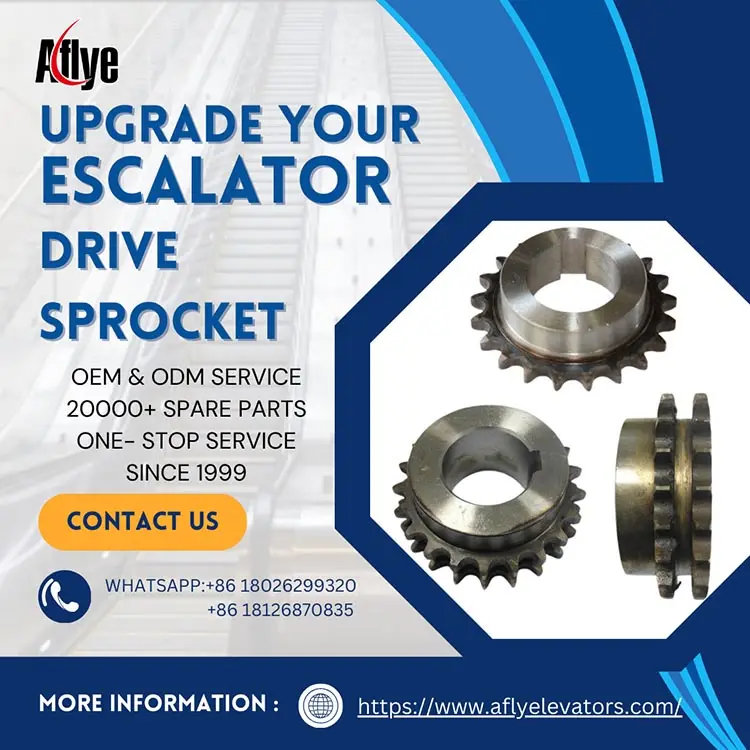
1. Tooth Profile Wear Reduces Proper Engagement Depth
The sprocket tooth profile is precisely machined according to the chain pitch. After long-term exposure to impact loads and cyclic tension, the sprocket may develop:
Sharpened tooth tips and reduced tooth thickness
Worn tooth roots with decreased effective wrap angle
Slight pitch elongation due to deformation
These changes prevent the chain from fully seating into the sprocket grooves, reducing the contact area. During startup, braking, or heavy-load conditions, force concentrates on the tooth tips, making the chain easy to be lifted off — resulting in tooth jumping or chain skipping.
2. Pitch Mismatch Creates “False Chain Slack”
After wear, the sprocket’s actual pitch circle diameter increases, which is equivalent to the chain “becoming longer,” while the tensioning device does not compensate accordingly. This creates a hidden issue — the chain surface tension may appear normal, but the engagement pitch is already misaligned.
When the escalator passes through load fluctuation zones (such as areas where passengers stand in groups), the chain load suddenly increases. The slack side begins to vibrate, causing the chain to bounce off the sprocket teeth and eventually skip.
3. Uneven Wear Shifts the Chain Running Path
In real-world applications, sprockets rarely wear evenly. Common causes include:
Long-term unidirectional heavy loads
Misaligned lubrication nozzles
Installation coaxiality errors
Bearing wear causing sprocket wobble
When one side of the sprocket wears more than the other, the chain gradually shifts sideways, forming angled engagement. This not only affects proper meshing but may also cause the chain to rub against guide structures. The resulting periodic tension variation significantly increases the risk of chain skipping.
4. Poor Lubrication Accelerates Wear and Destabilizes Friction
When lubrication is insufficient, rolling friction between the chain and sprocket turns into dry friction, greatly accelerating wear. More critically, dry friction creates irregular wear surfaces, making the chain’s running resistance inconsistent. Uneven force distribution along the chain pitch can then cause the chain to derail at high-speed sections.
Using standard-compliant lubricants and regularly cleaning old grease are key maintenance measures to extend sprocket service life.
5. Chain Skipping Brings Chain-Reaction Risks
Once the drive chain skips teeth, consequences go beyond abnormal noise. It may lead to:
Sudden jolts that cause passenger imbalance
Increased vibration in the drive system, shortening bearing life
Chain collisions with guards, damaging other elevator and escalator components
Severe cases triggering safety protection systems and stopping the escalator
Therefore, sprocket wear should not be judged simply by whether it can still rotate, but by the degree of tooth profile wear and pitch deviation.
6. When Should the Drive Sprocket Be Replaced?
During maintenance, technicians should focus on checking:
Whether tooth tip thickness has become noticeably thinner
Whether the tooth profile shows hook-shaped wear
Whether there is looseness or play between the chain and sprocket during engagement
Whether periodic impact noises occur during chain operation
If any of these conditions are observed, the matched drive sprocket and chain assembly should be replaced promptly.
A-FLY supplies multiple models of escalator drive sprockets, main drive chains, and a full range of elevator and escalator spare parts. Our products are manufactured using high-strength alloy steel with integral heat treatment and precision tooth machining, ensuring high engagement accuracy, strong wear resistance, and stable operation across various escalator brands.
Summary
Escalator chain skipping is not accidental — it is often the inevitable result of sprocket wear. Early detection of tooth profile changes, proper lubrication, and regular pitch deviation measurement are essential to preventing major shutdown incidents.
Choosing a reliable elevator and escalator parts supplier like A-FLY helps ensure stable transmission system performance, reduce maintenance costs, and improve long-term escalator safety and reliability.