
Why Small Step Roller Size Deviations Cause Escalator Vibration
In daily escalator maintenance, many technicians encounter a puzzling situation: after replacing step rollers with new ones, the escalator starts to vibrate or produce abnormal noise.
Inspection shows that the step rollers rotate smoothly, the rubber is not aged, and the dimensional deviation appears “almost negligible.” Yet it is precisely these seemingly minor dimensional differences that are systematically amplified, eventually affecting the operation of the entire escalator.
As a long-term global elevator & escalator spare parts supplier, A-FLY has found through numerous on-site cases that step roller dimensional tolerance is one of the key hidden factors determining escalator smoothness.
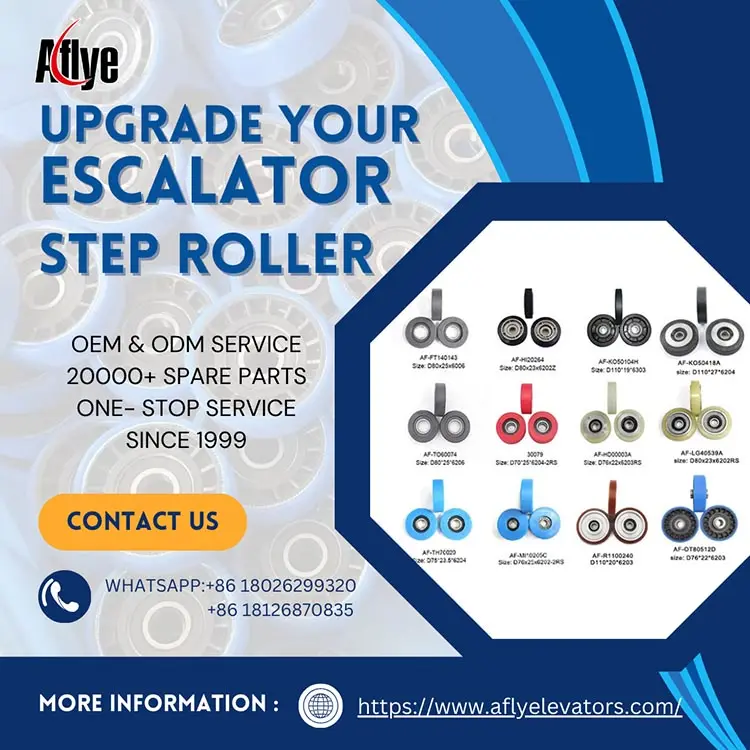
1. Step Rollers Are Not “Single-Point Components”
Step rollers do not operate independently. Together with the guide rails, step axles, and step chains, they form a continuous motion system.
When even slight deviations exist in step roller diameter, width, or concentricity, the problem does not remain at one roller—it is transmitted and propagated throughout the entire system.
2. How Are Small Dimensional Errors Amplified?
During escalator operation, step rollers perform high-frequency, repetitive, and synchronized rolling along the guide rails. Even tiny dimensional deviations can cause:
Subtle fluctuations in step height
Periodic changes in contact points between roller and guide rail
Rhythmic variations in load distribution
These effects are almost imperceptible in a single cycle, but after hundreds or thousands of repetitions, they develop into noticeable whole-escalator vibration.
3. Inconsistency Between Step Rollers Is the Core Cause of Vibration Amplification
Common issues seen in maintenance practice include:
Mixing new and old step rollers
Slight dimensional differences between rollers from different batches
Replacing rollers on one side while keeping old ones on the other
When multiple step rollers are not fully consistent, steps experience rhythmically uneven micro-impacts during operation. These impacts accumulate and are amplified into system-level vibration.
4. Disrupted Compatibility Between Guide Rails and Step Rollers
Once step roller dimensions deviate from the design value, the contact condition with the guide rail changes:
Shifted contact points
Localized stress concentration
Rolling turning into a mixed rolling-and-sliding state
This not only increases vibration, but also accelerates wear of both the guide rails and the step rollers themselves, creating a negative feedback loop.
5. Vibration Is Not Just a “Comfort Issue”
Many people assume vibration only affects ride comfort. In reality, it indicates:
Fluctuating loads on the step chain
Accelerated fatigue of bearings and step axles
Shortened service life of other escalator components
If ignored over time, vibration leads to higher maintenance costs and more frequent escalator downtime.
6. Why Are Dimensional Deviations So Easy to Overlook?
The main reasons are:
Visual differences are almost imperceptible
Individual step rollers feel normal when rotated by hand
Initial operation may still seem acceptable
However, an escalator is a highly synchronized system—any small inconsistency will be continuously amplified during operation.
7. How to Prevent Whole-Escalator Vibration Caused by Dimensional Errors
In practice, it is recommended to:
Replace step rollers as complete sets to avoid mixing
Use products with strictly controlled dimensional tolerances
Inspect guide rails and step axles at the same time
Avoid solving only the “surface symptom”
8. Choosing the Right Step Rollers Is More Effective Than Repeated Adjustments
High-quality escalator step rollers should offer:
Stable and consistent dimensional control
Good concentricity and rolling performance
High compatibility with the guide rail system
As a professional elevator & escalator spare parts supplier, A-FLY provides step rollers and related components in multiple specifications. These products are validated in real projects for dimensional consistency and long-term operational stability, helping customers effectively reduce vibration risks.
Conclusion
Small dimensional deviations in step rollers do not “disappear”—they are continuously amplified during operation.
Only by understanding the integrated nature of the escalator system and selecting elevator & escalator components with stable dimensions and proper matching can long-term smooth, quiet, and safe operation be achieved.
In escalator maintenance and modernization projects, working with an experienced supplier like A-FLY is a critical step in preventing recurring vibration issues.