
Door Operator Issues Caused by Incorrect Door Hanger Roller Diameter
In an elevator door system, door hanger rollers may be small in size, but they are one of the key components that determine whether door opening and closing are smooth, quiet, and stable.
When replacing door hanger rollers, many maintenance technicians focus only on whether the rollers can be installed, while overlooking a frequently underestimated detail—the diameter deviation of the door hanger roller.
As a long-term global elevator & escalator spare parts supplier, A-FLY has found through numerous on-site cases that excessive diameter deviation is a common root cause of abnormal door operator performance, increased noise, and premature component wear.
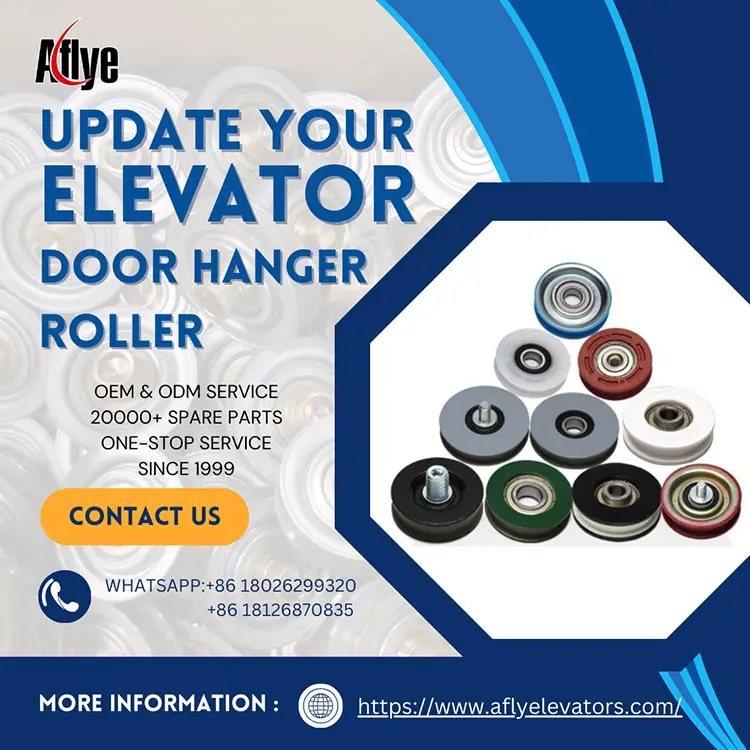
1. Why Is Door Hanger Roller Diameter So Important?
The diameter of a door hanger roller directly determines:
The running height of the door panel on the guide rail
Force transmission within the door operator
Opening/closing speed and synchronization
When the diameter deviates from the original design, the geometry of the door system is disrupted. Even a deviation of just a few millimeters can be repeatedly amplified under high-frequency operation.
2. What Is the First Problem to Appear When Diameter Deviation Is Too Large?
Unsmooth door movement is usually the earliest warning sign.
When the door hanger roller diameter is too large or too small, the door panel position on the guide rail changes, leading to:
Increased resistance during opening or closing
Uneven door movement
One door panel starting earlier or later than the other
This imbalance forces the door operator to run continuously under non-design operating conditions.
3. Noticeable Increase in Door Operator Noise
Diameter deviation alters the contact relationship between the roller and the guide rail, often resulting in:
Rough or irregular rolling
Local sliding or jumping
Abnormal friction between the roller and the rail
This eventually manifests as abnormal noise, squealing, or periodic sounds—especially near the end of the closing cycle.
4. Door Panel Asynchrony That Shortens Door Operator Lifespan
In center-opening or multi-panel door systems, inconsistent door hanger roller diameters can directly cause:
Different door panel running speeds
Uneven load distribution in the door operator
Abnormal stress on synchronization mechanisms
Over time, not only do the rollers wear faster, but other elevator door components—such as the door operator, door vanes, and guide rails—also suffer accelerated damage.
5. Accelerated Abnormal Wear of Guide Rails and Rollers
When door hanger roller diameter does not match specifications, contact points concentrate on limited areas of the guide rail, leading to:
Localized polishing or scoring of the rail
Uneven wear on the roller surface
Significantly shortened service life
These wear patterns often do not appear immediately, but emerge collectively after a period of operation.
6. Door Operator Control Parameters Are “Forced” to Change
In some systems, diameter deviation indirectly affects door operator control behavior:
The operator requires higher driving force to complete movements
Opening and closing times become longer
The controller frequently adjusts motion curves
These passive adjustments keep the motor and controller under long-term high load conditions.
7. Why Is Diameter Deviation So Easy to Overlook?
Door hanger roller diameter deviation has several typical characteristics:
Visual differences are not obvious
Doors still appear to open and close normally at first
Problems gradually worsen over time
Issues are often misdiagnosed as door operator or guide rail faults
As a result, many projects repeatedly adjust door operators or replace rails before discovering that the root cause lies in incorrect roller dimensions.
8. What Should Be Checked When Replacing Door Hanger Rollers?
To avoid problems caused by diameter deviation, it is recommended to:
Confirm the actual diameter specification of the original rollers
Avoid mixing different batches or different sizes of rollers
Replace rollers in pairs for center-opening doors to ensure consistency
Inspect guide rail and door operator condition at the same time
9. Choosing High-Consistency Door Hanger Rollers Is Critical
High-quality door hanger rollers should offer:
Strictly controlled diameter tolerances
Stable rolling performance
Good compatibility with the door operator system
As a professional elevator & escalator spare parts supplier, A-FLY provides door hanger rollers and related components in multiple specifications. These products are verified in real projects for dimensional consistency and durability, helping customers reduce door operator failures and repeated maintenance.
Conclusion
Excessive door hanger roller diameter deviation may seem like a minor issue, but it can trigger a chain of door operator problems.
Only by strictly controlling dimensional accuracy during selection and replacement can elevator door systems maintain long-term smooth, quiet, and stable operation.
In elevator door system maintenance, choosing reliable elevator & escalator components and working with an experienced supplier like A-FLY is an important guarantee for reducing failure rates and extending equipment lifespan.