
What Safety Problems Can Escalator Entrance Brush Wear or Detachment Cause?
The entrance area of an escalator is an important access point for passengers and one of the areas where safety risks are concentrated. Although the escalator entrance brush is a small wear part, it plays an important role in preventing passengers’ shoes, clothing, and other items from getting too close to the gap between the escalator steps and skirt panels.
When the entrance brush becomes worn, deformed, or detached, it may reduce the effectiveness of the escalator’s safety protection and increase the risk of entrapment. Therefore, the condition of the escalator safety brush should be checked regularly during routine escalator maintenance, and damaged components should be replaced promptly.
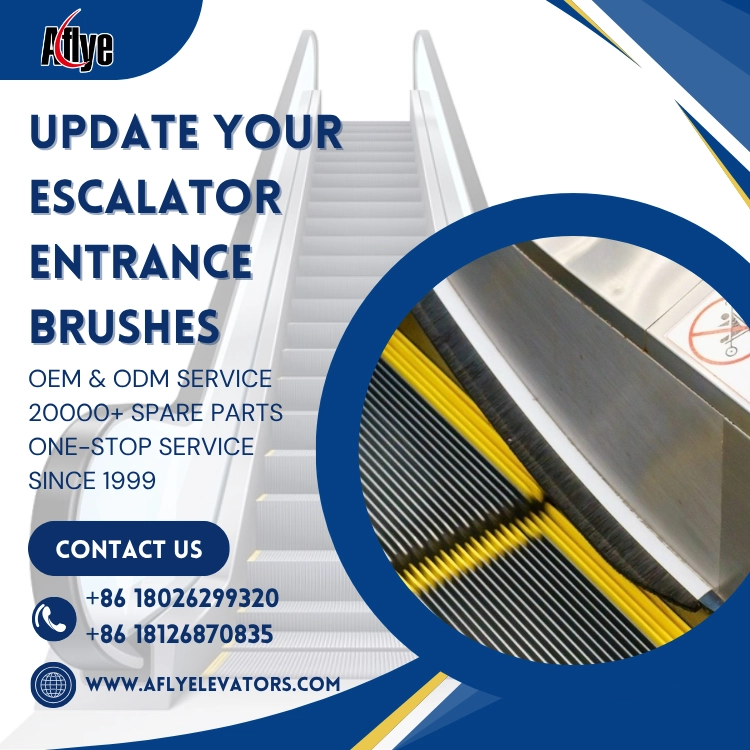
1. What Is the Function of an Escalator Entrance Brush?
Escalator entrance brushes are typically installed on both sides of the escalator entrance and exit areas or near the skirt panels. The flexible bristles create a safety separation zone.
Their main functions include:
Reminding passengers to maintain a safe distance;
Reducing the possibility of shoes and clothing getting too close to the step edges;
Reducing the possibility of foreign objects entering the escalator operating area;
Improving the overall passenger experience.
As an important escalator safety component, the entrance brush is exposed to passenger contact, environmental dust, and equipment vibration over long periods, making it an escalator wear part that requires regular inspection.
2. Common Causes of Escalator Entrance Brush Wear or Detachment
1. Bristle Wear from Long-Term Use
Escalators operate frequently every day. Continuous passenger contact and environmental exposure can gradually shorten and soften the bristles and may eventually cause them to break.
Common symptoms include:
Reduced brush height;
Uneven bristle distribution;
Reduced protective effectiveness.
2. Loose Mounting Structure
Escalator entrance brushes are usually secured with mounting brackets. Loose screws, deformed brackets, or improper installation may cause the brush to become loose or detach during operation.
3. Damage Caused by External Impact
Handling goods, improper cleaning equipment operation, or passengers carrying large items through the entrance area may cause the escalator entrance brush to bend, deform, or fall off.
4. Material Aging Caused by Environmental Factors
Long-term exposure to dust, moisture, and temperature changes may cause some brush materials to harden or crack, reducing their service life.
3. What Safety Problems Can an Abnormal Escalator Entrance Brush Cause?
1. Increased Risk of Clothing and Shoes Being Caught
When the escalator safety brush is severely worn, it may no longer effectively remind passengers to stay away from hazardous areas. Shoelaces, trouser cuffs, or other soft materials may therefore get closer to the area between the steps and skirt panels.
2. Reduced Escalator Safety Protection
The entrance brush is an auxiliary safety protection component. If it is missing or damaged, the overall safety protection performance of the escalator may be affected.
3. Reduced Passenger Experience
A damaged escalator entrance brush may become loose, produce abnormal noises, or show visible damage, affecting the overall appearance and operating quality of the equipment.
4. Increased Maintenance Costs
If entrance brush problems are ignored for an extended period, more foreign objects may enter the escalator step system, potentially increasing wear on other escalator parts.
4. Solutions for Escalator Entrance Brush Problems
For worn or detached escalator entrance brushes, regular inspections should be included in routine escalator maintenance.
First, check the brush length, bristle density, and mounting security.
Next, confirm whether the distance between the brush, escalator steps, and skirt panels meets the applicable requirements.
If the bristles are severely worn or deformed, or if the mounting components are damaged, the escalator safety brush should be replaced promptly.
During replacement, the correct product should be selected according to the escalator model, mounting dimensions, and actual installation structure to avoid installation difficulties caused by dimensional mismatches.
5. Purchasing Tips for Escalator Entrance Brushes
When purchasing escalator entrance brushes, pay particular attention to:
Brush dimensions and mounting method;
Bristle material and wear resistance;
Compatibility with the original equipment interface;
Overall product durability.
For escalator maintenance companies and engineering projects, choosing a supplier with extensive experience in elevator and escalator parts can help reduce model-selection errors and installation compatibility issues.
6. A-FLY Elevator & Escalator Parts Supply Capability
A-FLY specializes in the global supply of elevator and escalator parts, offering one-stop sourcing for escalator entrance brushes, escalator safety brushes, escalator comb plates, escalator steps, escalator handrails, escalator chains, and other elevator and escalator components.
For escalator maintenance, modernization projects, and project procurement, A-FLY supports product selection confirmation, dimensional matching, and OEM/ODM customization, helping customers quickly obtain reliable escalator parts solutions.
Conclusion
Although the escalator entrance brush is a relatively small component, it is an important protective part for passenger safety. Identifying wear, looseness, and detachment in time and replacing damaged components through proper escalator maintenance can help reduce safety risks and improve long-term escalator operating stability.
Choosing a reliable escalator parts supplier is also an important part of ensuring safe and reliable equipment operation.