
Why Can't Elevator Buttons from Different Brands Be Directly Replaced? 5 Key Parameters to Confirm Before Purchasing
In elevator maintenance and modernization projects, elevator button procurement is a common task. Many buyers assume that if two buttons look similar and have comparable dimensions, they can be directly replaced. However, this is often not the case.
Different brands and models of elevator buttons may vary significantly in structure, electrical specifications, wiring configurations, and installation methods. Purchasing the wrong button can lead to installation difficulties, button malfunctions, abnormal illumination, or even control system failures.
So, what key parameters should be confirmed before replacing an elevator button?
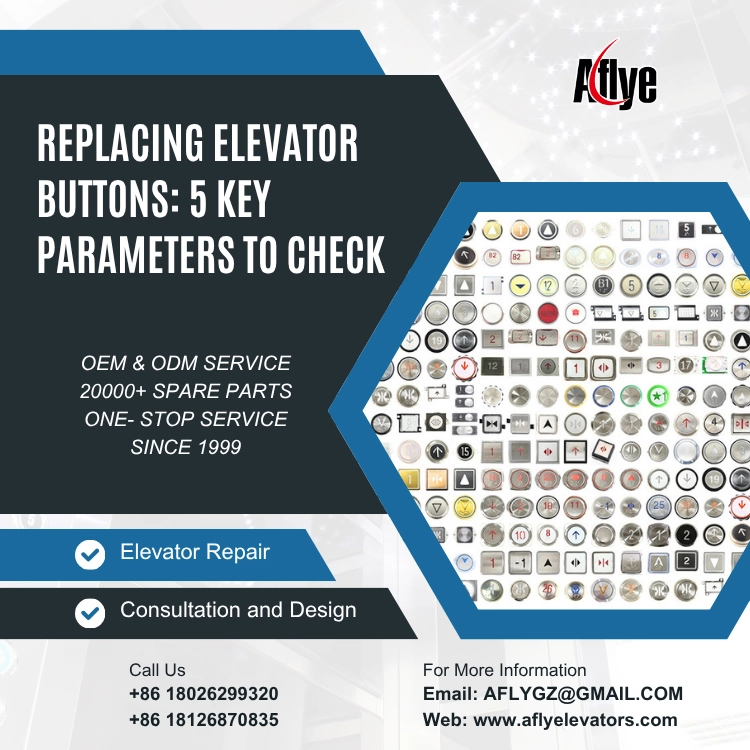
1. Confirm the Elevator Button Dimensions
The elevator button size is one of the most basic yet frequently overlooked specifications.
Although many buttons appear similar, their actual mounting hole size, button diameter, installation depth, and fixing method can differ considerably. If the dimensions do not match, the button may not fit into the existing COP (Car Operating Panel) or HOP (Hall Operating Panel), increasing modification costs and installation time.
Maintenance Recommendation
Measure and record:
Button outer diameter
Mounting hole diameter
Rear installation depth
Clip or fastening dimensions
It is also helpful to provide on-site photos to the supplier for verification.
2. Confirm the Voltage and Illumination Type
Different elevator buttons operate at different voltages, including:
DC 12V
DC 24V
AC 110V
AC 220V
Choosing the wrong voltage may result in:
Button lights not working
Continuous flashing
LED damage or burnout
In addition, illumination designs vary between brands and models, such as:
Ring illumination
Point-source lighting
Full-character illumination
Potential Risk
Incorrect voltage or lighting specifications can cause elevator button failures and may even affect the stability of the control system.
3. Confirm the Wiring Interface Type
Many elevator buttons look identical from the front but use completely different internal connection methods.Common interface types include:
Pin-type connectors
Solder-wire connections
Quick-connect terminals
PCB board connections
Even if a button fits physically, it may not connect properly to the elevator's control circuit if the interface type is incompatible.
Solution
Before purchasing, take clear photos of the back of the button and verify:
Wiring method
Number of terminals
Connector configuration
4. Confirm Characters and Functional Definitions
Different elevator brands often use different symbols and functional layouts.
Common button types include:
Door Open Button
Door Close Button
Alarm Button
Fire Service Button
Floor Selection Button
Some international brands also use customized icons or special symbols. If the functional markings do not match, passengers may become confused, resulting in a poor user experience.
5. Confirm Control System Compatibility
Modern elevators increasingly utilize intelligent control systems. Some elevator buttons include:
Communication modules
Display drivers
Proprietary communication protocols
Even if the appearance, dimensions, and voltage specifications are identical, incompatible communication protocols may cause:
Unresponsive buttons
Abnormal button illumination
Failed floor registration
Communication fault alarms
Therefore, when identifying an elevator button model, it is highly recommended to provide:
Elevator brand
Control system model
Original button part number
to ensure proper compatibility.
Elevator Button Procurement Recommendations
To avoid purchasing errors, provide the following information when requesting a quotation:
Front photo of the button
Rear photo of the button
Elevator brand
Elevator model
Button dimensions
Original product code (if available)
Providing these details significantly improves matching accuracy and helps reduce elevator downtime and unnecessary procurement costs.
A-FLY's Elevator Button Supply Capabilities
As a professional elevator and escalator spare parts supplier, A-FLY has been serving maintenance companies, engineering contractors, and spare parts distributors worldwide for many years.
Our product range includes:
Elevator button faceplates
Display boards
Various elevator and escalator spare parts
With an extensive brand database and rich model-matching experience, A-FLY can quickly identify the correct product based on:
Photos
Dimensions
Part numbers
Physical samples
We also provide OEM and ODM customization services, helping customers solve complex elevator button procurement and replacement challenges.
Conclusion
The main reason elevator buttons from different brands cannot be directly replaced is that they differ in dimensions, interfaces, voltage requirements, functional definitions, and communication protocols.
For maintenance personnel and procurement professionals, verifying these five key parameters before purchasing can effectively prevent installation failures and elevator button malfunctions. Working with an experienced elevator and escalator spare parts supplier can make the procurement process faster, more accurate, and more reliable.