
Should You Replace the Entire Elevator Button or Just the Faceplate? A Procurement and Maintenance Guide
In daily elevator operation, elevator buttons are among the most frequently used components. Over time, they may develop issues such as unresponsive operation, dim or failed illumination, worn characters, sticking buttons, or aging appearances.
When a fault occurs, maintenance personnel often face a common question: Should the entire elevator button assembly be replaced, or is it sufficient to replace only the elevator button faceplate?
The answer depends on the nature of the problem. Making the right decision can reduce maintenance costs while ensuring reliable elevator operation.
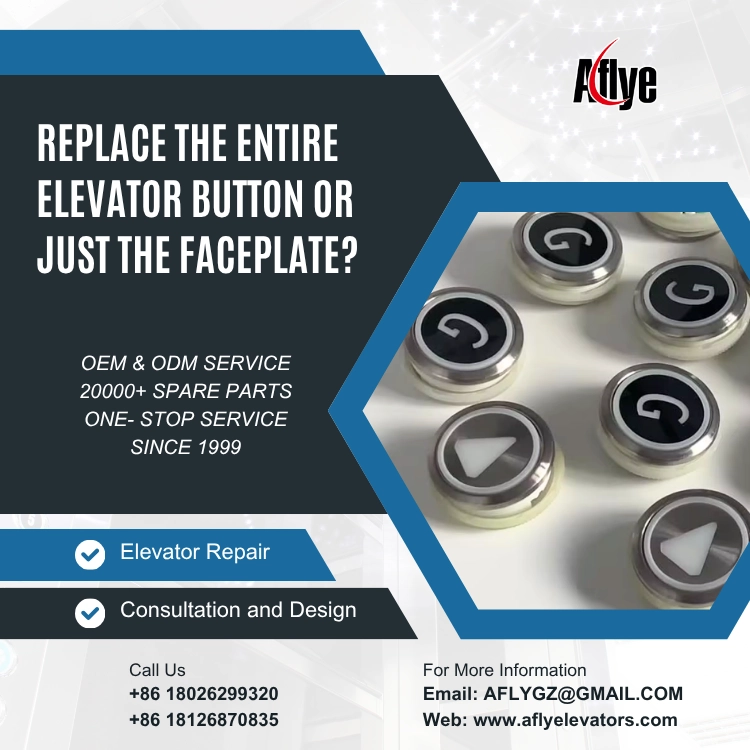
1. When Should You Replace Only the Elevator Button Faceplate?
If the button functions properly and floor calls can still be registered normally, but the following issues are present, replacing only the button faceplate may be sufficient:
Severely worn button markings or characters
Scratched, cracked, or yellowed surfaces
Aging light diffusers affecting display quality
Appearance no longer matches the elevator cabin design
Modernization projects requiring a uniform button style
These issues mainly affect appearance and passenger experience rather than electrical functionality. Replacing only the elevator button faceplate is usually more cost-effective and requires less installation time.
2. When Is It Recommended to Replace the Entire Elevator Button?
If any of the following faults occur, replacing only the faceplate is unlikely to solve the problem:
No response when the button is pressed
Button light is off or flashing abnormally
Button sticks or returns slowly
Internal contact failure
Defective LED components
Burned wiring terminals or connectors
Persistent poor electrical contact
In these cases, the problem involves the internal mechanism or electronic components. A complete elevator button replacement is recommended to prevent recurring failures and additional maintenance costs.
3. Common Causes of Elevator Button Failures
Elevator button problems are typically caused by:
Mechanical wear from frequent use
Oxidation of wiring caused by humid environments
LED damage due to voltage fluctuations
Physical impact causing panel deformation
Surface corrosion from cleaning chemicals
Natural aging of elevator spare parts
Therefore, maintenance personnel should inspect not only the button itself but also related components, including:
Button boards
Wiring terminals
A comprehensive inspection helps identify the true source of the problem.
4. How to Reduce Elevator Button Replacement Costs
For maintenance companies and property management teams, keeping commonly used buttons in stock is highly recommended.Frequently replaced items include:
Floor selection buttons
Door open buttons
Door close buttons
Alarm buttons
Hall call buttons
Maintaining inventory of these components can significantly reduce elevator downtime.
Before purchasing replacement buttons, be sure to verify:
Button dimensions
Mounting hole size
Wiring configuration
Operating voltage
Illumination color
Character or symbol requirements
Brand compatibility
Proper verification helps avoid costly purchasing mistakes and installation delays.
5. Elevator Button Procurement Recommendations
When purchasing elevator buttons, it is not advisable to identify models solely by appearance. Even buttons that look identical may differ in:
Connector types
Voltage requirements
Communication protocols
Control system compatibility
As a professional elevator and escalator spare parts supplier, A-FLY provides a comprehensive range of products for maintenance companies, engineering contractors, and spare parts distributors worldwide, including:
Elevator button faceplates
Display boards
Control boards
Various elevator and escalator spare parts
A-FLY supports:
Multi-brand compatibility
OEM/ODM customization
Bulk purchasing
Fast delivery services
Customers can provide photos, dimensions, or samples, and A-FLY's technical team can help quickly identify the correct model, reducing procurement errors and saving valuable time.
Conclusion
When an elevator button fails, the decision to replace the entire assembly or only the faceplate should be based on the actual condition of the component.
Appearance-related issues generally require only a faceplate replacement.
Functional failures usually require a complete elevator button replacement.
Choosing the right elevator spare parts and working with a reliable supplier can help reduce maintenance costs, improve elevator reliability, and enhance the passenger experience.