
How Surface Hardening Affects Traction Sheave Lifespan
In an elevator traction system, the traction sheave does more than transmit driving force. Its surface condition directly determines wire rope wear rate, operational stability, and the overall service life of the system.
When replacing traction sheaves, many people focus on dimensions and groove profiles, while overlooking one critical factor—the surface hardening treatment.
As a long-term global elevator & escalator spare parts supplier, A-FLY has found through numerous projects that differences in surface hardening treatment often have a greater impact on traction sheave lifespan than the base material itself.
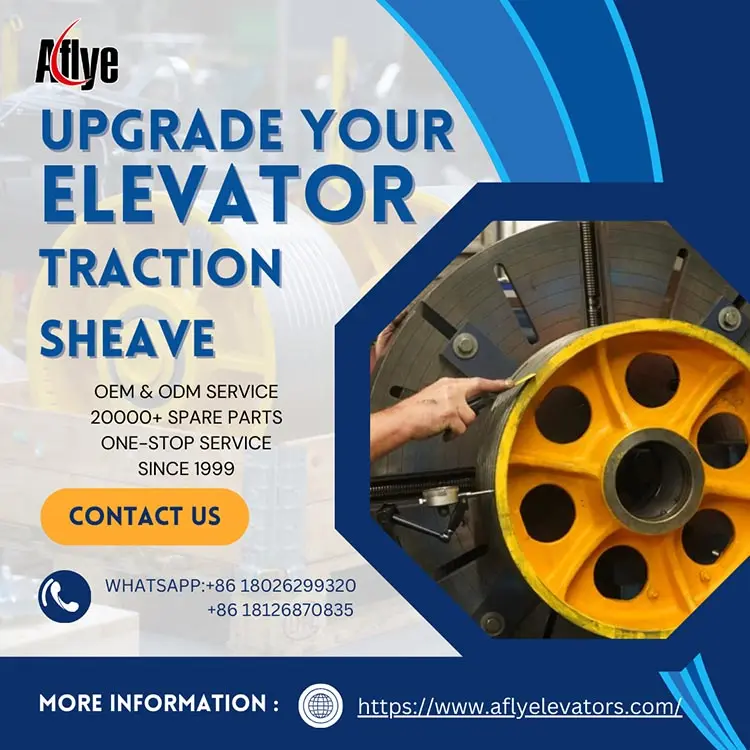
1. Why Does a Traction Sheave Need Surface Hardening?
During operation, the traction sheave remains in continuous high-frequency contact with wire ropes and must withstand:
Continuous friction
Cyclic loading
Start-and-stop impact
Temperature rise and variation
If surface hardness is insufficient, the sheave is prone to groove wear, surface scoring, or localized collapse, ultimately destroying traction conditions.
Therefore, surface hardening is one of the core processes that ensure traction sheave durability.
2. How Much Does Hardening Treatment Affect Wear Rate?
Traction sheaves without effective surface hardening often show early-stage issues such as:
Changes in groove dimensions
Abnormal polishing of contact surfaces
Unstable friction coefficients
In contrast, traction sheaves with proper hardening treatment form a stable wear-resistant surface layer. This makes the wear process slower and more predictable, significantly extending service life.
3. Is “Higher Hardness Always Better”? Not Necessarily
A common misconception is that higher surface hardness always means longer service life.
In reality, excessive hardness combined with insufficient toughness can lead to:
Micro-cracks on the surface
Localized flaking or spalling
“Cutting-type” wear on wire ropes
An ideal hardening process must strike a balance between wear resistance and toughness, protecting the sheave itself while avoiding accelerated damage to the wire rope.
4. Why Do Different Hardening Treatments Lead to Amplified Lifespan Differences?
Under identical operating conditions, traction sheaves with different hardening treatments tend to show increasingly divergent lifespans over time:
No obvious difference in the early stage
Noticeable differences in wear rate during mid-term operation
Potentially multiple-fold lifespan differences in later stages
This explains why some traction sheaves require frequent replacement, while others remain stable for long-term operation.
5. Chain Effects on Wire Rope Service Life
The surface condition of the traction sheave affects not only its own lifespan but also indirectly determines:
Contact stress distribution on the wire rope
Fatigue rate of rope strands
Occurrence of abnormal polishing or flattening
Once the traction sheave surface treatment is improper, even high-quality wire ropes cannot avoid premature wear.
6. What Should Be Considered When Selecting a Traction Sheave?
In practical projects, it is recommended to look beyond size and model specifications and evaluate:
Whether the surface has undergone stable hardening treatment
Uniformity of the hardened layer
Compatibility with the corresponding wire rope specifications
Suitability for high-frequency or heavy-load applications
All of these factors directly influence the overall service life of the traction system.
7. A-FLY’s High-Reliability Traction Sheave Solutions
As a professional elevator & escalator spare parts supplier, A-FLY provides traction sheaves and related components in multiple specifications.
By carefully balancing material selection and surface treatment processes, A-FLY delivers solutions that combine wear resistance with system compatibility—helping customers achieve more stable and longer-lasting performance across different application scenarios.
Conclusion
Differences in traction sheave surface hardening treatment may seem subtle, but they determine real-world performance over years of operation.
Choosing the right surface treatment not only extends the service life of the traction sheave itself, but also effectively protects wire ropes and reduces overall maintenance costs.
When selecting traction system components, working with an experienced and process-mature supplier like A-FLY ensures more stable, durable, and reliable elevator operation.