
How Hardened Step Roller Rubber Affects Escalator Operation
In an escalator operating system, the step roller may seem like a minor component, but it directly affects riding comfort and operational safety.
During inspections, many maintenance teams focus on chains, drive sprockets, or brakes, while overlooking a problem that develops quietly over time—hardening of the step roller rubber.
As a long-term global elevator & escalator spare parts supplier, A-FLY has found through extensive escalator maintenance and modernization cases that once step roller rubber hardens, it affects far more than the roller itself—it impacts the operation of the entire escalator.
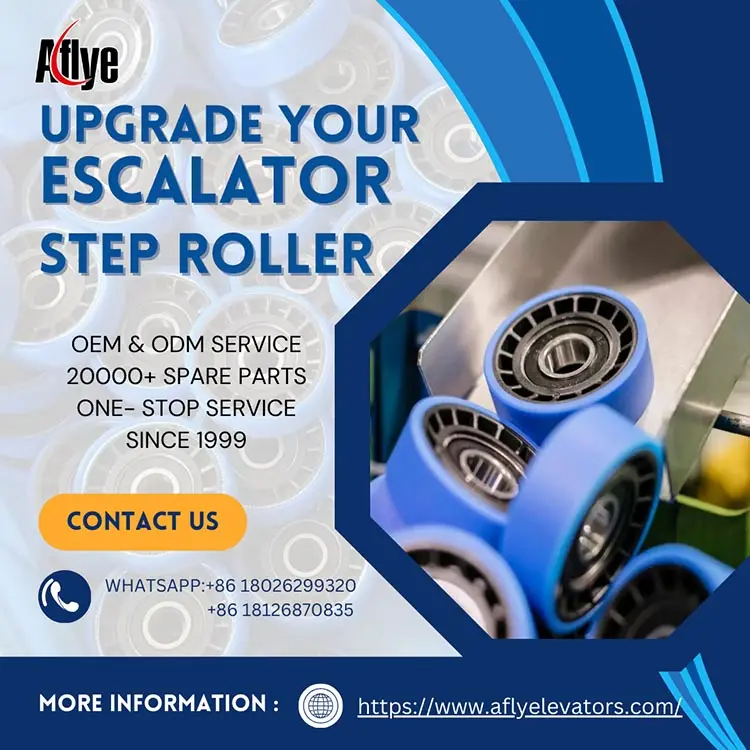
1. The Real Function of Step Roller Rubber Is More Than “Just a Rubber Coating”
The rubber on an escalator step roller is not decorative. During operation, it performs multiple critical functions:
Absorbing vibration generated during step movement
Reducing impact between metal components
Ensuring stable rolling of steps along the guide rails
Lowering operational noise
Once the rubber loses its elasticity, all of these functions deteriorate simultaneously.
2. What Is the Most Immediate Change After Rubber Hardens?
The earliest and most noticeable impact is usually a decline in riding comfort, including:
Increased operating noise
A “dry” or harsh vibration feeling during movement
More noticeable impact during start-up and stopping
These symptoms are often mistaken for “normal behavior of an old escalator,” when in fact they are clear signs of rubber performance degradation.
3. Amplified Vibration Triggers Chain Reactions Throughout the Escalator
When hardened rubber can no longer absorb micro-impacts effectively:
Step vibration is directly transmitted to the step chain
Guide rails experience higher instantaneous impact loads
Metal component fatigue accelerates
Over long-term operation, this significantly shortens the service life of multiple escalator components.
4. Reduced Stability of Step Movement
Rubber hardening also affects how well the step roller conforms to the guide rail, resulting in:
Less smooth step rolling
Localized “jumping” or shaking
Unstable step travel paths
During peak passenger flow, these instabilities become even more pronounced.
5. Noise Is More Than Just a Comfort Issue
When step roller rubber hardens, increased noise is not merely unpleasant—it often indicates:
Increased metal contact or impact
Accelerated wear between the roller and guide rail
Uneven loading on the step chain
If ignored, noise becomes a symptom rather than the root problem.
6. Impact on Other Critical Escalator Components
Hardened step roller rubber frequently causes a series of cascading effects:
Greater fluctuation in step chain tension
Accelerated localized wear of guide rails
Increased load on step axles and bearings
When these issues overlap, overall escalator reliability declines noticeably.
7. Why Is Rubber Hardening So Often Overlooked?
There are three main reasons:
Visual appearance changes are minimal
The escalator still “works” in the early stage
Problems accumulate gradually rather than appearing suddenly
By the time failures become obvious, multiple elevator and escalator components are often already affected.
8. When Should Step Roller Replacement Be Considered?
In maintenance practice, step rollers should be closely evaluated if any of the following occur:
Escalator operating noise increases significantly
Step vibration becomes more noticeable
Step roller rubber feels hard and lacks elasticity
Long service life combined with high operating frequency
At this stage, continued use usually causes more harm than benefit.
9. Choosing the Right Step Rollers Is More Important Than “Making Do”
High-quality escalator step rollers should feature:
Stable and consistent rubber elasticity
Strong resistance to aging
Good compatibility with the guide rail system
As a professional elevator & escalator spare parts supplier, A-FLY provides escalator step rollers and related components in multiple specifications, suitable for different operating intensities and environmental conditions—helping customers effectively improve vibration, noise, and overall operational stability.
Conclusion
Hardened step roller rubber is not a “minor issue that can be ignored”—it is often the starting point of overall escalator performance decline.
Timely inspection and replacement of appropriate step rollers not only improves riding comfort, but also protects the entire escalator system and extends the service life of key components.
In escalator maintenance and modernization projects, choosing reliable elevator & escalator components and working with an experienced supplier like A-FLY is essential for achieving long-term safe, smooth, and stable operation.