
Why Do Escalator Friction Wheels Develop Uneven Wear? What Should You Check When the Handrail Speed Becomes Abnormal?
In the escalator handrail drive system, the escalator friction wheel generates friction through contact with the handrail, helping the handrail run smoothly. If maintenance inspection finds that only one side of the friction wheel is severely worn, this is usually not normal wear. It may be related to the installation position, handrail tension, or running path.
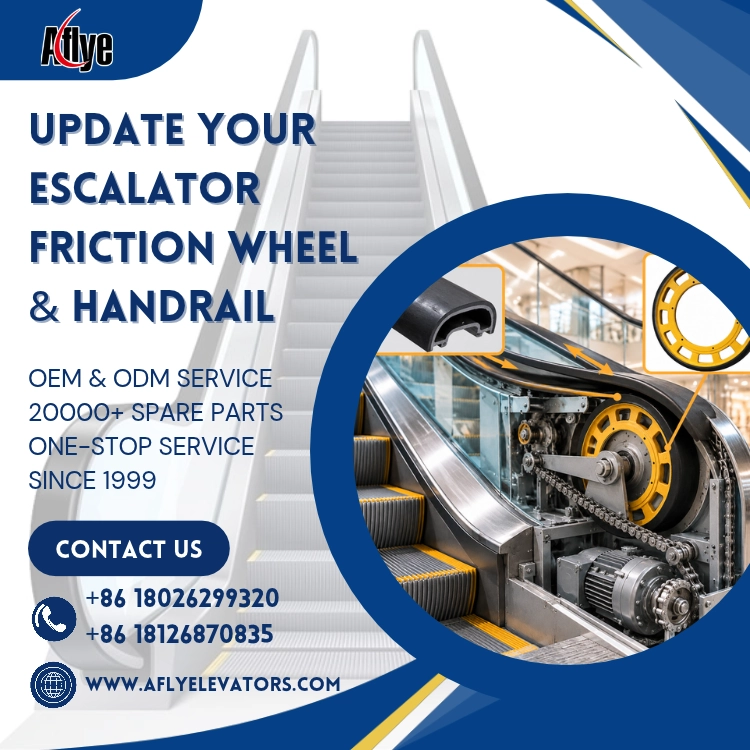
1. Why Does an Escalator Friction Wheel Develop Uneven Wear?
1. Friction wheel misalignment
If the escalator handrail friction wheel is not properly aligned with the handrail centerline, contact pressure may become concentrated on one side of the wheel. Long-term operation can then cause noticeable uneven wear.
2. Uneven handrail tension
Abnormal handrail tension can change the contact area between the friction wheel and handrail, resulting in uneven loading across the wheel surface and accelerating one-sided wear.
3. Increased bearing or shaft clearance
When the friction wheel bearing is worn or the wheel shaft becomes loose, the wheel may wobble or tilt during operation. This can cause one side to continuously experience greater friction.
4. Handrail running path deviation
Abnormal positioning of guide rollers, support rollers, or pressure rollers can cause the handrail to gradually move away from its normal path. In this situation, even a new friction wheel may develop uneven wear again.
2. What Problems Can Uneven Friction Wheel Wear Cause?
As one side of the friction wheel gradually becomes smaller in diameter, the effective contact area and friction conditions can change. This may result in:
Abnormal escalator handrail speed;
Handrail slipping;
Handrail vibration;
Periodic operating noise;
Increased localized handrail wear;
Higher loads on the drive system and related rollers.
3. How Can Uneven Friction Wheel Wear Be Resolved?
When abnormal wear is found, it is not recommended to replace the friction wheel alone. The inspection should also cover the wheel surface, bearing clearance, installation position, handrail tension, and the overall running path of the escalator handrail system.
If the wheel surface has developed obvious tapered wear, cracks, hardening, or excessive bearing play, the friction wheel should be replaced promptly. After replacement, the contact position between the friction wheel and handrail should be readjusted.
4. Escalator Friction Wheel Purchasing Tips
Before purchasing an escalator friction wheel, confirm the outer diameter, width, shaft hole size, bearing model, wheel surface material, mounting structure, and compatible handrail specifications.
For old escalators, it is recommended to provide photos of the original friction wheel, actual measurements, and the escalator model for accurate matching. This can help prevent repeated uneven wear caused by incorrect dimensions or materials.
5. A-FLY Elevator & Escalator Parts Supply
A-FLY supplies escalator friction wheels, handrails, guide rollers, support rollers, pressure rollers, step rollers, and other escalator wear parts for escalator repair, maintenance, and modernization projects.
We support dimension confirmation, sample matching, and OEM/ODM customization, while also supplying mechanical, electrical, and safety-related elevator and escalator parts to meet the one-stop sourcing needs of contractors, maintenance companies, and distributors.
Conclusion
Uneven wear on an escalator friction wheel often indicates uneven loading throughout the handrail drive system. When replacing the friction wheel, checking the handrail tension, bearing condition, installation alignment, and handrail running path at the same time can help prevent the new friction wheel from developing uneven wear again.