
Why Does Elevator Steel Belt Pulley Wear Shorten Steel Belt Life?
In elevator systems using steel belt drive technology, the elevator Steel Belt Pulley is an important component for power transmission. It transfers motor power to the elevator car and counterweight through friction and engagement with the elevator steel belt, making it a key part of the elevator traction system.
Compared with traditional steel wire rope systems, steel belt drive systems have higher requirements for sheave groove accuracy, contact conditions, and installation quality. When the elevator Steel Belt Pulley becomes worn, it not only affects elevator running smoothness but also directly reduces the service life of the elevator steel belt. Therefore, the condition of the Steel Belt Pulley should be carefully inspected during regular elevator maintenance.
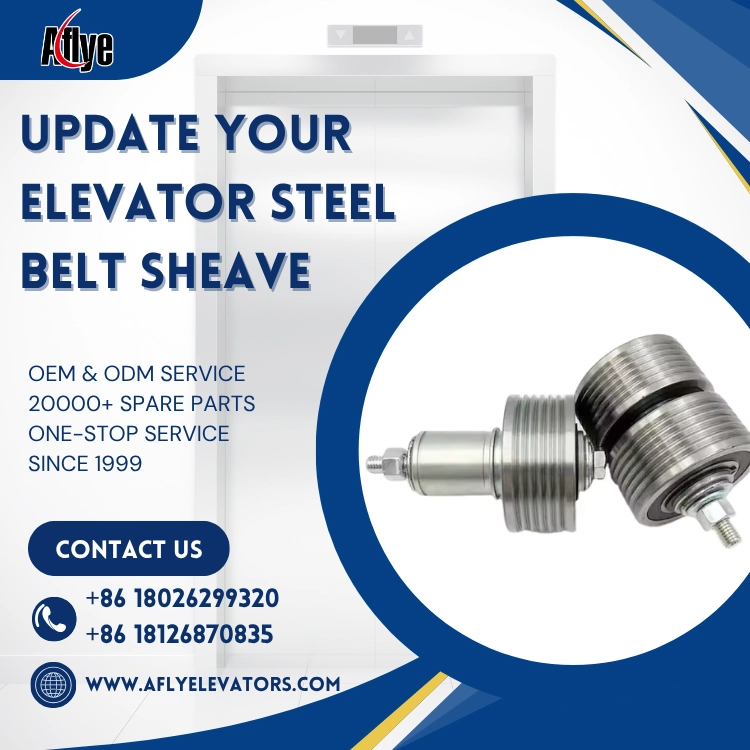
1. Steel Belt Pulley Groove Wear Causes Uneven Steel Belt Loading
Under normal conditions, the elevator steel belt should maintain uniform contact with the Steel Belt Pulley to ensure stable load transmission.
After long-term operation, the sheave grooves may experience:
Groove surface wear;
Changes in groove shape;
Surface hardening or damage;
Uneven local wear.
These changes reduce the contact area between the steel belt and the groove, causing certain areas to withstand excessive pressure.
Long-term operation may result in:
Steel belt edge wear;
Surface indentation marks;
Accelerated steel belt fatigue;
Reduced steel belt service life.
2. Uneven Steel Belt Pulley Wear Causes Steel Belt Tracking Problems
The elevator steel belt drive system requires accurate running alignment. If the Steel Belt Pulley develops uneven wear or installation deviation, the steel belt may fail to maintain proper center alignment.
Common symptoms include:
Steel belt moving side to side;
Friction noise during operation;
Wear marks on the steel belt edges;
Reduced elevator riding comfort.
If the problem is ignored for a long time, the steel belt will continuously experience lateral forces, causing fatigue damage to its internal structure.
Solution:Check the installation accuracy of the Steel Belt Pulley, axial clearance, and groove condition. If necessary, readjust or replace the Steel Belt Pulley.
3. Abnormal Steel Belt Pulley Surface Increases Friction Wear
If the surface of the Steel Belt Pulley has rust, foreign objects, or machining defects, it can increase the running resistance of the steel belt.
Possible consequences include:
Increased steel belt surface temperature;
Faster aging of the friction layer;
Reduced drive efficiency;
Increased motor load.
Especially in high-frequency operating elevators, even minor abnormalities can accumulate over time and cause significant damage.
4. Poor Matching Between Steel Belt Pulley and Steel Belt Affects Service Life
Different elevator steel belt specifications require matching Steel Belt Pulleys. Problems may occur when:
Steel belt width does not match;
Groove dimensions are incorrect;
Groove profile does not meet requirements;
Replacement parts have insufficient precision.
These issues can cause concentrated stress on specific areas of the steel belt, shortening its service life.
Therefore, during elevator modernization or spare parts replacement, it is not enough to check only the external dimensions. The complete traction system compatibility must also be confirmed.
5. How to Determine Whether the Steel Belt Pulley Needs Replacement?
During elevator maintenance, technicians should check:
Steel Belt Pulley groove wear condition;
Whether the steel belt shifts during operation;
Whether abnormal wear marks appear on the steel belt surface;
Whether abnormal operating noise exists;
Whether elevator startup and braking are smooth;
Whether steel belt tension is balanced.
If the Steel Belt Pulley has affected normal steel belt operation, corrective action should be taken promptly to prevent further damage to the elevator steel belt.
Elevator Steel Belt Pulley Purchasing Recommendations
When purchasing an elevator Steel Belt Pulley, the following specifications should be confirmed:
Steel belt model;
Steel belt width and thickness;
Number of grooves;
Groove profile dimensions;
Outer diameter specification;
Installation method;
Compatible traction machine model.
It is recommended to provide original part photos, dimensional data, or elevator model information for professional matching. This can help avoid installation problems caused by incorrect model selection.
A-FLY Elevator & Escalator Parts Supply Capability
As a professional elevator and escalator parts supplier, A-FLY provides global maintenance companies, engineering contractors, and parts distributors with:
Elevator steel belts;
Guide pulleys;
And complete elevator traction system components.
A-FLY supports OEM/ODM customization, sample confirmation, drawing matching, and fast delivery. Based on different elevator models, A-FLY can provide professional steel belt drive system solutions to help customers reduce procurement risks and improve elevator maintenance efficiency.
Conclusion
Elevator Steel Belt Pulley wear not only affects the performance of the sheave itself but also directly shortens the service life of the elevator steel belt and impacts the stability of the entire elevator traction system.
By regularly inspecting Steel Belt Pulley conditions, replacing worn components in time, and selecting a reliable elevator parts supplier, potential failures can be effectively reduced, ensuring long-term safe and smooth elevator operation.