
Monarch NICE3000 Elevator Faults & Solutions
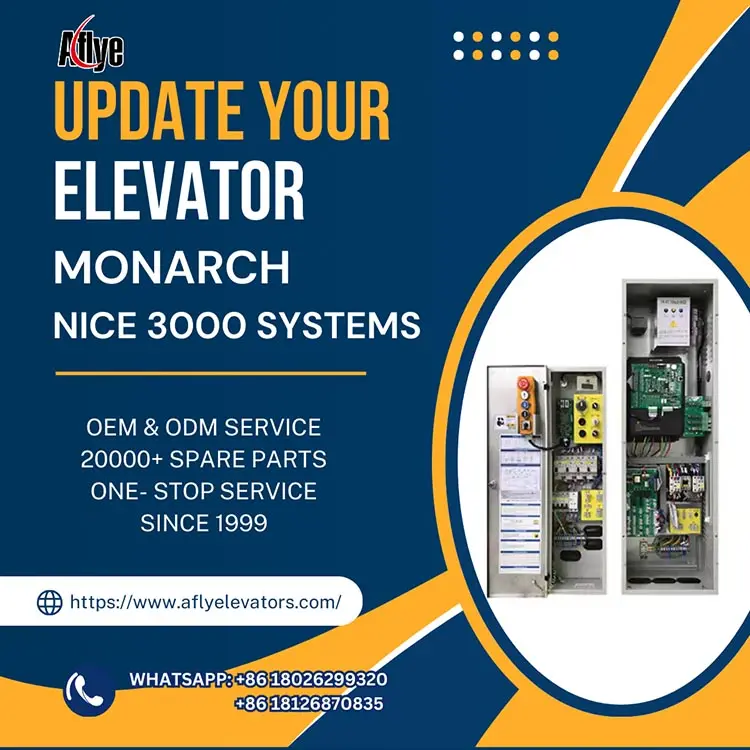
Worldwide, the Monarch NICE 3000 series elevator control system is widely used in residential buildings, commercial properties, and modernization projects due to its high stability and strong compatibility. However, after long-term operation, any control system may experience alarms, shutdowns, or abnormal performance.
As a long-term supplier serving the global elevator and escalator spare parts market, A-FLY has observed in numerous maintenance and replacement projects that most issues with the NICE 3000 series are not caused by system design problems, but rather by aging components, abnormal signals, or changes in operating conditions.
1. Common Operating Problems in the NICE 3000 Series
In field maintenance work, common issues typically include:
Noticeable vibration during elevator startup or braking
Unstable speed during operation
Reduced leveling accuracy or floor misalignment
Alarm messages on the control cabinet or display panel
Intermittent elevator shutdowns that temporarily recover after reset
These symptoms are often not caused by a single fault, but by imbalances between multiple subsystems.
2. Encoder-Related Faults and Solutions
In the NICE 3000 system, encoder signal stability has a major impact on ride quality. Common issues include:
Encoder aging causing unstable feedback signals
Reduced shielding performance of encoder cables
Loose connectors or poor electrical contact
A practical solution is to first inspect and replace compatible encoders and related signal components, then recheck parameter settings. This approach often significantly improves vibration and leveling issues.
3. Chain Reactions Caused by Brake System Abnormalities
Many faults mistakenly considered “drive system problems” actually originate from brake system abnormalities, such as:
Incomplete brake release increasing startup load
Changes in brake clearance causing system misjudgment
Aging brake coils reducing response speed
Therefore, when troubleshooting NICE 3000 faults, it is advisable to inspect the elevator brake, brake coil, and related components, rather than focusing only on the control board.
4. Power Supply and Cooling Issues Should Not Be Ignored
In high-temperature or dusty environments, NICE 3000 systems often experience:
Drive over-temperature alarms
System restarts due to unstable power supply
Aging cooling fans reducing heat dissipation efficiency
Typical solutions include cleaning the control cabinet environment and replacing cooling fans or power modules, which can effectively reduce alarm frequency.
5. Safety Circuit and Door System-Related Faults
The door system is a high-frequency source of alarms in NICE 3000 systems. Common problems include:
Aging door lock contacts
Poor door operator performance
False triggering of the light curtain
These issues directly affect the safety circuit status and may prevent the elevator from operating. Replacing key components such as door lock contacts or light curtains can often restore system stability quickly.
6. “False Faults” Caused by Parameter and Mechanical System Mismatch
During modernization projects or component replacement, if parameters are not adjusted accordingly, the system may show:
Unsmooth acceleration or deceleration
Incorrect load detection by the controller
Frequent alarms despite normal hardware conditions
Therefore, troubleshooting NICE 3000 systems requires integrated evaluation of the traction machine, brake system, guide shoes, and other mechanical components.
7. Correct Troubleshooting Logic
In practical maintenance work, a more efficient troubleshooting process is:
Confirm that the mechanical system operates smoothly
Inspect peripheral elevator components
Finally evaluate the main control board or drive unit
This outside-to-inside diagnostic approach significantly reduces misjudgments and unnecessary replacement costs.
8. Spare Parts Support from A-FLY
As a professional elevator and escalator spare parts supplier, A-FLY can provide comprehensive support for Monarch NICE 3000 projects, including:
Encoders and feedback components
Brake systems and electrical brake components
Door system and safety circuit parts
Replacement solutions suitable for elevator modernization projects
These solutions help maintenance teams resolve faults efficiently without replacing the entire system.
Conclusion
Most faults in the Monarch NICE 3000 elevator system are not caused by the control system itself but by aging components and changing operating conditions.
Through systematic troubleshooting, proper replacement of key components, and cooperation with an experienced supplier like A-FLY, elevator operators can restore system stability while significantly reducing long-term maintenance costs.
In elevator maintenance and modernization projects, understanding system logic is far more important than blindly replacing equipment.