
What’s the Difference Between an Elevator Car Door and a Landing Door?
In an elevator system, the doors are among the most critical components directly tied to passenger safety. When riding an elevator, you’ll notice two doors — one attached to the car and another at each landing. Although both are commonly referred to as “elevator doors,” they differ completely in structure, function, and installation.
Here’s a detailed explanation from A-FLY, your professional elevator and escalator parts supplier.
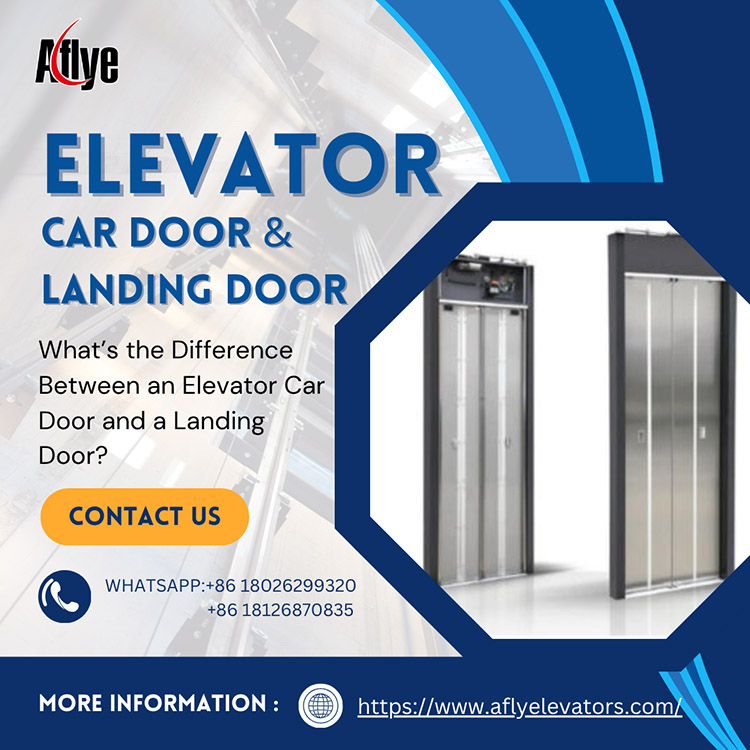
1. What Is an Elevator Car Door?
The car door is installed at the entrance of the elevator car and is part of the elevator itself.
Its main purpose is to seal the car entrance during operation to protect passengers.
It’s driven by the door operator system, which includes the elevator motor, hanger rollers, guide rails, control board, and light curtain sensors.
When the control system sends an open/close signal, the motor activates, moving the panels smoothly via the transmission mechanism.
A-FLY Tip:
Since car doors operate frequently, choosing high-quality door operators, hanger rollers, and light curtains is crucial to minimize wear, reduce noise, and extend service life.
2. What Is an Elevator Landing Door?
The landing door is installed at the entrance of each floor and belongs to the building structure, not the elevator car.
Its purpose is to prevent passengers from entering the shaft when the elevator is not present.
When the elevator reaches the designated floor and stops, the landing door is mechanically linked to the car door to open simultaneously.
During elevator movement, it remains locked to prevent accidental openings and ensure safety.
A-FLY Tip:
Common landing door components include elevator door locks, landing rollers, guide shoes, and door vanes.
A-FLY offers a wide range of compatible models suitable for both new installations and modernization projects.
3. Key Differences Between Car Door and Landing Door
Installation Position:
Car doors are mounted on the elevator car; landing doors are installed at each floor entrance.
Ownership:
Car doors are part of the elevator equipment; landing doors are part of the building.
Drive Mechanism:
Car doors are powered by the door operator, while landing doors open synchronously via mechanical linkage.
Safety Function:
Car doors protect passengers during operation; landing doors prevent people from falling into the shaft.
Though separate, both doors work together through a coordinated linkage system to ensure smooth, safe, and synchronized operation.
4. How to Ensure Stable Elevator Door Operation
To keep both car and landing doors functioning properly, regular maintenance and high-quality components are essential:
Clean door tracks and rollers regularly to prevent debris buildup.
Inspect the control board and sensors for signal stability.
Replace worn-out parts such as hanger rollers, door locks, and guide shoes promptly.
Test the light curtain sensitivity to maintain reliable anti-pinch protection.
A-FLY provides a full range of elevator door components covering both car and landing doors, all compatible with major brands and strictly quality-tested for smooth, quiet, and safe performance.
5. Conclusion: A-FLY — Making Elevator Door Systems Safer and More Reliable
Whether it’s the car door or landing door, both are the first line of safety defense in any elevator system.
With precise design and premium-quality components, elevators can achieve silent, stable, and secure door operation.
With over a decade of expertise, A-FLY specializes in elevator and escalator parts, offering durable door systems, rollers, operators, locks, and more.
We provide one-stop solutions for global maintenance and modernization projects.
Choose A-FLY — where safety meets quality.