
Why Do Elevator Door Operator Rollers Wear Out So Fast?
In routine elevator maintenance, elevator door operator rollers are among the most frequently replaced elevator spare parts. Many maintenance teams notice that while the overall door operator system remains relatively stable, the rollers tend to wear out prematurely or even fail repeatedly. So why are door rollers so “prone to damage”? Is frequent replacement really unavoidable?
As an experienced elevator and escalator spare parts supplier, A-FLY has summarized several key reasons based on real project experience.
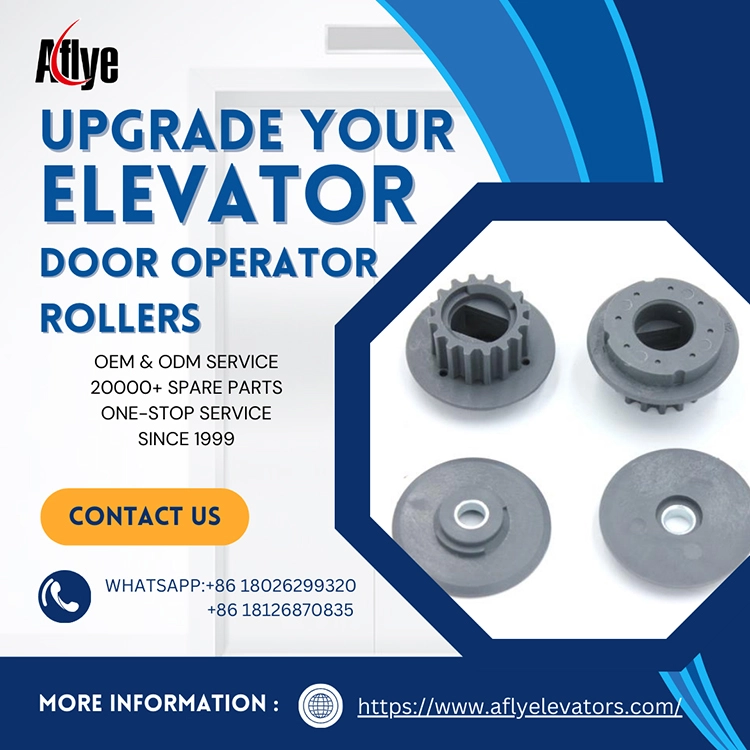
1. Main Reasons Why Elevator Door Rollers Wear Out Quickly
High-frequency door operation is the primary factor. In places such as shopping malls, office buildings, and hospitals, elevators open and close doors countless times every day. Rollers continuously endure repetitive rolling friction and impact loads, which naturally accelerates wear.
Track or structural misalignment is another major cause. Uneven tracks, unbalanced door panels, or incorrect installation angles can result in uneven force distribution on the rollers, leading to severe one-sided or localized wear.
Poor material and bearing quality also play a significant role. Low-quality rollers often lack sufficient wear resistance, aging resistance, and bearing stability. Problems such as jamming and abnormal noise can appear in a short period of time.
In addition, dust and oil contamination entering the roller bearings can significantly shorten their service life.
2. How Often Should Elevator Door Rollers Be Replaced?
Under normal residential or low-frequency usage conditions, high-quality door operator rollers typically last 1.5 to 3 years. However, in high-traffic public environments, if the selection is inappropriate or conditions are harsh, replacement may be required in as little as 6 months to 1 year.
Replacement is recommended when the following signs appear:
Noticeable abnormal noise or vibration during door opening and closing
Door panels move unsmoothly or at inconsistent speeds
Visible flattening, cracks, or deformation on the roller surface
Door performance cannot be improved even after repeated parameter adjustments
3. How to Select the Right Rollers to Extend Service Life
When selecting elevator door operator rollers, size compatibility alone is not enough. The following factors should also be considered:
Whether the roller material offers high wear resistance and low noise performance
Whether the internal bearings are stable and properly sealed
Whether the roller matches the specific door operator system and application scenario
Whether the product comes from a reliable elevator spare parts supplier with stable long-term supply
High-quality rollers not only reduce replacement frequency but also decrease the overall load on the door operator system.
4. A-FLY — Providing More Reliable Roller Solutions for Door Operator Systems
As a professional elevator and escalator spare parts supplier, A-FLY provides elevator door operator rollers in various specifications and materials, balancing wear resistance, quiet performance, and installation compatibility. Our products are widely used in different elevator brands and operating conditions, helping customers truly achieve fewer replacements, fewer failures, and more stable operation.