
Signs of Escalator Step Roller Damage and Replacement Cycle
In an escalator operating system, step rollers are critical components that support each step and ensure smooth movement along the guide tracks. These rollers operate at extremely high frequency, bearing continuous pressure and friction almost every second, which makes them typical wear-and-tear parts.
Once step rollers begin to age or fail, they not only affect ride smoothness but may also introduce serious safety risks.
As a professional elevator and escalator parts supplier, A-FLY explains the common signs of step roller damage and the recommended replacement cycle to help maintenance teams make accurate judgments.
1. Common Signs of Escalator Step Roller Damage
Step roller failure usually develops gradually rather than suddenly. The following symptoms are clear indicators that replacement may be required:
Abnormal operating noise
When the internal bearing is worn or lubrication fails, continuous clicking or friction noises can be heard during operation. If the noise increases with speed, it usually means the roller has lost proper rolling performance.
Step vibration or unstable operation
Damaged rollers cannot rotate smoothly, causing uneven movement between the step and the chain. Passengers may feel slight shaking, which is a typical sign of uneven wear or cracking.
Flattened or cracked roller surface
Long-term heavy loads can cause the roller surface material to wear down or fracture. If not replaced in time, uneven load distribution may lead to more serious structural damage.
Abnormal step chain elongation
When roller resistance increases, the chain bears additional stress, accelerating chain wear. If chain tension needs frequent adjustment, the condition of the rollers should be checked first.
2. Why Do Escalator Step Rollers Fail?
Step rollers operate under high load and continuous motion. Damage is commonly caused by mechanical fatigue, environmental conditions, or insufficient maintenance, including:
Long-term heavy load operation causing bearing fatigue
Dust and sand entering the roller and affecting rotation
Insufficient lubrication leading to overheating and material aging
Misalignment of the step chain causing uneven roller wear
High passenger flow in public areas exceeding design limits
Regular inspection and timely replacement are essential to ensure long-term stable escalator operation.
3. Recommended Replacement Cycle for Step Rollers
Roller lifespan varies depending on brand and operating conditions, but industry experience generally recommends:
Shopping malls and office buildings: inspection every 18–24 months, replacement based on wear condition
Airports, metro stations, and high-traffic environments: detailed inspection every 12–18 months
Immediate replacement if obvious noise, cracking, or uneven wear is detected
Service life depends not only on material quality but also on installation accuracy, chain tension, and environmental factors such as humidity.
4. A-FLY Step Roller Solutions
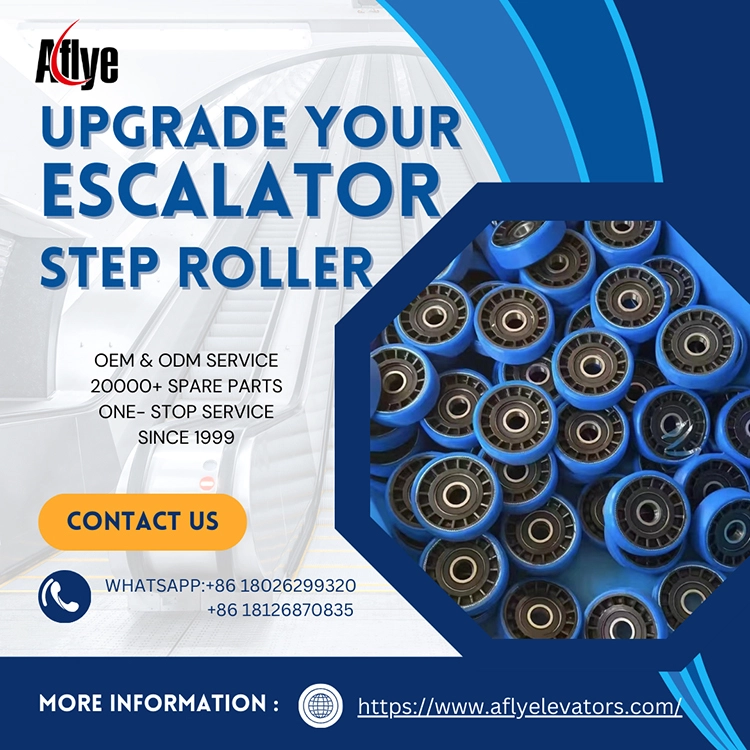
As a professional elevator and escalator parts supplier, A-FLY provides high-quality escalator step rollers compatible with major global brands. Common sizes include D70, D75, D76, and D80, widely used in maintenance and modernization projects.
A-FLY step rollers feature:
High-wear-resistant polyurethane coating
Reinforced steel core structure
Heavy-duty bearing design
Low noise operation
Strong impact resistance
Long service life and precise installation fit
They are ideal for escalator maintenance, modernization, and bulk engineering procurement.
5. Conclusion: Small Rollers, Big Impact
Step roller damage is one of the most common escalator issues. However, with timely inspection and replacement, vibration, chain damage, and potential safety accidents can be effectively avoided.
Choose A-FLY to ensure smoother, safer, and more durable escalator operation.