
Main Causes of Elevator Light Curtain Failure and Selection Tips
The elevator light curtain is one of the most important modern safety anti-clamping devices. It provides real-time detection when passengers enter and exit the cabin, preventing pinching accidents. However, after long-term use, it is not uncommon for the light curtain to fail. Once a light curtain malfunctions, the elevator door system may become unsafe or even unable to operate properly. Therefore, understanding the causes of light curtain failure and how to choose a high-quality model is crucial for maintenance companies and property management.
As a professional elevator & escalator parts supplier, A-FLY has summarized the following key points based on numerous maintenance cases.
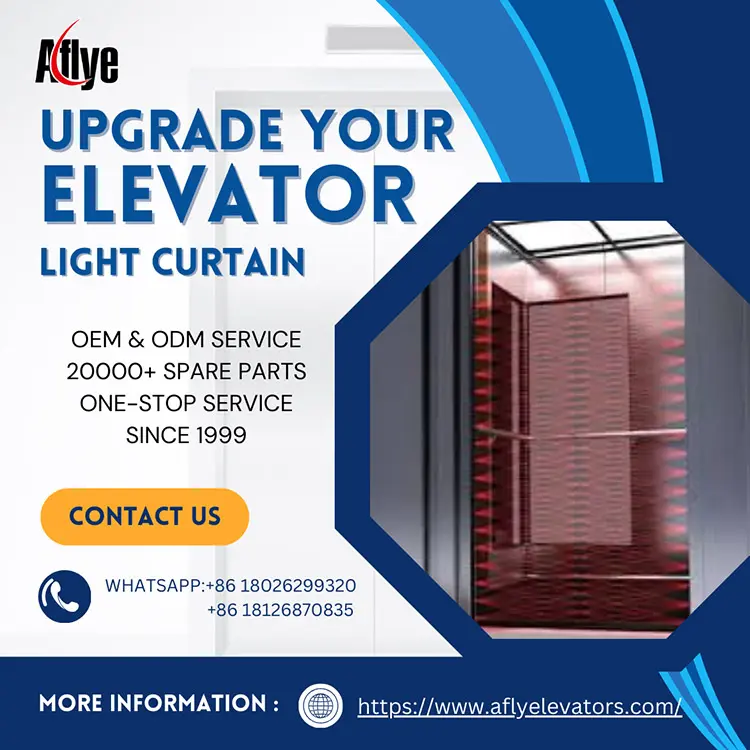
I. Main Causes of Elevator Light Curtain Failure
1. Dust and moisture blocking the sensors
The light curtain consists of multiple pairs of sensors (emitter + receiver). When dust, oil, or moisture covers the sensor surface, it weakens or completely blocks the light signal, causing misjudgment or failure. This is especially common in crowded environments such as shopping malls and metro stations.
2. Internal circuit aging
Over time, the internal circuit board, capacitors, resistors, and other components will age, leading to reduced sensitivity, delayed response, or intermittent failure. Light curtains used for more than five years are particularly prone to aging issues.
3. Door system vibration causing misalignment
Frequent door opening and closing produces vibration, which gradually loosens the light curtain base and shifts the angle. Even slight misalignment can cause detection errors and compromise safety.
4. Power interference or voltage fluctuation
Most light curtains use DC12V or DC24V power supply. If the power module deteriorates or the voltage becomes unstable, the light curtain may fail to start or frequently trigger alarms. Many on-site intermittent malfunctions are related to voltage issues.
5. Incompatibility between the light curtain and the door operator
Different elevator door operators require different signal types. If the light curtain output is incompatible with the door operator, it may not be recognized or may respond slowly.
II. Tips for Selecting a High-Quality Elevator Light Curtain
1. Choose a high-density model with ≥94 light beams
The more light beams, the more accurate the detection — especially for small objects such as children, luggage, and pets. Common models include 94-beam, 154-beam, and 174-beam light curtains.
A 94-beam model is sufficient for most commercial and residential elevators, while 154 or 174 beams may be used in special environments.
2. Select a higher dust- and water-resistance rating
Choose light curtains rated IP54 or above to reduce the impact of dust and moisture and extend service life.
3. Prioritize anti-interference designs
A good light curtain should resist LED lighting interference, ambient light interference, and electromagnetic interference, ensuring consistent detection performance.
4. Confirm compatibility with the elevator door operator brand
Ensure the signal type matches the control system requirements of the door operator.
5. Pay attention to the mechanical mounting structure
The base must be firm, shock-resistant, and impact-resistant. A loose structure will cause optical deviation.
Models with reinforced aluminum housings and anti-vibration design offer better stability.
III. A-FLY Provides Professional Elevator Light Curtain Solutions
With years of industry experience, A-FLY offers elevator light curtains with the following advantages:
Ultra-high-density optical sensors with enhanced sensitivity
Supports both DC12V and DC24V
Compatible with multiple elevator door operator brands
Dust-proof, moisture-proof, and anti-interference
Reinforced anti-vibration structure suitable for various environments
Global supply with OEM/ODM support
We also provide complete elevator door system components, including:
door operators, elevator door locks, door ropes, door hanger rollers, door sliders, and more — offering one-stop solutions for maintenance companies and engineering contractors.
IV. Conclusion: Choosing the Right Light Curtain Means Choosing Safety
Light curtain failures usually result from dust, aging, voltage issues, or structural misalignment. By selecting a high-quality light curtain and performing regular maintenance, the safety of the elevator door system can be significantly improved.
Choose A-FLY to make your elevator’s light curtain more stable, responsive, and durable.
A-FLY — global elevator & escalator parts supplier, providing professional elevator safety upgrade solutions.