
Causes of Noise in Elevator Guide Shoe Rollers & Replacement Tips
During daily elevator operation, when passengers clearly hear squeaking sounds, friction noise, or intermittent abnormal noises, the issue is often not caused by the traction machine or guide rails themselves, but by elevator car guide shoe rollers. Although guide shoe rollers are wear parts, they play a critical role in elevator smoothness, ride comfort, and long-term operational safety.
As a professional elevator and escalator parts supplier, A-FLY has observed across global maintenance and modernization projects that abnormal noise from guide shoe rollers is often an early warning sign of elevator system issues.
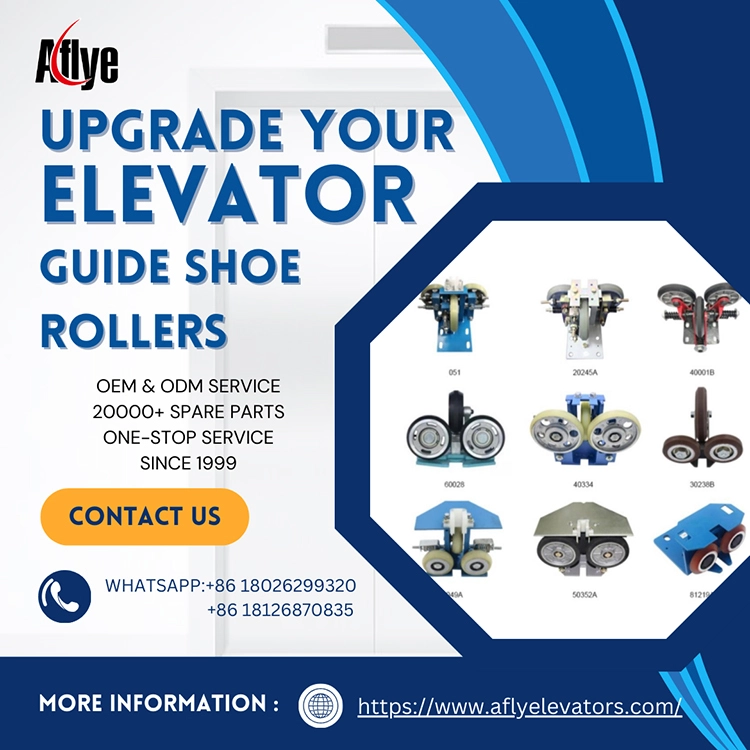
1. Common Causes of Abnormal Noise in Elevator Guide Shoe Rollers
1. Roller surface wear or aging
Guide shoe rollers operate in continuous contact with the guide rails. When the roller material becomes worn or aged, load distribution becomes uneven, resulting in continuous friction noise. This is especially common in old elevators or high-traffic applications.
2. Bearing damage or lubrication failure
If the internal bearing suffers from insufficient lubrication, corrosion, or fatigue damage, the roller may produce noticeable noise during operation, often accompanied by slight vibration. If not addressed promptly, this can further damage the guide rails.
3. Uneven or contaminated guide rail surfaces
Burrs, rust, oil contamination, or dust on the guide rail surface can disrupt smooth roller movement and increase friction noise. In such cases, simply replacing the roller may not fully eliminate the noise unless the guide rail condition is also addressed.
4. Improper installation clearance or uneven wear
Incorrect installation angles or uneven pressure adjustment can cause one-sided loading on the roller, leading to uneven wear and intermittent abnormal noise.
2. Risks Associated with Ignoring Guide Shoe Roller Noise
If guide shoe roller issues are overlooked, they may lead to a series of problems:
Increased vibration and reduced ride comfort
Accelerated guide rail wear, raising long-term maintenance costs
Roller jamming, affecting car stability
Persistent noise causing passenger safety concerns and negatively impacting building image
Therefore, abnormal guide shoe roller noise is not just a “noise issue,” but a warning sign of potential safety and cost risks.
3. Key Points for Replacing Guide Shoe Rollers
1. Choose wear-resistant, low-noise materials
High-quality guide shoe rollers are typically made from wear-resistant nylon or polyurethane (PU), which effectively reduce noise while protecting the guide rails.
A-FLY guide shoe rollers use high-density wear-resistant materials and are suitable for high-speed and high-frequency elevator operation.
2. Pay attention to bearing quality
The bearing is the core component affecting roller lifespan and noise performance. Select rollers with well-sealed, fatigue-resistant bearings to prevent recurring noise issues.
3. Ensure correct size and installation compatibility
When replacing rollers, confirm that the outer diameter, width, and shaft bore match the original specifications to ensure proper contact with the guide rail and avoid secondary uneven wear.
4. Replace in pairs and inspect related components
During maintenance or modernization, it is recommended to replace guide shoe rollers on both sides simultaneously and inspect the guide rail condition to ensure consistent and stable operation.
4. A-FLY — Your Reliable Elevator Guide Shoe Roller Supplier
As an experienced elevator and escalator parts supplier, A-FLY provides global customers with:
Elevator guide shoe rollers / guide rollers
Traction sheaves, deflector sheaves, and guide wheels
Elevator door system components
Various elevator wear parts and modernization solutions
A-FLY guide shoe rollers are known for low noise, high wear resistance, and stable performance. They are compatible with many major elevator brands and are widely used in residential buildings, commercial properties, and elevator modernization projects.
Conclusion
Abnormal noise from elevator car guide shoe rollers is not a minor issue—it is an important indicator of elevator operating condition. Identifying the cause early and replacing the rollers correctly can restore quiet, smooth operation and significantly extend the service life of the entire elevator system.
Choose A-FLY to make every elevator run quieter, smoother, and more reliable.