
How to Assess Wear of Elevator Guide Shoes and Guide Shoe Liners
In an elevator operating system, elevator guide shoes and guide shoe liners are critical components that ensure smooth movement of the car and counterweight along the guide rails. Although they do not directly participate in the driving process, abnormal wear can easily lead to noise, vibration, and even safety risks for passengers.
So how can you determine whether the guide shoes and liners have worn to the point where replacement is necessary?
Below, A-FLY, a professional elevator and escalator parts supplier, shares practical evaluation methods based on real maintenance experience.
1. The Function of Elevator Guide Shoes and Guide Shoe Liners
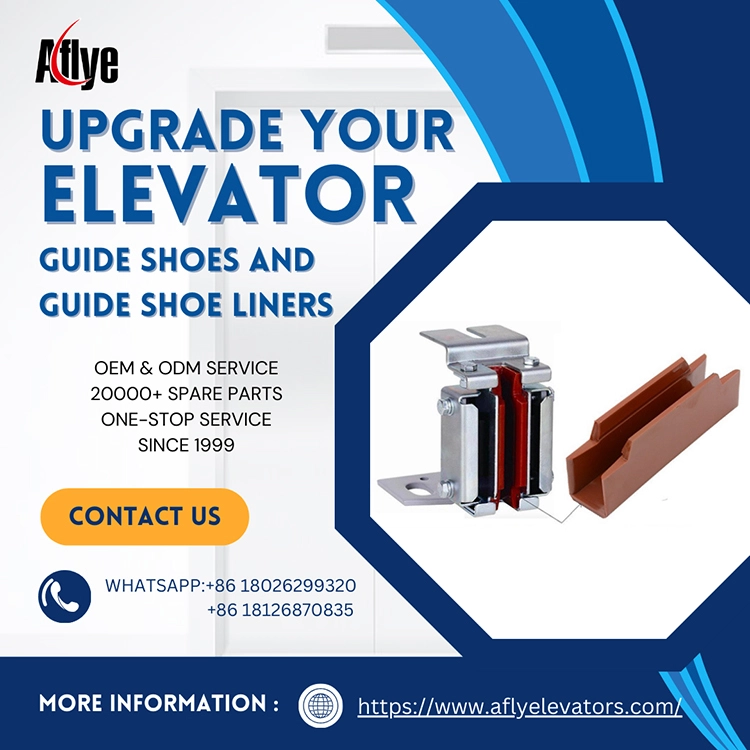
Elevator guide shoes are installed on the car frame and counterweight frame to guide vertical movement along the rails. Guide shoe liners, typically made of nylon, polyurethane, or composite materials, serve to:
Reduce direct metal-to-metal contact
Minimize operating noise and vibration
Protect the guide rail surface and extend its service life
For this reason, guide shoes and liners are typical wear parts and require regular inspection.
2. Common Signs of Wear in Guide Shoes and Liners
During daily operation or maintenance, the following symptoms often indicate wear:
1. Continuous abnormal noise during operation
When the liner becomes excessively worn and its cushioning effect decreases, squeaking or friction noise may occur, especially during elevator startup and braking.
2. Slight car vibration or swaying
Uneven wear of guide shoes can cause improper contact with the guide rails, resulting in minor lateral movement and reduced ride comfort.
3. Noticeable reduction in liner thickness
During inspection, visual checks or measurements may reveal that the liner thickness is close to its design limit, indicating the need for replacement.
4. Abnormal wear marks on the guide rails
If the liner fails, metal parts of the guide shoe may contact the guide rail directly, causing scratches or localized rail wear.
3. How to Scientifically Determine When Replacement Is Needed
Replacement decisions should be based on a comprehensive evaluation, including:
Service life: Key inspection is recommended after 1–2 years of operation
Wear uniformity: Severe one-sided or localized wear requires immediate action
Noise and vibration changes: Noticeable deterioration compared with initial operation
Guide rail condition: Presence of abnormal wear patterns
For high-speed or high-traffic elevators, inspection and replacement intervals should be shortened accordingly.
4. The Importance of Choosing High-Quality Guide Shoes and Liners
High-quality guide shoes and liners not only reduce wear but also significantly improve elevator stability and noise performance.
A-FLY elevator guide shoes and liners are manufactured using wear-resistant nylon, polyurethane, or composite materials, offering:
Stable friction coefficients for smoother operation
Excellent wear resistance and longer service life
High compatibility with mainstream guide rail systems
Suitability for residential, commercial, and modernization projects
5. A-FLY — Your Reliable Elevator Guide Shoe Parts Supplier
As a professional elevator and escalator parts supplier, A-FLY provides global customers with:
Elevator guide shoes and guide shoe liners
Guide rollers and traction sheaves
Elevator door system components
Various elevator safety and mechanical parts
A-FLY products are widely used across different elevator brands and models, with support for customization and fast global delivery.
Conclusion
Although small in size, elevator guide shoes and liners directly affect operational smoothness and passenger safety. By accurately assessing wear conditions and replacing components in a timely manner, elevator failures can be reduced and overall service life extended.
Choose A-FLY to ensure smoother, quieter, and more reliable elevator operation every time.