
Why Does Escalator Friction Wheel Wear Cause Abnormal Handrail Speed?
In an escalator system, the escalator friction wheel is one of the core components of the handrail drive system. It uses friction force to drive the escalator handrail and ensures that the handrail speed remains synchronized with the step speed. When the friction wheel becomes worn, aged, or hardened, the transmission efficiency will decrease significantly, eventually causing abnormal handrail speed and affecting safe escalator operation.
Therefore, during escalator maintenance, the friction wheel should be considered as one of the key wear parts requiring regular inspection.
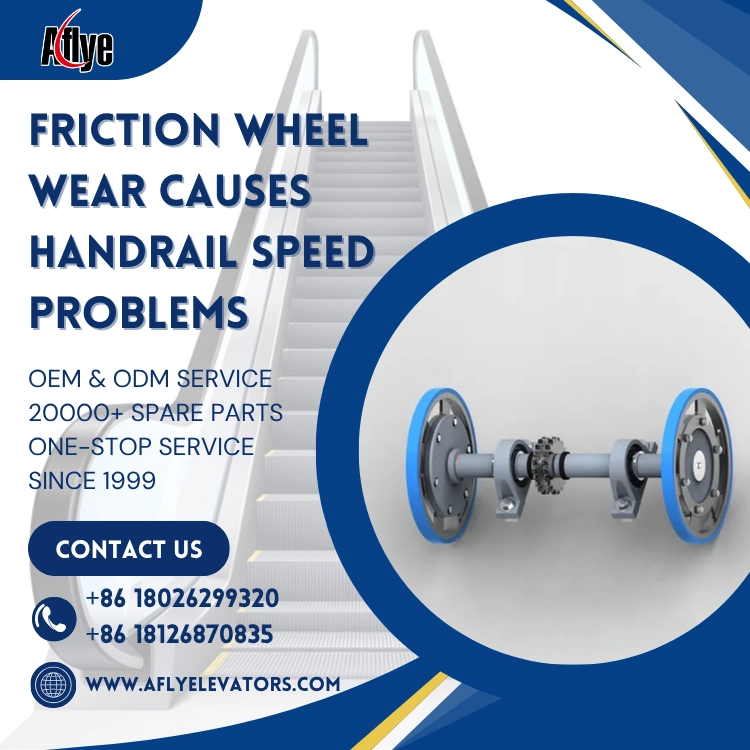
1. Friction Wheel Wear Causes Transmission Slippage
The escalator friction wheel relies on the friction force of its rubber surface to drive the handrail. After long-term operation, the wheel surface may become worn, hardened, flattened, or cracked, resulting in reduced friction performance.Common symptoms include:
Slower handrail speed
Temporary handrail slipping during startup
Obvious speed fluctuation under heavy load
Handrail and step speed mismatch
Solution:Check the wear condition and rubber hardness of the friction wheel surface. If the wear exceeds the allowable limit, the escalator friction wheel should be replaced in time.
2. Reduced Wheel Diameter Affects Handrail Speed
After long-term wear, the outer diameter of the friction wheel gradually decreases, reducing the linear speed output during operation.
Although the drive motor speed remains unchanged, the reduced effective diameter causes the handrail speed to become lower than the step speed, resulting in synchronization problems.
Maintenance personnel can use a speed measuring device to check the speed difference between the handrail and steps. If the deviation exceeds the standard value, the friction wheel size and wear condition should be carefully inspected.
3. Hardened Friction Wheel Reduces Driving Force
High temperatures, ultraviolet exposure, oil contamination, and long-term operation can accelerate rubber aging. Even if there is no obvious surface damage, a hardened friction wheel may still cause:
Handrail slipping
Unstable speed during acceleration
Increased failures in humid or rainy environments
Sharp friction noise during operation
Therefore, judging the condition of a friction wheel only by appearance is not reliable. Its elasticity and surface hardness should also be checked.
4. Insufficient Tension Can Worsen Speed Problems
Even if the friction wheel itself is in good condition, insufficient handrail tension can reduce transmission efficiency.
The following components should also be inspected:
Handrail tension device
Pressure roller assembly
Guide rollers
Drive shaft bearings
Handrail wear condition
Only when the entire handrail drive system works properly together can stable operation be ensured.
5. Escalator Friction Wheel Purchasing Recommendations
When purchasing an escalator friction wheel, the following parameters should be confirmed:
Outer diameter and width
Rubber material
Hardness grade
Shaft hole size
Bearing specification
Compatible escalator brand and model
It is recommended to match the product according to the original model, sample, or detailed dimensions to avoid abnormal handrail speed caused by incorrect specifications.
A-FLY Elevator & Escalator Parts Supply Capability
As a professional elevator and escalator spare parts supplier, A-FLY provides global maintenance companies, engineering contractors, and spare parts distributors with a complete range of escalator components, including:
Guide rollers
Pressure rollers
Handrail drive assemblies
Other elevator and escalator spare parts
A-FLY supports:
OEM/ODM customization
Sample matching
Drawing confirmation
Fast delivery
Based on customers’ equipment models and technical requirements, A-FLY provides professional matching solutions to reduce purchasing risks and improve maintenance efficiency.
Conclusion
Although the escalator friction wheel is only one component of the handrail drive system, it directly determines whether the handrail speed remains stable. When abnormal handrail speed, slipping, or synchronization problems occur, maintenance personnel should first check friction wheel wear, diameter changes, rubber aging, and tension system conditions.
Through proper preventive maintenance and the use of high-quality elevator and escalator spare parts, escalator safety, reliability, and service life can be effectively improved.