
Elevator Steel Belt vs. Wire Rope: Which Lasts Longer?
In modern elevator systems, the traction system is a core component that determines operational safety and stability, and the choice of traction medium is especially critical. Currently, there are two main solutions on the market: traditional elevator wire ropes and elevator traction steel belts.
So, in real-world applications, which one is more durable? And how should you choose the right solution based on project requirements?
As a professional elevator and escalator parts supplier, A-FLY provides an in-depth analysis from the perspectives of structure, service life, and maintenance.
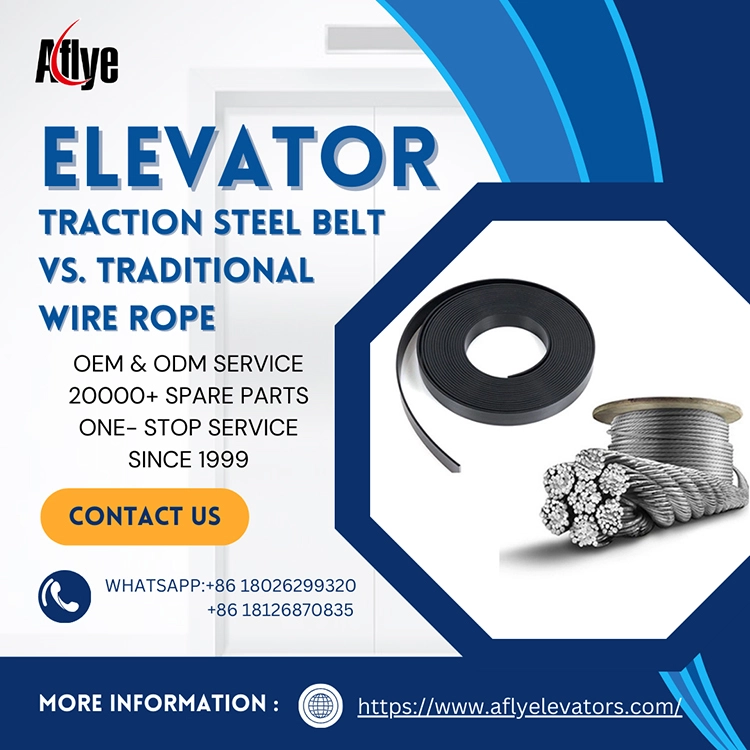
1. Characteristics of Traditional Elevator Wire Ropes
Traditional elevator wire ropes are made of multiple strands of high-strength steel wires twisted together and have long been widely used in residential, commercial, and freight elevators.
Their main advantages include:
Mature technology with a long history of application
High tensile strength, suitable for heavy-load conditions
Strong adaptability, compatible with almost all traction sheave systems
Relatively controllable cost and easy replacement
However, during long-term operation, wire ropes inevitably experience fatigue wear, broken strands, and reduced service life due to insufficient lubrication. In high-frequency or high-speed elevator applications, the replacement cycle of wire ropes is relatively short.
2. Structural Advantages of Elevator Traction Steel Belts
Elevator traction steel belts are a new-generation traction medium, typically consisting of multiple high-strength steel cords embedded in polyurethane or composite materials to form a flat structure. Compared with traditional wire ropes, steel belts offer clear structural advantages:
Larger contact area with the traction sheave, providing more uniform friction
Quieter operation with lower vibration and noise
No need for frequent lubrication, simplifying maintenance
More evenly distributed stress on steel cords, offering stronger fatigue resistance
As a result, traction steel belts are increasingly used in mid- to high-speed elevators, high-end residential buildings, office towers, and projects with high comfort requirements.
3. Which One Is More Durable?
If durability is evaluated solely based on the ability to withstand heavy loads, traditional wire ropes still have an advantage, especially in heavy-duty or harsh operating conditions. However, from a comprehensive perspective of long-term durability and operational stability, traction steel belts perform better in the following aspects:
Longer fatigue life with a reduced risk of wire breakage
More uniform wear, less prone to localized damage
Lower wear on traction sheaves, extending the lifespan of the entire system
Better suitability for high-frequency starts and high-speed operation
With proper installation and correct selection, the overall service life of traction steel belts is often equal to or even longer than that of traditional wire ropes.
4. How to Make the Right Choice?
There is no absolute answer when choosing between wire ropes and traction steel belts—the key lies in project requirements:
Standard residential elevators or modernization projects: traditional wire ropes are more economical and practical
Mid- to high-speed elevators with high comfort requirements: traction steel belts offer clear advantages
Space-limited or low-headroom designs: traction steel belts make compact structures easier to achieve
As an experienced elevator parts supplier, A-FLY recommends the most suitable traction solution based on elevator speed, load capacity, traction sheave specifications, and operating environment.
5. A-FLY — Your Trusted Traction System Parts Supplier
A-FLY has long focused on supplying core elevator and escalator components, including:
Traction sheaves and guide sheaves
Permanent magnet synchronous traction machines
Elevator door systems and control components
All products are manufactured in strict accordance with industry standards, compatible with multiple elevator brands, and widely applied in global markets—helping customers achieve the best balance between safety, durability, and cost.
Conclusion
Whether using traditional wire ropes or next-generation traction steel belts, durability depends not only on the material itself but also on correct selection and professional system matching. Choosing reliable components and a trustworthy supplier is the key to long-term stable elevator operation.
Choose A-FLY to make every traction more reliable and every ride safer.