
Does the Material of an Elevator Landing Sill Affect the Lifespan of the Landing Door?
In the elevator landing door system, the elevator landing sill may look insignificant, but it is actually a key component that endures heavy friction and long-term mechanical force. Many elevator maintenance technicians and building owners often ask: “Does the material of the landing sill affect the lifespan of the elevator landing door?”
The answer is: Yes — and the impact is significant.
The technical team from A-FLY Elevator & Escalator Parts Supplier will provide an in-depth explanation from the perspectives of material type, durability, and wear characteristics.
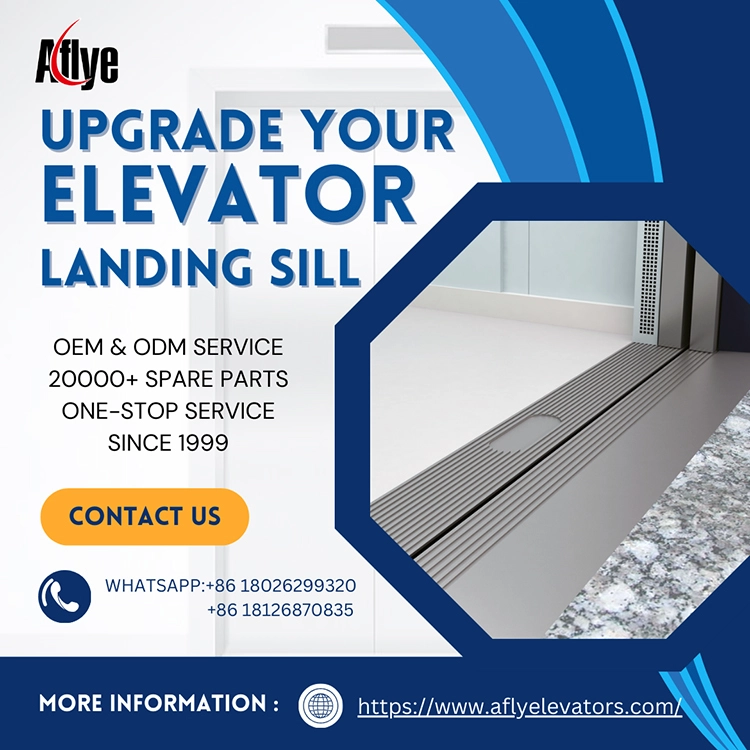
1. The Material of the Landing Sill Directly Affects Its Lifespan
The landing sill is an important part of the elevator door system, mainly enduring:
Sliding friction when the door panels open and close
Long-term rolling of the door guide wheels
Environmental factors such as dust, sand, and moisture
Passenger traffic and external impact
Why material matters:
The stronger and more wear-resistant the material is, the longer the landing door system will last; the weaker the material, the faster the wear.
2. Common Landing Sill Materials and Their Lifespan Differences
1. Aluminum Alloy Landing Sill
This is the most commonly used material. It is lightweight and moderately priced, but aluminum has only medium hardness and wears faster in high-traffic environments.
Suitable for: Residential buildings, small office buildings
Lifespan performance: Moderate; requires regular wear inspection
2. Stainless Steel Landing Sill
Stainless steel has high strength, excellent wear resistance, and strong corrosion resistance. It is widely used in modern buildings.
Advantages:
Remains flat after long-term use
Suitable for high-frequency operation
Not easy to rust or deform
Suitable for: Shopping malls, subway stations, hotels, hospitals, high-end residences
Lifespan performance: Excellent; significantly extends the sliding system lifespan
Extremely hard and highly wear-resistant but heavy and difficult to process. Mostly found in older elevators or industrial environments.
Lifespan performance: High strength but prone to rust; requires extra protection
4. High-Strength Alloy Steel Landing Sill
Increasingly used in high-end elevators due to its superior comprehensive performance.
Features:
Strongest wear resistance
High load capacity
Stable even under long-term high-frequency operation
Suitable for: High-rise commercial buildings, heavy-duty elevators
Lifespan performance: Top-tier durability; greatly reduces maintenance frequency
3. How Different Materials Affect the Landing Door System Lifespan
Affects the wear rate of the guide wheels
If the sill is too soft → deeper wheel indentation → faster wheel wear
If the sill is too hard but not wear-resistant → scratching occurs → door movement becomes rough
Affects the smoothness of door movement
Uneven wear on the landing sill may cause:
Door shaking
Door jamming
Door misalignment
Severe cases may prevent the landing door from closing properly.
Affects the load on the door operator
Higher friction → heavier load on the operator → shortened operator lifespan
Stable sill material → smoother operation → lower mechanical load
Affects safety
Severe sill wear can cause larger door gaps or catch foreign objects.
Poor maintenance may lead to safety hazards.
4. A-FLY Provides High-Quality Landing Sills and Door System Parts
As a professional elevator & escalator parts supplier, A-FLY offers durable landing door components, including:
High-strength alloy steel landing sills
Elevator door operator system parts
Door locks, door sliders, door ropes, and other full door system parts
All A-FLY products undergo wear tests and material quality inspections and are compatible with major elevator brands.
5. Conclusion: Different Materials = Huge Lifespan Differences
The material of the landing sill directly determines the lifespan and stability of the landing door system. Choosing a more wear-resistant and stable material not only reduces maintenance costs but also extends the overall lifecycle of the door system.Choose A-FLY to make your elevator door system more durable, safer, and more stable.