
Common Faults of PMSM Traction Machines
With the development of energy-saving and intelligent elevator technologies, Permanent Magnet Synchronous Traction Machines (PMSM) have become a standard configuration in modern elevators. Compared with traditional asynchronous traction machines, PMSMs offer higher efficiency, lower energy consumption, and quieter operation. However, during long-term operation or improper maintenance, certain typical faults may still occur.
Below, A-FLY, a professional elevator & escalator spare parts supplier, summarizes the most common faults of permanent magnet synchronous traction machines and their causes.
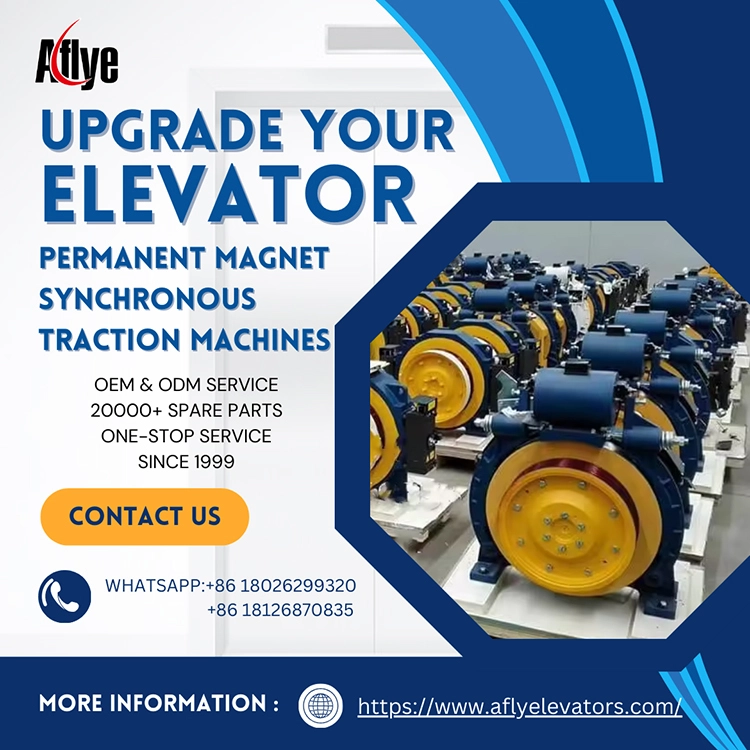
1. Abnormal Startup or Failure to Start
This is one of the most common issues and is usually related to:
Inverter parameter mismatch
Encoder signal abnormalities
Unstable power supply
When the control system cannot accurately obtain the motor position feedback, the traction machine may fail to start or repeatedly start and stop.
2. Increased Noise or Vibration During Operation
PMSM traction machines are designed for quiet operation. If abnormal noise or vibration occurs, it is often caused by:
Bearing wear
Shaft misalignment during installation
Traction sheave imbalance
Ignoring these issues may accelerate damage to bearings and traction sheaves.
3. Motor Overheating or Temperature Alarms
Overheating is usually caused by:
Excessive load
Poor ventilation or heat dissipation
Incorrect control parameter settings
Long-term high-temperature operation may reduce the performance of permanent magnets, directly affecting elevator efficiency and safety.
4. Loss of Magnetic Strength (Demagnetization)
In high-temperature or overload conditions, permanent magnets may gradually demagnetize, resulting in:
Weak startup torque
Unstable speed
Increased energy consumption
Once demagnetization occurs, the traction machine typically requires replacement or factory repair.
5. Encoder-Related Faults
The encoder is a critical feedback component of a PMSM traction machine. Problems such as:
Encoder damage
Signal interference
Loose wiring
can lead to inaccurate leveling, vibration, or protective shutdowns.
6. Abnormal Brake Operation
If the brake fails to release or cannot fully engage, elevator safety is directly compromised. Common causes include:
Aging brake coils
Abnormal supply voltage
Mechanical wear
How to Reduce the Risk of PMSM Traction Machine Failures
Regular inspection of operating conditions, proper inverter parameter settings, good ventilation, and the use of high-quality elevator components are essential for extending the service life of permanent magnet synchronous traction machines.
A-FLY — Your Reliable Supplier of PMSM Traction Machine Components
As a professional elevator & escalator spare parts supplier, A-FLY provides core components fully compatible with permanent magnet synchronous traction machines, including:
Encoders for PMSM traction machines
Traction sheaves and steel wire ropes
Brakes and brake coils
Elevator inverters and control main boards
A-FLY products are widely used in residential elevators, commercial elevators, and modernization projects. They are compatible with multiple mainstream elevator systems and support OEM / ODM services and global supply.
Conclusion
Permanent magnet synchronous traction machines offer advanced performance, but they are not completely maintenance-free. Understanding common faults and replacing key elevator components in time is essential to ensure long-term safe and stable operation.
Choose A-FLY to make your traction system more reliable and more efficient.