
Common Elevator Overspeed Governor Failures & Replacement Tips
In an elevator safety system, the overspeed governor is a critical protection device that prevents car overspeed and uncontrolled descent. Once the governor detects that the elevator speed exceeds the preset limit, it triggers the safety gear to forcibly stop the car—serving as the last line of defense for passenger safety.
However, after long-term operation or improper maintenance, overspeed governors can also develop faults. As a professional elevator & escalator parts supplier, A-FLY summarizes the most common failure symptoms and the key precautions to observe during replacement, based on extensive field maintenance experience.
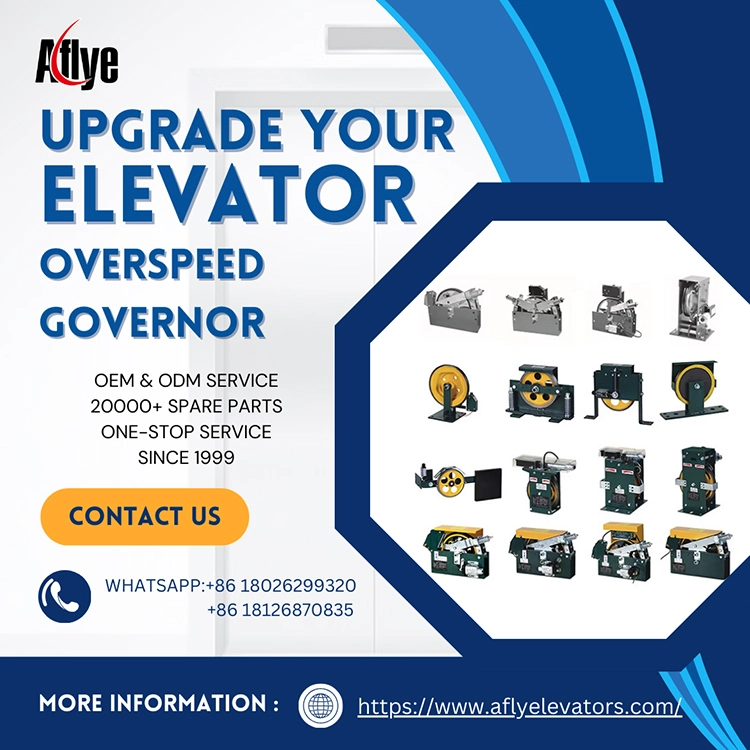
I. Common Failure Symptoms of Elevator Overspeed Governors
1. Insensitive or delayed actuation
Wear of internal rotating components, bearing aging, or insufficient lubrication can cause delayed response or failure to actuate—especially dangerous during inspections or emergency conditions.
2. Worn or slipping governor rope
After prolonged operation, the governor rope may develop burrs, elongation, or insufficient tension, leading to inaccurate speed detection and reduced protection effectiveness.
3. Frequent false trips
Some elevators trigger governor alarms or stops at normal speeds. Typical causes include abnormal tensioning devices, worn speed sheaves, or parameter drift.
4. Abnormal switches or electrical signals
Poor contact of safety switches or aging wiring can cause the control system to misjudge operating status, resulting in faults or failure to reset.
5. Corrosion or mechanical sticking
In humid, high-temperature, or dusty environments, internal metal parts may corrode or seize, reducing rotational flexibility and service life.
II. Potential Risks Caused by Governor Failures
If the overspeed governor fails, the elevator loses a critical protection measure during overspeed or abnormal conditions, posing serious safety risks. Conversely, frequent false trips increase downtime and maintenance costs and disrupt normal building operations. Therefore, timely assessment and replacement are essential.
III. Key Precautions When Replacing an Elevator Overspeed Governor
1. Match the model and rated speed
Different elevator speeds require different governor parameters. Confirm rated speed, tripping speed, and direction to avoid selection errors.
2. Inspect related components simultaneously
When replacing the governor, also inspect or replace the governor rope, tensioning sheave, and safety switches to ensure the system works as a whole.
3. Ensure compliant installation position and direction
Installation height, rope routing, and fixing methods must comply with relevant elevator safety standards to ensure accuracy and reliable actuation.
4. Perform functional testing after replacement
After installation, conduct governor actuation tests and electrical signal verification to confirm proper linkage with safety gear and the control system.
IV. A-FLY — A Trusted Supplier of Elevator Overspeed Governors and Safety Parts
As a professional elevator & escalator parts supplier, A-FLY provides:
Elevator overspeed governors and matching governor ropes
Governor tensioning devices and safety switches
Safety gears and related control system components
A-FLY products are widely used in residential and commercial elevators as well as modernization projects. They are compatible with many mainstream elevator brands and support OEM/ODM customization and global delivery—helping customers enhance safety and compliance.
Conclusion
Although an elevator overspeed governor rarely actuates, it determines the safety level at critical moments. Prompt fault identification and correct replacement of the governor and related components are essential for long-term safe operation.
Choose A-FLY to make every elevator’s safety protection more reliable and give you greater peace of mind.