
In modern elevator control systems, the elevator inverter (VVVF drive) is the core component that enables smooth starting, precise speed control, and energy-efficient operation. When an inverter malfunctions, the system usually indicates the fault source through alarm codes. Being able to quickly identify and handle these alarms is critical for maintenance teams and building operators.
Today, A-FLY Elevator Parts Supplier summarizes the most common elevator inverter alarm codes and corresponding maintenance recommendations to help you improve troubleshooting efficiency and reduce downtime risks.
I. Common Types of Elevator Inverter Alarm Codes
Although alarm codes may vary slightly among different brands (such as Monarch NICE3000, STEP, etc.), the fault categories are generally similar. Below are the most common ones:
1. Overcurrent Fault
Typical codes: OC, E001, F000
Possible causes:
Excessive load at motor start-up
Short circuit or phase-to-phase contact in wiring
Brake not fully released, causing high starting resistance
Damage to the motor or inverter IGBT module
Maintenance suggestion:
Check the motor cables, load condition, brake operation, and inverter IGBT module.
2. Overvoltage Fault
Common codes: OV, E003
Possible causes:
Open or damaged braking resistor, causing excessive regenerative voltage
Elevator running down with light load, generating high inertia voltage
Severe power grid fluctuations
Solution:
Focus on inspecting the braking resistor (BR) and ensure a stable power supply.
3. Undervoltage Fault
Common codes: UV, E004
Possible causes:
Insufficient supply voltage
Poor contact in power lines
Power supply module failure
Maintenance method:
Check the power supply environment and replace the inverter power board if necessary.
4. Overheat Fault
Common codes: OH, E005
Possible causes:
Aging or damaged cooling fan
Dust accumulation on heat sinks
Poor ventilation or high machine-room temperature
Maintenance focus:
Clean the cooling system and inspect the fan and temperature sensors.
5. Communication Error
Common codes: CE, E011
Possible causes:
Communication interruption between the inverter and main control board
Loose or broken CAN / RS485 communication cables
Control system software abnormalities
Handling recommendation:
Reconnect communication cables, check terminals, and upgrade software if required.
II. Recommended Troubleshooting Sequence for Inverter Alarms
To restore elevator operation efficiently, follow this troubleshooting order:
Check external factors first: power supply, motor, brake, and communication cables.
Then inspect internal inverter components: fan, power board, IGBT module, and drive board.
Finally, check system logic issues: control parameters and speed curves for changes or resets.
A structured troubleshooting process helps avoid misjudgment and unnecessary replacement costs.
III. A-FLY Provides High-Quality Elevator Inverters and Supporting Parts
As a professional elevator parts supplier, A-FLY offers a full range of elevator inverters and related components, including:
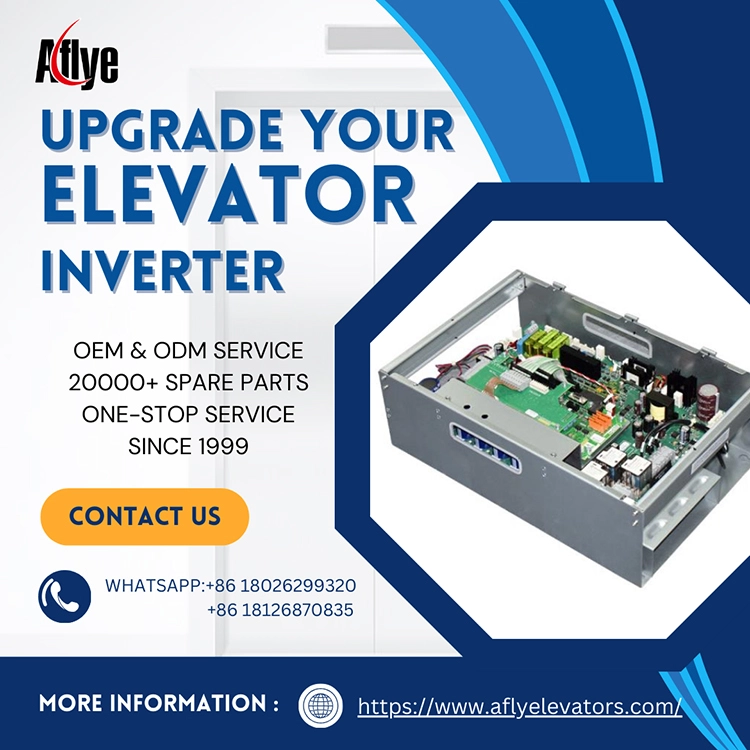
NICE3000 elevator inverters
Inverter drive modules
Braking resistors (BR), IGBT modules, power boards
Motors, encoders, main control boards, door operator control boards, and other elevator control system parts
A-FLY products are compatible with major global brands and support worldwide delivery and OEM/ODM services, making us a reliable long-term partner for maintenance companies and engineering contractors.
IV. Summary: Fast Fault Identification Ensures Safe and Stable Elevator Operation
Elevator inverter alarms are not something to fear—the key lies in timely diagnosis, correct handling, and choosing reliable replacement parts. By understanding common alarm codes and troubleshooting methods, maintenance teams can significantly reduce downtime and improve system stability.
Choose A-FLY to make your elevator control systems more professional, efficient, and reliable.