
Elevator Main Board vs. Inverter Board Explained
In modern elevator systems, both the elevator main control board and the inverter control board are core control components. During maintenance or spare-parts replacement, many technicians and purchasing managers often ask:
What is the difference between these two boards? Can they replace each other? How should faults be identified when problems occur?
As a professional elevator & escalator parts supplier, A-FLY provides a clear explanation below.
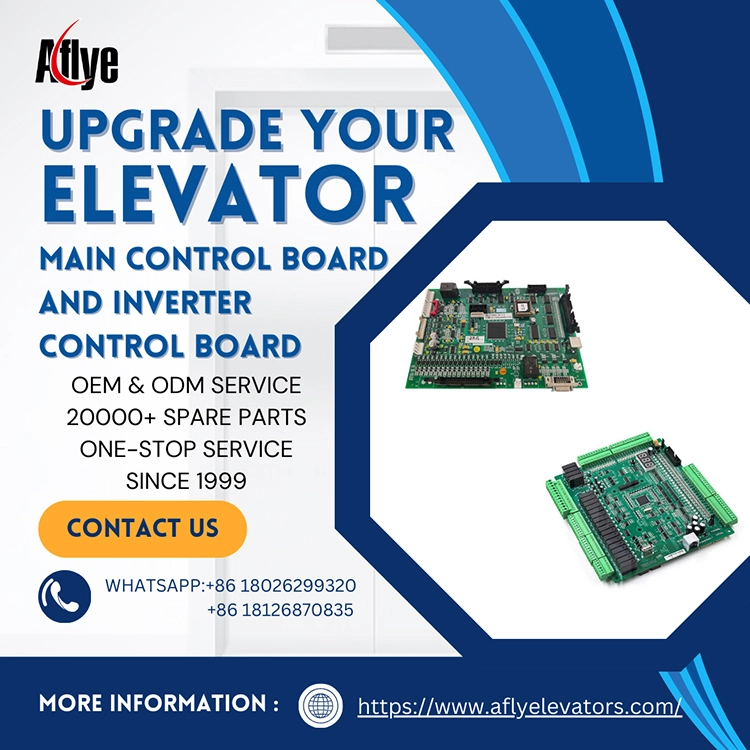
1. What Is an Elevator Main Control Board?
The elevator main control board is the “brain” of the entire elevator system. Its primary responsibilities include:
Receiving signals from cabin buttons, COP/HOP panels, door locks, light curtains, and safety circuits
Managing elevator operating logic, floor recognition, and safety permissions
Communicating with the inverter, door operator, display boards, and other elevator components
In simple terms, the main control board decides when the elevator can run, in which direction it moves, and whether operation is allowed.
When the main board fails, common issues include failure to start, repeated fault alarms, incorrect floor logic, or unstable operation.
2. What Is an Inverter Control Board?
The inverter control board is located inside the elevator inverter (VFD) and acts as its core processing unit. Its main functions are:
Interpreting speed and direction commands from the main control board
Controlling motor start, acceleration, deceleration, and braking
Ensuring smooth operation, energy efficiency, and motor protection
Compared with the main control board, the inverter control board focuses more on how the motor runs. It directly affects ride comfort, noise level, energy consumption, and speed stability.
3. Key Differences Between the Main Control Board and the Inverter Control Board
From a functional perspective:
The main control board handles system logic, safety control, and operational decisions
The inverter control board manages power output and motor performance
From fault behavior:
Main board faults often appear as communication failures, incorrect floor positioning, door lock response errors, or logic alarms
Inverter control board faults commonly involve overcurrent, overvoltage, speed instability, vibration, or abnormal motor behavior
From a replacement perspective, the two boards are not interchangeable. Model numbers, software, parameters, and interfaces must be strictly matched.
4. How Do the Two Boards Work Together?
Although their functions differ, the elevator main control board and inverter control board must work in close coordination.The main board sends operation commands, while the inverter executes them and feeds real-time status data back to the main board.
If communication becomes unstable, problems such as inaccurate leveling, frequent shutdowns, or alarm faults may occur.
In real maintenance cases, many issues that appear to be main board failures are actually caused by inverter control board signal problems—and vice versa.
This is why professional diagnosis and coordinated replacement are essential.
5. Key Points to Consider When Replacing or Selecting Boards
When replacing an elevator main control board or inverter control board, always confirm:
Original board model and software version
Elevator brand and control system (such as NICE3000, STEP, Monarch, etc.)
Interface definitions and communication protocols
Whether parameter adjustment or program matching is required
A-FLY provides professional selection guidance for both main control boards and inverter control boards, helping customers avoid secondary failures caused by incompatibility.
6. A-FLY – A Reliable Supplier of Elevator Control Boards
As a professional elevator and escalator parts supplier, A-FLY supplies the global market with:
Inverter control boards and drive modules
NICE3000 series control system components
Elevator buttons, COP/HOP panels, display boards, and related parts
All products are strictly tested, compatible with major elevator brands, and supported by fast delivery and technical assistance.
Conclusion
The elevator main control board is responsible for decision-making, while the inverter control board is responsible for power execution.
Only when both boards are properly matched and operate stably can an elevator deliver safe, smooth, and comfortable performance.
Choose A-FLY to ensure every control board is reliable—and every elevator operates with confidence and safety.