
Causes of Inaccurate Elevator Leveling & Recommended Replacements
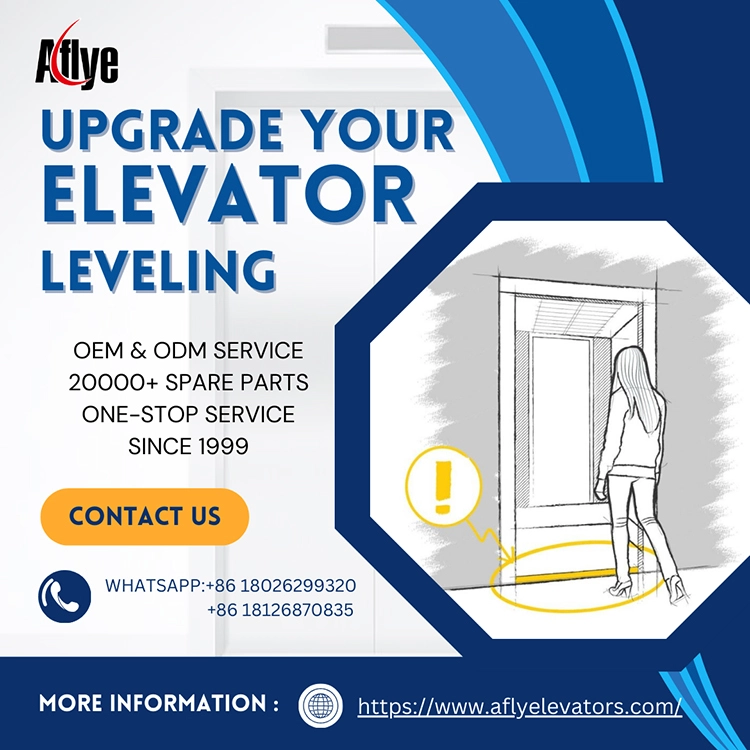
During daily elevator operation, inaccurate leveling is one of the most common issues encountered by both maintenance technicians and passengers. When an elevator stops above or below the floor level, it not only affects ride comfort but may also create safety risks such as tripping or door interference.
So what causes poor elevator leveling accuracy, and which key components should be replaced to effectively solve the problem?
As a professional elevator and escalator parts supplier, A-FLY provides a systematic analysis below.
1. Encoder Malfunction – One of the Most Common Causes
The encoder is responsible for providing real-time feedback on the elevator’s position and speed. If the encoder becomes aged, its internal signal becomes unstable, or its installation loosens, the control system may receive incorrect position data, resulting in leveling deviation.
Replacement recommendation:
Check the encoder cable and connectors. Replace it with a high-precision elevator encoder if necessary.
2. Wear in the Traction System Affects Position Accuracy
After long-term operation, traction sheaves, wire ropes, or deflector sheaves may suffer from wear, slipping, or diameter changes. These issues alter the traction ratio, causing a mismatch between the calculated travel distance and the actual movement of the car.
Replacement recommendation:
Regularly inspect traction sheave grooves and replace worn elevator wire ropes or traction sheaves as needed.
3. Decreased Brake Performance Causes Stopping Offset
If the brake does not fully engage or responds slowly, slight slipping may occur at the moment of stopping, which eventually leads to inaccurate leveling.
Replacement recommendation:
Check brake coil voltage, braking clearance, and response time. Replace the elevator brake or brake switch if performance has declined.
4. Aging Inverter or Incorrect Parameter Settings
The elevator inverter controls speed regulation and deceleration. Parameter drift, aging internal components, or frequent inverter alarms can result in abnormal deceleration curves, directly affecting leveling accuracy.
Replacement recommendation:
Recalibrate inverter parameters. If instability persists, replace the system with a more reliable elevator inverter module.
5. Door Zone Switch and Leveling Signal Abnormalities
The distance of the vane plate for shaft switches may require adjustment or re-learning. If the door zone switch, magnetic switch, or leveling sensor fails, the control system cannot accurately determine whether the car has reached the correct landing position.
Replacement recommendation:
Check the sensitivity of door zone switches and replace aged elevator limit switches or leveling sensors.
6. Why Choose A-FLY to Solve Leveling Problems?
As a professional A-FLY elevator & escalator parts supplier, we provide complete solutions for elevator leveling issues, including:
Traction sheaves, deflector sheaves, and wire ropes
Elevator brakes and brake switches
Elevator inverters and control modules
Door zone switches and leveling sensors
A-FLY elevator parts are compatible with multiple mainstream elevator brands and are widely used in maintenance, replacement, and modernization projects—helping customers quickly restore precise elevator leveling performance.
Conclusion
Inaccurate elevator leveling is rarely caused by a single component. In most cases, it results from the combined aging or failure of several key parts. Only by accurately identifying the cause and replacing the correct elevator components can the problem be fundamentally resolved.
Choose A-FLY to ensure precise leveling at every stop—and make your elevators safer, more reliable, and more professional.