
How to know if an elevator traction sheave needs replacement
In an elevator system, the traction sheave is a core component that determines the stability and safety of the car’s operation. Through friction with the wire ropes, it drives the elevator up and down. Therefore, after long-term operation, the sheave will inevitably experience wear, deformation, or reduced friction coefficient. So, when must the elevator traction sheave be replaced? How can you determine whether it has reached the replacement threshold? Below, A-FLY Elevator & Escalator Parts Supplier provides professional evaluation methods for you.
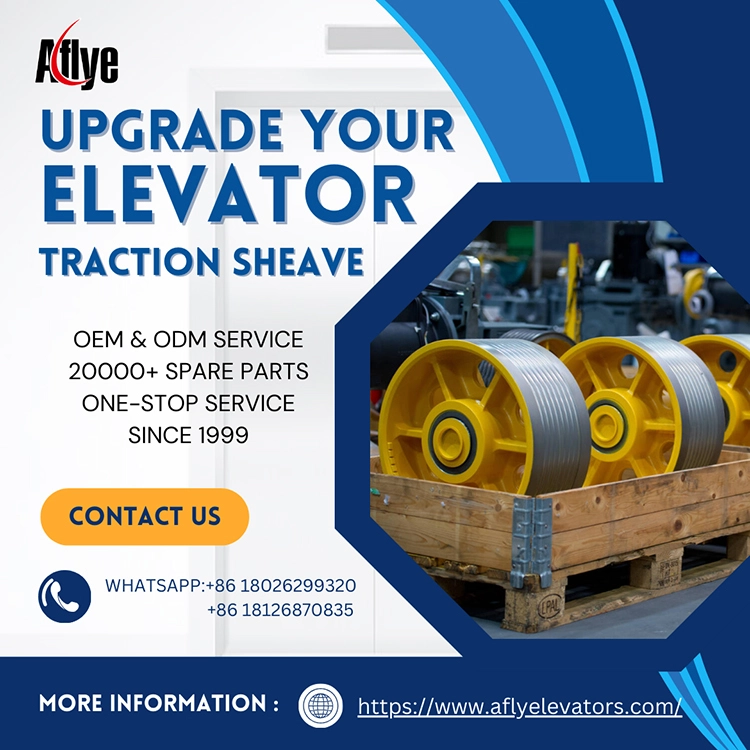
1. Worn or Deepened Rope Grooves—The Most Obvious Replacement Indicator
After prolonged contact with the wire ropes, the rope grooves on the traction sheave gradually become deeper or wider. When any of the following occurs, replacement must be considered:
The groove depth clearly exceeds the original standard
The groove profile becomes irregular
Metal fatigue cracks appear on the groove walls
Worn grooves cause the rope to “sink” abnormally
Groove wear reduces traction force and may cause elevator slippage—one of the highest-risk failures.
2. Vibration, Noise, or Slipping During Operation
If the elevator shows any of the following during starting, ascending, or descending:
Noticeable vibration
Abnormal noise or metal friction sound
Slight impact
Poor floor leveling performance
Difficulty starting or slipping
These symptoms usually indicate insufficient traction caused by a worn traction sheave. Slippage especially signals that the friction between the sheave and rope is no longer adequate, requiring immediate action.
3. Abnormal Wear on the Wire Ropes Indicates Sheave Failure
If the rope groove becomes worn or deformed, the wire rope’s force distribution changes. When you observe:
Local flattening
Increasing broken wires
Uneven rope diameter
Rope deformation
Severe wear at specific sections
This often results from sheave out-of-round conditions, uneven wear, or inconsistent groove shapes. In such cases, both the rope and the sheave should be evaluated together for possible replacement.
4. Out-of-Round or Eccentric Sheave Issues
If the sheave center becomes misaligned, periodic vibration occurs during operation. Common signs include:
Rhythmic “thump-thump-thump” sounds during travel
Slight car sway
Uneven rope tension
These are typical symptoms of long-term sheave wear or bearing misalignment and require prompt replacement.
5. Surface Cracks or Metal Fatigue on the Sheave
As a high-load component, the traction sheave can develop:
Micro cracks
Surface chipping
Signs of metal fatigue
Severe oxidation
These problems reduce structural strength and may lead to breakage. Immediate replacement is required.
6. Replacement Is Recommended When Service Life Is Reached
Under normal conditions:
Commercial elevator traction sheave lifespan: 8–12 years
Heavy-use environments (subway, hospitals, malls): 5–7 years
Even if no obvious failure is present, proactive replacement is recommended to ensure safety once the expected service life is reached.
A-FLY — Professional Traction System Parts Supplier
As a global elevator & escalator parts supplier, A-FLY provides:
All types of traction sheaves
Guide sheaves and tension sheaves
Traction machine components
Multi-brand compatibility solutions
A-FLY products use high-strength materials, high-precision machining, and dynamic balance testing to ensure durability and stability—ideal for maintenance and modernization projects.
Conclusion: The Traction Sheave Is Critical to Core Elevator Safety
Once an elevator traction sheave becomes excessively worn, it not only affects smooth operation but can also cause slippage, leveling errors, or even safety hazards. Therefore, timely inspection and replacement of the traction sheave are essential responsibilities for all property owners and maintenance units.
Choose A-FLY to make every lift more stable and every ride safer.