
Causes and Solutions for Elevator Door Lock Contact Failure
In all elevator safety protections, the door lock system is one of the most critical defense lines. It directly determines whether the elevator can start and whether passengers can ride safely under the correct conditions. However, after many years of operation, door lock contact failure becomes one of the most common maintenance issues. Once it occurs, it not only causes frequent shutdowns but may also create serious safety risks.
As a professional elevator & escalator parts supplier, A-FLY has summarized the main causes of door lock contact failure and the most effective solutions to help engineers, maintenance teams, and property managers quickly identify and accurately resolve the issue.
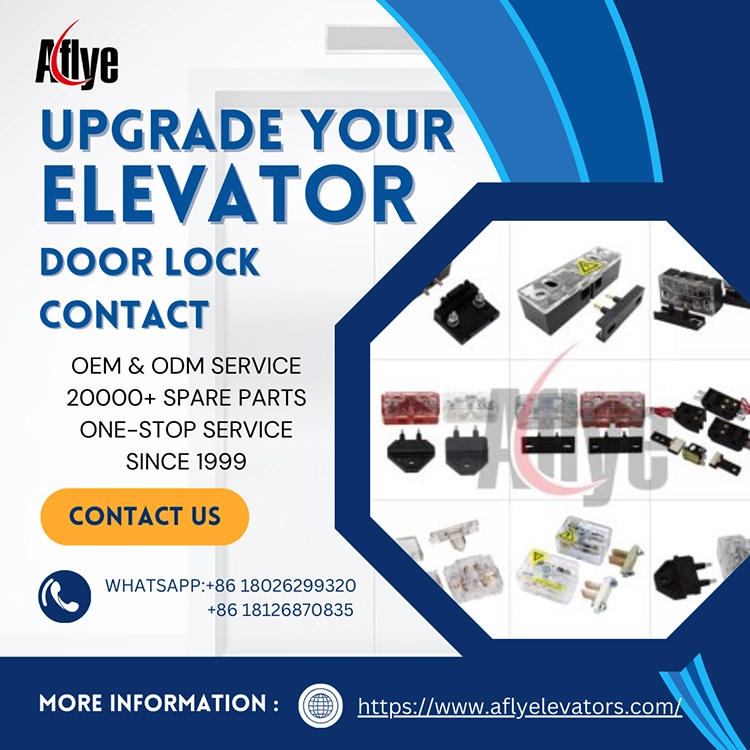
1. Common Causes of Elevator Door Lock Contact Failure
1. Contact oxidation or burning
Door lock contacts work continuously and are affected by humidity, electric sparks, and dust. Over time, oxidation, burns, or blackened surfaces may appear, resulting in poor conductivity. This issue is especially common in old elevators, humid environments, or buildings with unstable voltage.
2. Wear in the door operator system causing misalignment
When door hanger rollers, guide shoes, or door belts become worn, the hall door or car door may shift slightly, causing the door lock to fail to align correctly—thus the contacts cannot close properly.
3. Aging plastic housing or loosened internal mechanical components
Some Japanese and domestic elevator brands use plastic door lock housings. Over time, the material ages, and internal springs or levers may not move smoothly, preventing proper contact closure.
4. Infrared light curtain malfunction interfering with door lock signals
When the light curtain fails, mis-detects, or has loose wiring, the system may incorrectly think the door is not fully closed, resulting in the door lock contact failing to “establish.”
5. Wire breakage, poor soldering, or loose connectors
Due to long-term vibration or maintenance disassembly, door lock wiring may loosen—especially at:
• wire bending points
• plug connectors
• control cabinet terminals
These issues often cause intermittent door lock failures.
2. Solutions for Elevator Door Lock Contact Failure
1. Clean or replace the contact components
For mildly oxidized contacts, use professional contact cleaner.
If the contacts are burned or heavily damaged, the door lock contact assembly—or the entire door lock—must be replaced.
A-FLY provides door lock contacts and complete door lock assemblies compatible with all major brands, offering precise installation, long lifespan, and stable signal output.
2. Check for door operator misalignment and replace worn parts
If the door operator shakes or the door opens/closes roughly, inspect:
• door belt
After replacing these parts, door lock contacts often return to normal functionality.
3. Reinforce the door lock structure or replace old door locks
If the door lock’s internal mechanism is deformed or the spring fails, replacement is recommended. Old door locks offer far less reliability than modern components.
4. Troubleshoot signal conflicts between the light curtain and door lock
If the light curtain causes mis-detection, check:
• installation position
• damaged optical sensors
• loose wiring
A-FLY supplies stable, anti-interference light curtains compatible with multiple elevator brands.
5. Thoroughly check wiring, terminal blocks, and harnesses
Inspect:
• wiring from the door lock to the control cabinet
• wire harness wear due to door movement
• loose control cabinet terminals
• oxidized connectors
Replacing standardized pre-assembled harnesses can reduce long-term risks.
3. A-FLY — Professional Supplier of Elevator Door Locks and Door Operator Parts
As a leading elevator & escalator parts supplier, A-FLY provides:
• Complete door lock assemblies for all major brands
• Door lock contacts and switches
• Door operator parts (hanger rollers, belts, door knives, guide shoes)
• Light curtain sensors and door zone sensors
• Control system–related components
All A-FLY parts undergo durability and signal stability testing. They offer strong compatibility and long service life, suitable for maintenance, replacement, and modernization projects.
4. Conclusion: Small Door Lock, Big Safety Responsibility
Elevator door lock contact failure is not a minor issue—it determines whether the elevator can operate safely. Through timely inspection, accurate replacement, and choosing reliable components, shutdowns and safety hazards can be completely avoided.
Choose A-FLY to make your elevator door system more precise, safer, and more stable.