
What Are the Common Brake Voltages Used in Escalators?
In the safety mechanism of an escalator’s operating system, the escalator brake is one of the most critical safety components. Whether it is a sudden power failure, overspeed operation, chain slack, or abnormal vibration, the brake must intervene instantly to bring the escalator to a stable stop and prevent passengers from being injured. And whether the brake can operate reliably is closely related to its working voltage.
So, what are the common brake voltages used in escalators? What are the differences between different voltages? The engineering team from A-FLY Escalator & Elevator Parts Supplier provides a complete explanation for you.
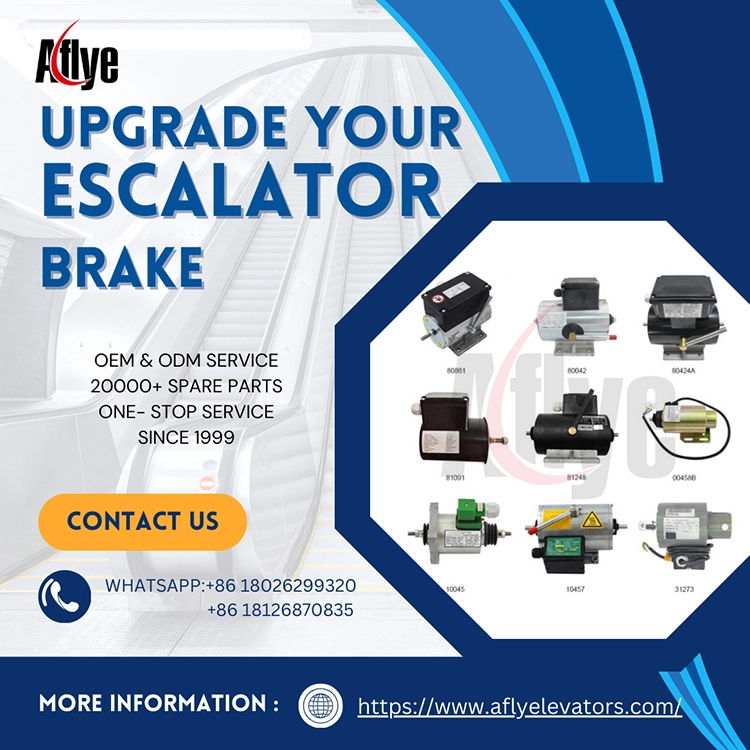
1. Why Do Escalator Brakes Require Multiple Voltage Options?
Escalator operating environments are complex:
Different brands have different design standards
Control cabinet voltage outputs vary
Site power conditions are different (malls, metro stations, airports, etc.)
To adapt to these conditions, brakes must come in multiple voltage versions to ensure stable operation and prevent misoperation in the safety circuit. Brake voltage affects not only operating speed, but also coil lifespan, braking stability, and compatibility with the control system.
2. Common Escalator Brake Voltages
Across global mainstream escalator systems, the most common brake voltages include:
1. DC110V Brake (Most Common)
DC110V is the most widely used brake voltage in the escalator industry.Features:
Fast response
Strong compatibility
2. DC48V Brake (Energy-Saving Type)
With the widespread use of energy-saving inverter control systems, DC48V brakes are becoming more common.Advantages:
Lower heat loss
Longer coil lifespan
Better matched with new generation energy-saving control cabinets
3. DC24V Brake (Low-Voltage Control Applications)
DC24V is a standard voltage for low-voltage control, used in low-power or small escalators.Advantages:
Safer low-voltage operation
Easier integration with smart control systems
Commonly used in malls, medium/small escalators, or modernization projects
4. AC220V Brake (Common in Older Escalators)
In older escalators, AC220V brakes are still widely seen.Features:
No need for DC power conversion
Simple control system structure
However, this voltage is rarely used in modern escalators and is mostly found in replacement parts for older units.
3. What Are the Differences Between Brake Voltages?
Although the brake voltages differ, the goal of every brake is the same:
To ensure that the escalator stops immediately when an emergency occurs.
Differences mainly appear in:
Response speed (higher voltage = faster action)
Coil heating level (lower voltage = more energy-saving)
System compatibility (depends on the control cabinet output)
Lifespan and maintenance frequency
Therefore, brake selection must strictly match escalator model, control system, and original factory parameters.
4. A-FLY Provides a Full Range of Escalator Brake Voltage Options
As a professional escalator & elevator parts supplier, A-FLY provides globally compatible brake products, including:
DC110V escalator brake
DC48V escalator brake
DC24V escalator brake
AC110V escalator brake
AC220V escalator brake
Complete series of disc brakes and drum brakes
A-FLY brake advantages:
Stable braking force with no vibration
High-temperature-resistant coils with longer lifespan
Perfect compatibility with major brands
Certified by strict safety standards (CE / EN115)
Global shipping + OEM/ODM support
Whether for maintenance, modernization, or new installations, A-FLY can provide the most suitable brake solution.
Conclusion: Brake Voltage Seems Simple, but It Directly Determines Escalator Safety
Using the wrong voltage can cause:
Slow brake response
Poor braking effect
Coil burnout
Escalator startup failure or frequent alarms
Therefore, choosing the correct brake voltage is a fundamental requirement for escalator safety.
Choose A-FLY to make your escalator braking system more stable, durable, and safe.