
What Are the Common Failures of Escalator Inspection Boxes?
In an escalator system, the inspection box is one of the most frequently used control components by maintenance personnel. It can switch inspection modes, adjust direction, and perform low-speed debugging. It is a core tool for escalator maintenance and troubleshooting. Once the inspection box malfunctions, the escalator cannot be properly debugged, and the system may even fail to start, affecting the operation of the entire site.
As a professional escalator parts supplier, A-FLY will explain the common types of escalator inspection box failures, their causes, and key prevention points to help maintenance personnel quickly identify the source of problems.
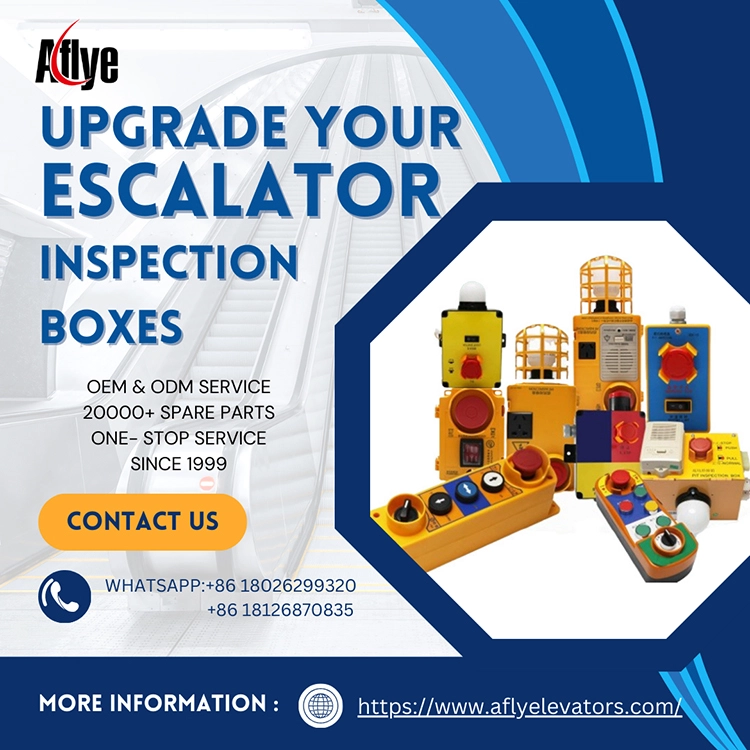
1. Button Failure or Contact Oxidation
The most easily damaged parts on the inspection box are the direction buttons (Up/Down), Start button, Stop button, etc. After long-term use, the internal contacts may fail due to:
Oxidation causing poor contact
Excessive wear of the button
Fatigue of internal metal springs
Moisture causing intermittent signals
Common symptoms:
Pressing the button has no response, direction cannot switch, cannot enter inspection mode.
A-FLY recommendation: Use industrial-grade buttons with high wear resistance and corrosion resistance, and regularly check internal contacts.
2. Selector Switch Failure (Auto/Inspection Switch Malfunction)
One of the most important switches on the inspection box is the Auto / Inspection mode selector. When it fails, the escalator may:
Fail to enter inspection mode
Fail to recognize inspection signals
Fail to return to automatic operation
Main causes include:
Wear of the rotary selector
Loose internal contacts
Vibration causing cracked solder joints
Dust or oil contamination causing poor contact
A-FLY provides high-quality replacement inspection boxes compatible with major escalator brands.
3. Loose Wiring or Terminal Burnout
Escalators operate with constant vibration. If the wiring inside the inspection box is not firmly fixed, it can lead to:
Signal wires with poor contact
Terminals becoming loose or falling off
Terminals burning due to overcurrent
Common symptoms:
Escalator cannot enter inspection mode, inspection box loses power, direction buttons do not respond.
Maintenance personnel should regularly check that terminal screws are tight and cables are not aged.
4. Emergency Stop Button Failure
The emergency stop button is the most critical safety device in the inspection box. If the button fails to reset, the latch is damaged, or contacts deform, the escalator will remain in “emergency stop” status and fail to start.
Real-world impact:
In field cases, 90% of escalators that cannot start are related to faulty emergency stop buttons.
A-FLY provides industrial-grade emergency stop buttons with large contacts, high durability, and strong vibration resistance to reduce such failures.
5. Cable Damage or Aging
Escalator inspection boxes are often installed on the side of the equipment or in machine spaces with harsh environments. Cables may suffer:
Wear causing insulation damage
Moisture causing reduced insulation resistance
Rodent chewing
Hardening due to high temperature
Symptoms: Unstable signal, intermittent failure, or no response at all.
A-FLY recommends using thickened protective sheaths and anti-rodent cables for improved durability.
6. Internal PCB Failure
Some inspection boxes include simple signal processing circuits (PCBs). If the following occurs, the inspection box may completely fail:
Cold solder joints
Aging capacitors
Damaged IC chips
Moisture causing corrosion
A-FLY inspection boxes use interference-resistant PCB designs suitable for high-frequency maintenance environments.
A-FLY — Your Trusted Supplier of Escalator Inspection Boxes
As a professional escalator parts supplier, A-FLY provides a wide range of inspection boxes and related parts, including:
Inspection boxes for major escalator brands
Emergency stop buttons, direction buttons, selector switches
Safety switches, speed sensors, brake components
Escalator chains, drive sprockets, friction wheels, etc.
All products undergo durability, anti-vibration, and anti-corrosion tests to ensure stable operation in demanding maintenance environments.
Conclusion: The Inspection Box Is the “Control Center” of Escalator Maintenance
Once the inspection box fails, escalators cannot be safely serviced. Identifying common symptoms and replacing faulty parts in time is essential to ensuring safe and continuous escalator operation.
Choose A-FLY to make your escalator inspection and maintenance smoother, more efficient, and safer.