
Types and Common Models of Elevator Relays
In elevator control systems, the elevator relay is a crucial electrical component responsible for signal switching and logic output. Although small in size, it plays a key role in safe elevator operation and system coordination. Relays are widely used in elevator control panels, door operator systems, safety circuits, power protection, and floor signal control.
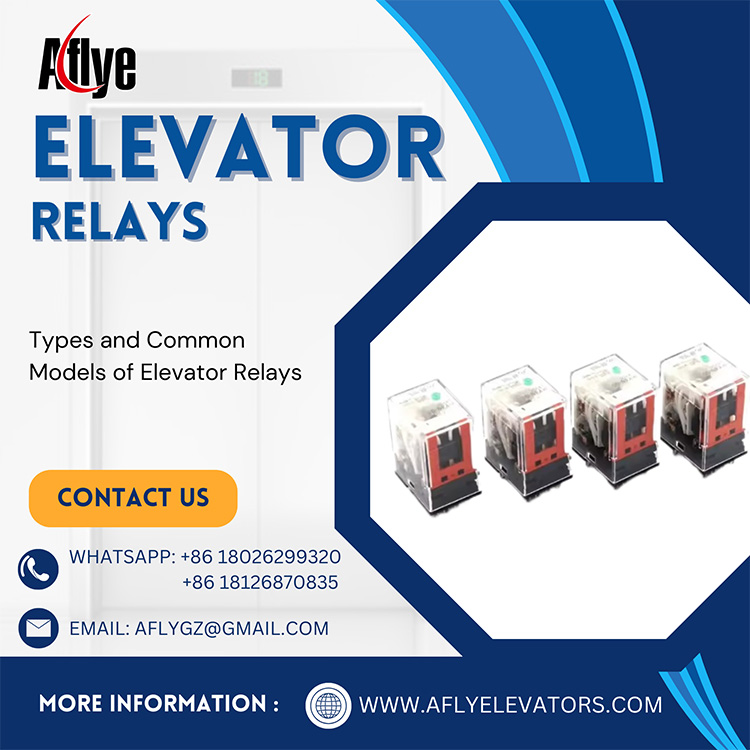
1. What is an Elevator Relay?
An elevator relay is an automatic control component that uses electromagnetic principles to switch electrical circuits. It enables low-voltage signals to control high-current circuits. It acts like a “signal dispatcher” inside the elevator system, accurately transmitting commands. Functions such as landing stopping signals, door lock signals, and motor braking signals all rely on relays to complete logic control.
2. Types of Elevator Relays
There are several types of relays commonly used in elevators:
Intermediate Relay: Widely used in elevator circuits for signal amplification, transmission, and logic conversion. It features multiple contacts and flexible control, commonly seen in elevator operation logic, motor start/stop switching, and safety circuits.
Electromagnetic Relay: Driven by a traditional electromagnetic coil, it provides reliable switching performance and strong anti-interference capability, making it suitable for main control systems.
Time Relay: Used for delay control, such as door closing delay or startup delay, enabling smoother elevator operation.
Solid State Relay (SSR): Uses electronic components instead of mechanical contacts, has no mechanical wear, and is ideal for frequent switching applications such as door operator signal control.
Safety Relay: Designed for elevator safety circuits such as door lock loops, emergency stop, and overspeed protection, ensuring safe elevator operation.
3. Common Models of Elevator Relays
Common relay models used in elevator maintenance and modernization include:
LY2 and MY2 series relays are commonly used in elevator control cabinets for signal interlocking. HH54P and JZX-22F series relays are widely used in various electrical control circuits. HHC68A series relays are often applied in elevator door operator control and safety circuits. Brands such as Omron, Schneider, and Finder relays are also widely used for brand elevator replacements. Solid state relays (SSR series) are suitable for high-frequency switching applications. Safety relays such as the Pilz PNOZ series are used in high-speed and export elevators for safety control.
These relays offer high switching accuracy, fast response time, and excellent anti-interference performance, making them ideal for complex industrial elevator environments.
4. How to Choose the Right Elevator Relay?
When choosing an elevator relay, the following factors should be considered: rated coil voltage (AC/DC 12V, 24V, 48V, 110V, 220V), contact capacity and quantity, control function requirements (delay, latching, interlocking), brand compatibility, and safety certification level.
5. A-FLY Provides One-Stop Elevator Relay Supply
As a professional elevator parts supplier, A-FLY provides a full range of high-quality elevator relays including intermediate relays, time relays, safety relays, and solid state relays. They are suitable for elevator control cabinet maintenance, modernization projects, and elevator service engineering.
Choosing A-FLY means reliable compatibility, high stability, and fast delivery with large stock support for global engineering projects.